Subsidies
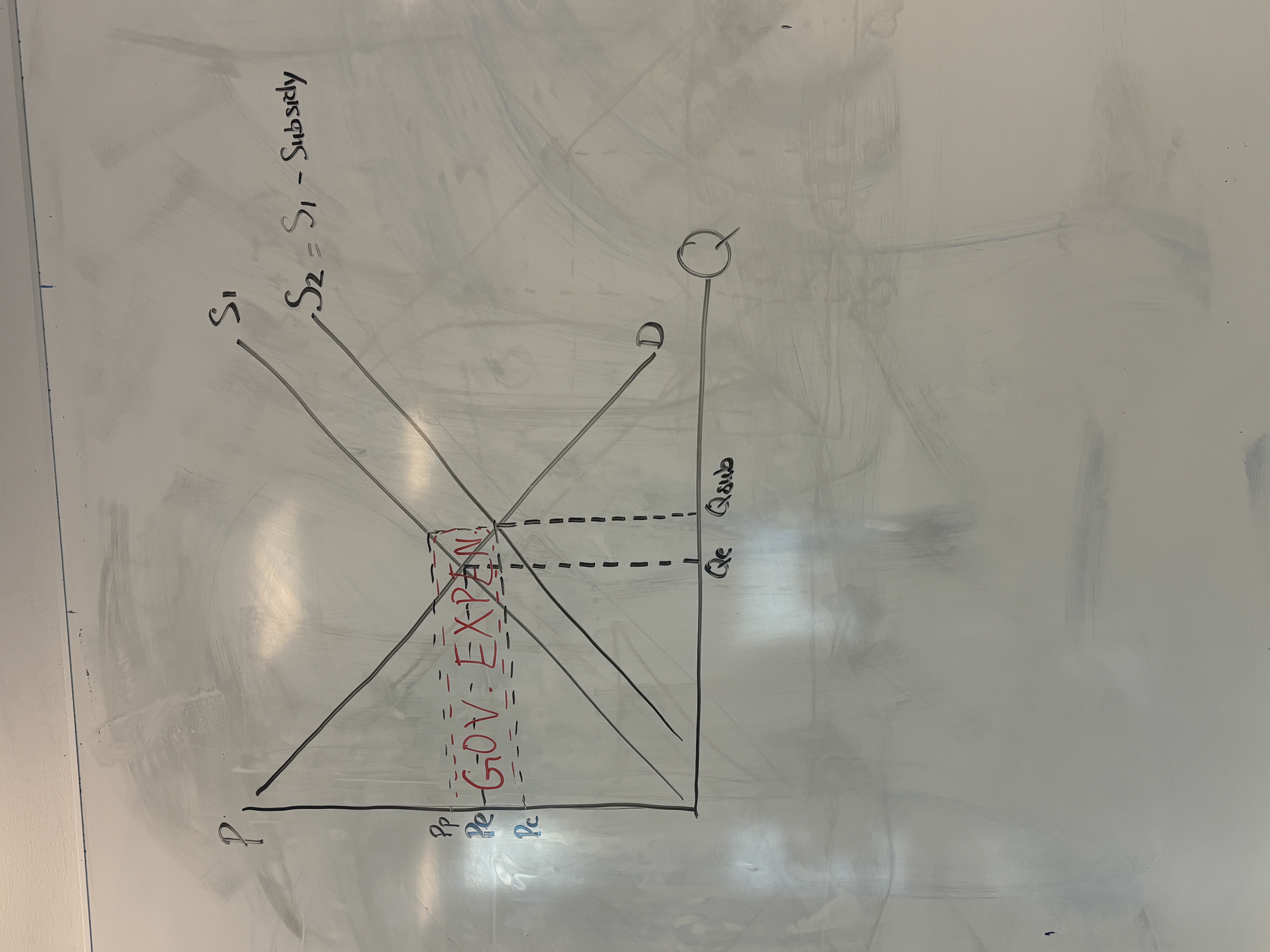
Subsidies are government funds given to producers to help increase production and consumption of a good by reducing their production costs. Subsidies reduce the cost to produce for suppliers. This will cause producers to increase the supply of their goods, as they can earn higher profits per unit. Hence when the supply curve will shift to the right.
GIVE EXAMPLE HERE
When the supply shifts to the right in the market, the market price for consumers to purchase decreases from Pe to Pc. The lower price is made possible because as consumers are receiving PePc (the space between that) of the subsidy for the quantity of the product in the market. Then to find the subsidy received by producers, as the government is paying a subsidy of PpPc for each unity, Pp is the price the producers receive for each unit sold, rather than the original price, which is Pe. Also the vertical distance between S1 and S2 is the price of the subsidy.
The amount of subsidy received by consumers vs the producers depends on the PED and PES. For PED, the amount of subsidy passed on to the consumers depend on how much the consumer is willing to buy up the increase in quantity produced, given a fall in price. (Example is subsidy to increase energy consumption of consumers (the PED is inelastic), whereas handbag producers will only need to pass on a small subsidy for consumers to buy a lot more handbags due to a small discount).
A subsidy can be effective in promoting consumption of a good by reducing market price.