Chapter 4: What are the Keys to Understanding Cultural and Ethnic Identities?
Are your Identities a Superpower or and Obstacle?
Identities
Assigned Sex
Race
Ethnicity
Generation
Gender-Identity
Religion
Socio-Economic Class
Spoken Language
Abilities and Talents
Geographic Location
Wit/Humor
Style
Nationality/Heritage
Family Name
Family Size
Marital Status
Social Affiliations
Physical Stature
Appearance
Interaction with our cultural group helps us acquire meanings, values, norms, and community styles supporting the development of our identities
We struggle with our identities
Intricate, complicated, amorphous
Identities are complex and intersected
What does it mean to be…
Culture shapes our view of ourselves, but we also develop our own set of ethics, values, norms, ways-of-behaving
Which aspects of your overall identity are most or least important to you?
which aspects of your overall identity do you question?
Are your identities consistent regardless of context or do you negotiate them?
Family and Gender Socialization
Identity - self-conception derived form gender, family, cultural, ethnic, and individual socialization processes that influence our behaviors, interactions, and how we see ourselves, behavior, and interactions
Social Identities - Cultural or ethnic membership gender and sexual orientation, social class, religion, generation/age, physical and mental abilities or profession
Personal Identities - Any unique attributes we associate with our individual self in comparison with those of others
Loyal, Eager, Fun, Independent
Family Socialization - Provides initial blueprint of roles, gender, relational identities, and boundaries.
Space, Time, and Power/ Status dynamics
Family Types
Traditional
Extended
Blended
Single-Parent
Family-Types in decision-making
Personal - negotiable roles: democratic decision-making: parents as friends to children —— Individualistic and small power distance
Positional - ascribed roles; hierarchal power structure; authoritarian parents; obedient children —— collectivistic and large power distance
Gender - Meanings we hold concerning our self-images and excepted other images of femaleness and maleness (Masculinity and Femininity)
Children learned gender toles via rewards and punishments form in performing proper and improper gender related behaviors
(U.S.) Fem. - interdependence , cooperation, verbal relatedness, empathy
Girls games, house, relational communities
(U.S.) Masc. - Independence, competition, verbal assertiveness
Boys’ games, Sports, competitive communities
Group Membership: Intercultural boundary crossing Factors — Journey of Immigrants
Enculturation - primary socialization processes of internalizing ones primary cultural values
Can be bi-cultural if relate to both cultures
Acculturation - Degree of identity change occurring when individual moves from familiar environment to an unfamiliar one.
Immigrants (voluntary/involuntary [refugees] - aim is permanent stay in an adopted country
Long term process integrating new values, norms, and symbols and Developing new skills.
Factors Influencing Immigrants’ ACCULTURATION Experience
Systems-Level - elements in host environment influence newcomers’ adaptation.
Economically Strong - tolerant; Economically harsh; immigrants scapegoated
Attitudes on assimilation or pluralism; influence policies
Local institutions - Media, social service, schools: Facilitate or hamper adaptation
Individual Level - cultural knowledge, fluency, age, push/pull, education, resilience
Mass Media Level - ethnic media eases stress of adaptation and loneliness
Interpersonal F-to-F and Network Level
Preexisting Ethnic Enclaves - support initial stages
Participation Creates - Social media/Apps help
Ethnic-Racial Identity Change Process
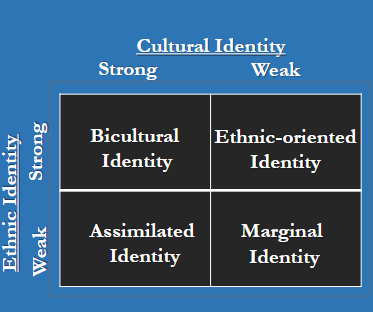
Berry’s Cultural-Ethnic Identity Typological Model (Immigrants)
How ethnic individuals see themselves in relation to both their ethnic and cultural identity
Strong Ethnic and Weak Cultural - Ethnic Oriented Identity: Avoid interaction with dominant group and retain ethnic values; stress interacting
Weak Ethnic and Strong Cultural - Assimilated Identity: See themselves as part of larger culture
Strong Ethnic and Strong Cultural - Bicultural Identity: Comfort as part of both groups
High - Compatible/Hyphenated
Low - “Living in between“
Weak ethnic and Weak Cultural - Marginal Identity: Feel alienated, disconnected and invisible
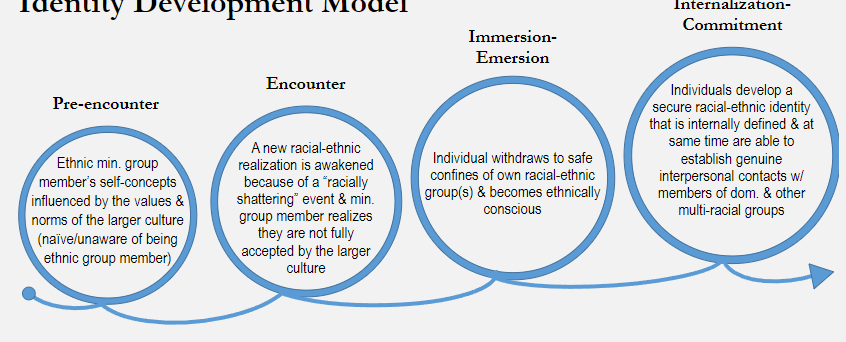
Helms and Parham’s Racial-Ethnic Identity Development Model
Pre-Encounter - Ethnic minority group members self-concepts influences by the values and norms of the larger culture; Naive/unaware of being ethnic group member
Encounter - A new racial-ethnic realization is awaked because of a racially shattering event and minority group member realizes they are not fully accepted by the larger culture
Immersion-Emersion — Individual withdraws to safe confines of own racial-ethnic groups and becomes ethnically conscious
Internalization-Commitment — Individuals develop a secure racial-ethnic identity that is internally defined at same time are able to establish genuine interpersonal contacts with members of dominant and other multiracial groups
Brewer’s Social Identity Complexity Theory (Social Identity Formation)
Compartmentalized - One social identity as primary in a setting and shifts to another in a different context
Merged - The more social identities individual has the more inclusive the “In-group“ becomes where no sharp in-group out-group distinctions made
Intersected - Compound identity in which 2 or more social membership categories crossed to form a singular social identity; feel connected with others sharing this compound identity experience
Dominant - Individual adopts one major social identity and other social categorization subordinated to the dominant role identity