Topic Phylogeny: Explaining the history of diversity
Overview of Phylogeny
Phylogeny is the hypothesized evolutionary history of a species or group of related species, often shown in a branching tree diagram.
Objectives
To explain the phylogenetic approach to evolutionary history, differentiate homology and analogy, interpret primitive vs. derived character traits, and create/interpret cladograms and phylogenetic trees.
Key Concepts
Requirements and Assumptions of Phylogeny
All organisms have ancestors.
Organisms share heritable character traits.
1. Phylogenies Reveal Relationships
Evolutionary change can lead related organisms to become more dissimilar over time.
Important Terms in Phylogenic Trees
Root: Most recent common ancestor of all taxa.
Node: A split point representing a common ancestor.
Branch: Evolutionary path.
Tip: Extant groups.
2. Homology
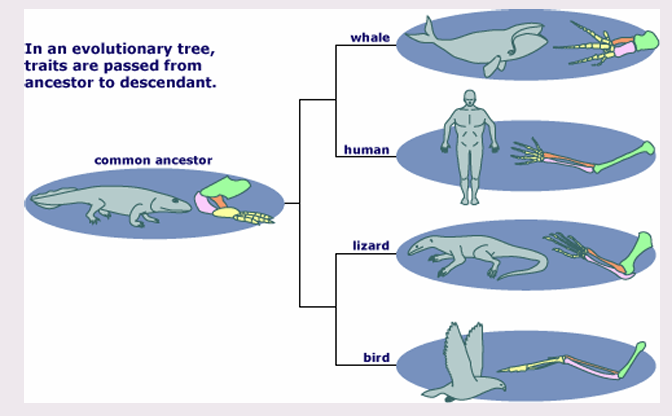
Homology Defined: Similarity in character traits due to shared ancestry, independent of function.
Examples: Bones in the forelimbs of whales, humans, lizards, and birds, deriving from a common ancestor.
3. Analogy
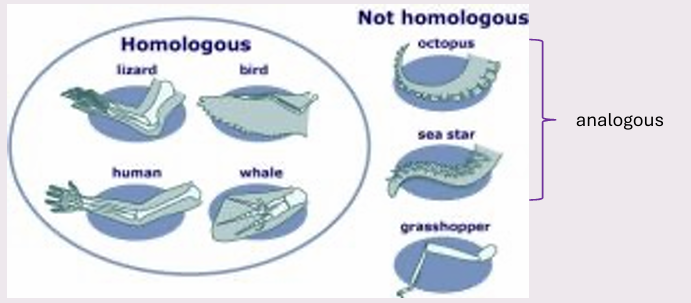
Analogy Defined: Similar in function and appearance but differing in structure and origin, arising from convergent evolution due to similar environmental pressures.
Example: Cacti and spurges showing similar succulent forms due to adaptation to arid environments.
Summary
Understanding phylogeny is crucial for interpreting evolutionary history and relationships, with the distinction between homologous and analogous traits being key to assessing origins.