Topic 8 Astrophysics
The Universe
Milky Way Galaxy: The Milky Way is a vast collection of billions of stars, along with gas, dust, and dark matter. Our Sun is located in one of the spiral arms of this galaxy, which is a barred spiral galaxy. It is one of many galaxies in the universe.
Our Solar System: The solar system consists of one star—the Sun—and a variety of celestial bodies that orbit it. This includes eight major planets:
Mercury: The closest planet to the Sun.
Venus: Similar in size to Earth but with a thick, toxic atmosphere.
Earth: The only known planet to support life, with liquid water on its surface.
Mars: Known as the Red Planet, it has the largest volcano and canyon in the solar system.
Jupiter: The largest planet, known for its Great Red Spot and numerous moons.
Saturn: Famous for its prominent ring system.
Uranus: An ice giant with a unique tilt, rotating on its side.
Neptune: The farthest planet from the Sun, known for its deep blue color and strong winds.
Planetary Orbits: The planets in our solar system follow nearly circular orbits around the Sun. This orbital motion is governed by the gravitational force exerted by the Sun, which keeps the planets in stable paths.
Gravitational Forces: Gravity is the fundamental force that creates the orbits of the planets and other objects in the solar system. The Sun's gravity pulls the planets towards it, while the planets’ motion creates a balance that keeps them in orbit. Additionally, satellites and moons are held in orbit around their respective planets by the gravitational attraction of those planets.
Overall Structure: The solar system is a dynamic system where the interplay of gravitational forces governs the movement and interaction of celestial bodies, making it a fascinating area of study in astronomy.
Gravity and orbits
Gravity's Role: Gravity not only keeps us grounded on Earth but also keeps the Earth (and other planets) in orbit around the Sun. It is a fundamental force that influences the motion of celestial bodies.
Dependence on Mass and Distance: The force of gravity depends on two key factors:
Mass: The more massive an object, the stronger its gravitational pull.
Distance: The gravitational force decreases with increasing distance between two objects.
Types of Orbits:
Circular Orbits: In a circular orbit, the path of the orbiting object is a perfect circle.
Elliptical Orbits: Most planetary orbits are elliptical, meaning they have an elongated shape. The orbits can vary in eccentricity, affecting their shape and distance from the central body.
Gravitational Balance: For an object in orbit, the gravitational force must be balanced with the object's inertia, which attempts to move it in a straight line. This balance keeps the object in a stable orbit.
Calculating Orbital Speeds: The speed of an object in orbit can be calculated using the formula:

Orbital Speed: The speed at which an object travels in its orbit.
Orbital Radius: The average distance from the object to the central body it is orbiting.
Time Period: The time it takes for one complete orbit.
Important Note: When calculating these values, remember that the orbital speed can vary based on the distance from the central body and the shape of the orbit, with circular orbits generally requiring a constant speed.
Stellar evolution
Nebula Formation: Stars form from clouds of dust and gas (nebulae) pulled together by gravity into a protostar.
Nuclear Fusion: As temperature increases, hydrogen nuclei fuse into helium, releasing energy that stabilizes the star.
Main Sequence: The star enters a stable main sequence phase, balancing nuclear fusion and gravity, lasting billions of years. Heavier stars have shorter lifespans.
Red Giant/Supergiant Phase: When hydrogen in the core runs out, gravity compresses the star, causing it to expand into a red giant (small stars) or a red supergiant (large stars), resulting in a red appearance.
White Dwarf Formation: A small to medium-sized star, like the Sun, eventually sheds its outer layers, leaving behind a hot, dense core known as a white dwarf.
Brightening and Expansion: Big stars undergo more fusion to create heavier elements, expanding and contracting as gravitational and thermal forces shift.
Supernova and Aftermath: When they explode in a supernova, they eject outer layers into space, leaving a dense core. If the core is massive enough, it collapses into a neutron star or a black hole, a region from which light cannot escape.
Classifying stars
Color and Temperature: Stars are categorized by their visible colors, which correlate with their surface temperatures—red, orange, yellow, white, and blue.
Color Indicators:
Red Stars: Coolest, emitting the lowest frequency of light.
Orange Stars: Hotter than red stars.
Yellow Stars: Hotter than orange stars.
White Stars: Hotter than yellow stars.
Blue Stars: Hottest, emitting the highest frequencies of light.
Classification Importance: Understanding these color classifications helps us better comprehend the properties and behaviors of stars in the universe.
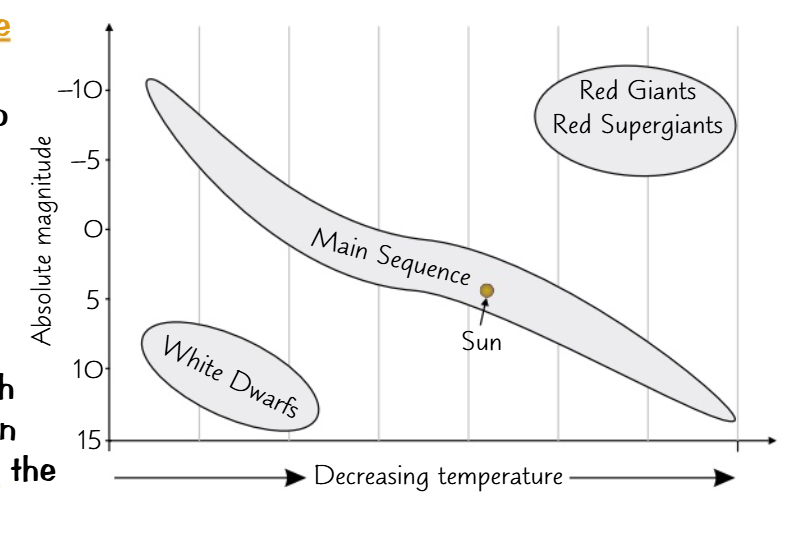
Absolute Magnitude: A star's brightness is influenced by its size and distance from Earth. Absolute magnitude measures how bright a star would appear at a standard distance of 10 parsecs, allowing for a consistent comparison.
Hertzsprung-Russell Diagram: This diagram classifies stars based on their absolute magnitude and surface temperature. Key features include:
Main Sequence Stars: A diagonal band where most stars, including the Sun, are located. These stars fuse hydrogen into helium.
Red Giants and Supergiants: Positioned above the main sequence, indicating they are very bright but cooler.
White Dwarfs: Found below the main sequence, representing stars that are hot but less luminous.
This diagram helps visualize the relationships between a star's brightness, temperature, and evolutionary stage.
Red - Shift
Waves and Motion:
Waves are affected by the motion of their source. When a source moves relative to an observer, the frequency changes—known as the Doppler Effect. This applies to all types of waves, including light.
Redshift:
Definition: Light from galaxies is often red-shifted, meaning it shifts to longer wavelengths as the source moves away from us.
Causes: This occurs when galaxies are receding, causing a decrease in frequency and an increase in wavelength.
Measurement: By examining the absorption spectrum, astronomers can determine how much light has shifted, indicating the speed and direction of the galaxy.
Calculating Redshift: The amount of redshift can be calculated using the change in wavelength compared to the original wavelength, providing insights into the galaxy's motion and distance.

The Big Bang
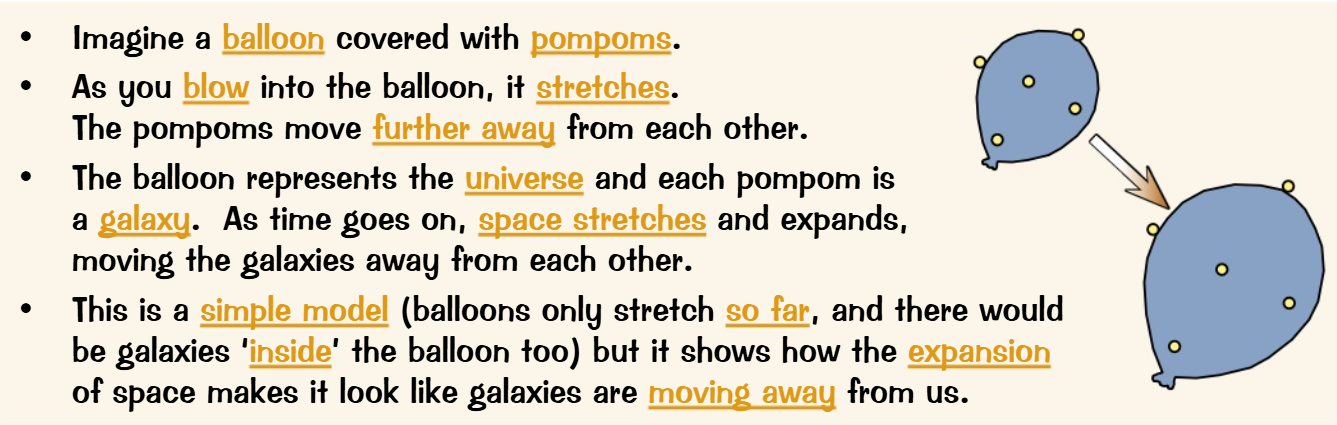
Redshift Observations: Measurements show that distant galaxies are moving away from us, indicating that the universe is expanding. The farther away a galaxy is, the faster it appears to be receding.
Microwave Radiation: The Cosmic Microwave Background (CMB) radiation is detected uniformly from all directions, providing further evidence of an expanding universe.
Big Bang Theory: This evidence supports the idea that the universe began with a massive explosion known as the Big Bang. Key points include:
The early universe was extremely hot and dense.
As it expanded, it cooled, leading to the formation of galaxies and structures.
The expansion continues today, suggesting an ongoing evolution of the universe.