Parabola
The graph of a quadratic function y= ax + bx + c is called parabola. You have noticed that the parabola opens upward or downward. It has a turning point called vertex which is either the lowest point or the highest point of the graph. If the value of a > 0, the parabola opens upward and has a minimum point. If a0, the parabola opens downward and has a maximum point. There is a line called the axis of symmetry which divides the graph into two parts such that one-half of the graph is a reflection of the other half. If the quadratic function is expressed in the form y=alx-h+k, the vertex is the point (h, k). The line xh is the axis of symmetry and k is the minimum or maximum value of the function.
The domain of a quadratic function is the set of all real numbers. The range depends on whether the parabola opens upward or downward. If it opens upward, the range is the set ly: y2 ki; if it opens downward, then the range is the set |y:y_<k|
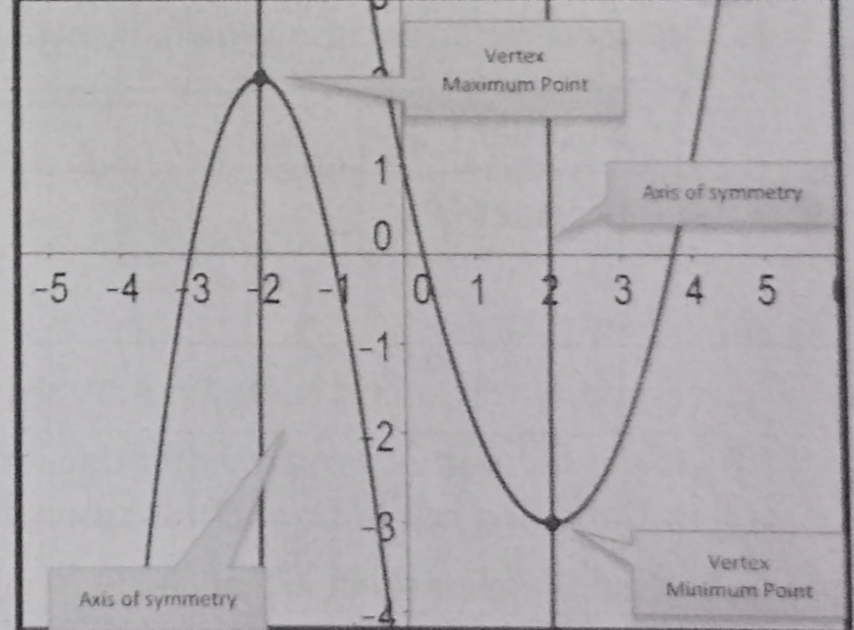
In the graph of y = a * x ^ 2 + bx + c the larger the jal is, the narrower is the graph.
For a > 0 , the parabola opens upward.
\ To graph y = a * (x - h) ^ 2 slide the graph of y = a * x ^ 2 horizontally ir units.. If h50, slide it to the right, if h< 0, slide it to the left. The graph has ver tex (h, 0) and its axis is the line x = h
To graph y = a * x ^ 2 + k slide the graph of y = d * x ^ 2 vertically k units. If k > 0 slide it upward; f ^ k<0. slide it downward. The graph has vertex (0, k) and its axis of symmetry is the line x = 0 (y-axis).
\ To graph y = a * (x - h) ^ z + k slide the graph of y=ax horizontally li units and vertically k units. The graph has a vertex (h, k) and its axis of symmetry is the line ex = h If a < 0 the parabola opens downward. The same procedure can be applied in transforming the graph of a quadratic function.
\ Vertex of the graph of a quadratic function:
\ In standard form f(x) = a * (x - h) ^ 2 + k the vertex (h, k) can be directly obtained from the values of h and k
\ In general form f(x) = a * x ^ 2 + bx + c the vertex (h, k) can be obtained using the formulas.
h=-b/2a and k= 4ac-b^2/4a
\ The graph of a quadratic function is a parabola. A parabola can cross the x-axis once, twice, or never. The x-coordinates of these points of intersection are called x-intercepts. Let us consider the graph of the quadratic function y = x²-x-6. It shows that the curve crosses the x-axis at 3 and -2. These are the x-intercepts of the graph of the function. Similarly, 3 and -2 are the zeros of the function since these are the values of x when y equals 0. These zeros of the function can be determined by setting y to 0 and solving the resulting equation through different algebraic methods.
\ Find a quadratic function whose zeros are -1 and 4.
Solution: If the zeros are -1 and 4, then
x = - orx = 4
x + 1 = 0orx - 4 = 0 then
(x + 1)(x - 4) = 0
x ^ 2 - 3x - 4 = 0
The equation of the quadratic function f(x) = (x² - 3x-4) is not unique since there are other quadratic functions whose zeros are -1 and 4 like f(x) = 2x²-6x-8, f(x) = 3x²-9x-12 and many more. These equations of quadratic functions are obtained by multiplying the right hand side of the equation by a nonzero constant. Thus, the answer is f(x) = a(x²-3x-4) where a is any nonzero constant.
\ Determine the equation of the quadratic function represented by the table of values below.
x= -3,-2,-1,0,1,2,3
y= 24,16,10,6,4,4,6
Solution:
Notice that you can't find any zeros from the given table of values. In this case, take any three ordered pairs from the table, and use these as the values of x and y in the equation y= a * x ^ 2 + bx +c.Let say
using point (1,4) 4 = a * (1) ^ 2 + b(1) + c
4 = a + b + c equation 1
using point (-1, 10) 10= a * (- 1) ^ 2 + b(- 1) +
10 = a - b + c equation 2
using point (2,4) 4 = a * (2) ^ 2 + b(2) + c
4= 4a + 2b + c equation 3
We obtain a system of 3 equations in a, b, and c
Add corresponding terms in eq.1 and eq. 2 to eliminate b
eq1 + eq 2
4= a+b+c
10=a-b+c
We have overline 14 =2. a + 2c equation 4
Multiply the terms in eq. 2 by 2 and add corresponding terms in eq. 3 to eliminate b
2(eq2) + eq 3
20 = 2a - 2b + 2c
4= 4a+2b+2c
We have 24= 6a + 3c equation 5
Notice that equation 4 and equation 5 constitute a system of linear equations in two varia bles. To solve for c, multiply the terms in equation 4 by 3 and subtract corresponding terms in equation 5.
3(eq 4) - eq5
42 = 6a + 6c
24 = 6a + 3c
18 = 3c
c = 6
\ Substitute the value of c in equation 4 and solve for a.
14= 2a +2( 6)
14 = 2a + 12
2a= 14-12
a= 1
Substitute the value of c and a in equation I and solve for b.
4 = a+b+c
4= 1 + b + 6
4=7+b
b =4-7
b = - 3
Thus, a 1,b=-3, and c=6. Substitute these in f(x) = ax + bx + c, the quadratic function is
f(x) = x - 3x + 0
\ When the vertex and any point on the parabola are clearly seen, the equation of the quadratic function can easily be determined by using the form of a quadratic function y=a(x-H)^2+k
\ Illustrative example 1
Find the equation of the quadratic function determined from the graph below.
Solution:
The vertex of the graph of the quadratic function is (2,-3). The graph passes through the point (5, 0). By replacing x and y with 5 and 0, respectively, and h and k with 2 and -3, respectively, we have
y=a(x-h)^2 + k
0= a(5-2)^2+3(-3)
0=a(3)^2-3
3=9a
a=1/3
Thus, the quadratic equation is y=1/3(x-2)^2-3 or y=1/3x^2-4/3-5/3
you can also determine the equation of a quadratic function by getting the coordinates of any 3 points lying on the graph. You can follow the steps in finding the equation of a quadratic function using this method by following the illustrative example presented previously in this section.