Thinking, Language, and Intelligence
Thinking
Concepts
We must begin by thinking how do psychologists study thinking?
Cognition - all the mental activities associated with thinking, knowing, remembering, and communicating.
Metacognition - cognition about our cognition; keeping track of and evaluating our mental processes.
People who use metacognition (evaluate how they are learning) learn better
Concepts - a mental grouping of similar objects, events, ideas, or people.
The concept “chair” could mean baby chair, rocking chair, dentist chair
Prototype - a mental image or best example of a category. Matching new items to a prototype provides a quick and easy method for sorting items into categories (as when you compare a feathered creature to a prototypical bird, such as a crow).
The basic idea of what you think of when given a category
Culture influences our prototype
What happens when our experiences do not match the prototype?
Solving Problems
We solve problems through trial and error
Algorithms - a methodical, logical rule or procedure that guarantees you will solve a particular problem. Contrasts with the usually speedier — but also more error-prone — use of heuristics.
Step by step
Heuristics - a simple thinking strategy — a mental shortcut — that often allows you to make judgments and solve problems efficiently; usually speedier but also more error-prone than an algorithm.
Insight - a sudden realization of the solution to a problem; contrasts with strategy-based solutions.
in bran scans of people who had insight there are rapid bursts of brain activity
Before the “aha” moment, the frontal lobe was active
The instant of discovery, there was a flash of activity in the right temporal lobe
Confirmation Bias - a tendency to search for information that supports your preconceptions and to ignore or distort evidence that contradicts them.
we use our assumptions to asses evidence
This is why when people are presented with evidence that does not support their beliefs, they often reject it
Fixation - the inability to consider a problem from a new perspective; an obstacle to problem solving.
not being able to look at stuff from a new angle
Making Good (and Bad) Decisions and Judgements
We make hundreds of decisions each day
do we weigh the pros and cons and base our decision on logic? (no)
Intuition - an effortless, immediate, automatic feeling or thought, as contrasted with explicit, conscious reasoning.
Usually adaptive
Huge; constant affecting judgements via unconscious automatic influences
Aided by deliberate, conscious thoughts
Leaders often make decisions without considering thought or reflection, just intuition
Two Quick but Risky Shortcuts
Heuristics enable quick thinking that often serves us well when we need to make quick decisions
Some mental shortcuts can lead us to make dumb decisions
The Representativeness Heuristic
Representativeness Heuristic - judging the likelihood of events in terms of how well they seem to represent, or match, particular prototypes; may lead us to ignore other relevant information.
Are English professors or truck drivers more likely to be short and read poetry?
Even though it may seem like English professors, there are more truck drivers meaning that statistically, truck drivers are more likely
The Availability Heuristic
Availability Heuristic - judging the likelihood of events based on their availability in memory; if an event comes readily to mind (perhaps because it was vivid), we assume it must be common.
Vivid photos of a mass tragedy, plane crash stay in our mind and lead people to think the world is incredibly dangerous
Overconfidence: Was There Ever Any Doubt?
Overconfidence - the tendency to be more confident than correct — to overestimate the accuracy of our beliefs and judgments.
Wise people feel confident about their knowledge, appreciate what they don’t know, and remain open to new information.
Our Beliefs Live On — Sometimes Despite Evidence
Belief Perseverance - clinging to beliefs even after evidence has proven them wrong.
How do avoid belief Perseverance? Consider the opposite
“whether you would have made the same high or low evaluations had exactly the same study produced results on the other side of the issue”
Once we believe something, it takes stronger evidence to change our mind than it did to create that belief
Framing: Let’s Put It This Way …
Framing - the way an issue is posed; framing can significantly affect decisions and judgments.
“How should the United States prepare for the outbreak of an unusual disease that could kill 600 people?”
Participants strongly preferred solutions framed as gains (“200 people will be saved”) rather than losses (“400 people will die”).
Nudge - framing choices in a way that encourages people to make beneficial decisions.
The Perils and Powers of Intuition
Unreasoned thinking harm our efforts to solve problems, but it also has some benefits
Intuition is recognition born of experience. It means you have experience, even if it is unconscious
Intuition is usually adaptive.
Intuition is immense. due to our two track system, our brain continues to work on stuff even when we are not consciously thinking about it
Thinking Creatively
Creativity - the ability to produce new and valuable ideas.
Requires a certain level of aptitude (ability to learn)
Convergent Thinking - narrowing the available solutions to determine the single best solution to a problem.
Divergent Thinking - expanding the number of possible solutions to a problem; creative thinking that branches out in different directions.
Robert Sternberg said that creativity has 5 different parts:
Expertise
Imaginative Thinking Skills
Venturesome Personality
Intrinsic Motivation
A Creative Environment
How to boost creativity:
Develop your expertise
Allow time for ideas to develop and flourish
Set aside time for your mind to roam freely
Do Other Species Share Our Cognitive Skills?
Other species are surprisingly smart (not Jeff though)
Using Concepts and Numbers
By touching screens for a food reward, black bears have learned to sort pictures into animal and nonanimal categories, or concepts
Monkeys can add numbers and tell the difference between two different quantities of peanuts
Displaying Insight
One African Grey parrot equaled or bettered the performance of Harvard students at a complex shell game testing visual memory
A crow once put stones into water in order to reach the water to drink
Transmitting Culture
Animals invent behaviors and transmit cultural patterns to their observing peers and offspring
Researchers have found at least 39 local customs related to chimpanzee tool use, grooming, and courtship
One group may slurp termites directly from a stick, while another group may pluck them off individually
Language
Humans pass thoughts through the air! (literally so weird)
Language - our spoken, written, or signed words and the ways we combine them to communicate meaning.
With language, we humans can transmit civilization’s knowledge from one generation to the next.
Human knowledge knows no limits due to language and our ability to communicate
Language Acquisition and Development
Syntax - the correct way to string words together to form sentences for a given language.
How do we do language?
Language Acquisition: How Do We Learn Language?
Grammar - in a language, a system of rules that enables us to communicate with and understand others.
Linguist Noam Chomsky thought that humans had an innate ability for grammar rules in order to communicate
Humans are born with universal grammar; not a specific one
Other researchers said that children learn grammar as they understand patterns in speech
Whatever language we experience as children, whether spoken or signed, we readily learn its specific grammar and vocabulary
Language Development: When Do We Learn Language?
After 2 years old, you learn around 3,500 words a year or 10 a day! HOW??
Receptive Language
Babies are born ready to learn any language
By 4 months of age, infants with hearing can recognize differences in speech sounds
Productive Language - ability to produce words
Productive Language
Babbling Stage - the stage in speech development, beginning around 4 months, during which an infant spontaneously utters various sounds that are not all related to the household language.
Deaf infants who observe their deaf parents using sign language begin to babble more with their hands
At 10 months, babies can discriminate between sounds in their native language
One-Word State - the stage in speech development, from about age 1 to 2, during which a child speaks mostly in single words.
starts with one syllable words (da) to words that label things (dog)
Two-Word Speech - the stage in speech development, beginning about age 2, during which a child speaks mostly in two-word sentences.
Telegraphic Speech - the early speech stage in which a child speaks in compressed sentences, like a telegram — “want milk” or “Daddy go store” — using mostly nouns and verbs.
Month | Stage |
4 | Babbles many sounds (“ah-goo”) |
10 | Babbling resembles household language (“ma-ma”) |
12 | One-word speech (“Kitty”) |
24 | Two-word speech (“Get Ball”) |
24+ | Rapid development into complete |
Critical Period
What happens if a child doesn’t learn a language until later into their development?
For these late bloomers, language development follows the same sequence, though the pace is often faster
But there is a limit to how late language learning is delayed
Childhood is a critical period for learning a language
If not exposed to either a spoken or a signed language by age 7, children lose their ability to fully comprehend and use any language.
Children exposed to less complex language — such as U.S. 4-year-olds in classrooms with 3-year-olds — often display less language skill
After the language learning window closes, it is much harder to learn a second language
The Brain and Language
How does the brain process language?
Broca’s Area - a frontal lobe brain area, usually in the left hemisphere, that helps control language expression by directing the muscle movements involved in speech.
People with damage to this area have trouble physically speaking words
Wernicke’s Area - a brain area, usually in the left temporal lobe, involved in language comprehension and expression.
People with damage to this area have trouble understanding other’s sentences and could only produce meaningless sentences
For people with brain damage, electrical stimulation of Broca’s area can help restore speaking abilities
Although you experience language as a single, unified stream, fMRI scans would show that your brain is busily multitasking and networking. Involves multiple brain networks
Large Language Model - an artificial intelligence program that uses statistical probabilities to perform basic language processes, such as producing, translating, and categorizing text.
Your conscious experience of learning about the brain and language seems to be one task. But thanks to your parallel processing, many different neural networks are pooling their work to give meaning to the words, sentences, and paragraphs
Thinking without Language
We often think in images, not words
Once someone has learned a skill, even watching that skill happen triggers brain activity in the same areas that are active when they actually use the skill.
It’s better to imagine how to reach your goal than merely to fantasize your desired destination.
Do Other Species Have Language?
Humans can take other’s perspective and apply a moral sense
Some animals can display basic understanding of language
Pigeons can differentiate between words and nonworkds
Various monkey species sound different alarm cries for different predators
They are able to differentiate the sounds and apply meaning to said sounds
Does this count as language though?
Allen Gardner and Beatrix Gardner taught a chimpanzee how to use sign language
Psychologists were skeptical
They had some points. Their grasp of language was equivalent to a 2 year old, Their signing might be nothing more than a conditioned response to get a reward, when info is unclear we often interpreted the data to get the results that we want
Are Humans the only species with a language ability?
If verbal or signed expression of complex grammar that allows us to exchange thoughts, then yes
If a way to communicate through a meaningful sequence of symbols, then no
Human communication evolved from gestures that apes often do
Do humans deserve the title “homo sapiens” or “wise human”
Intelligence
What is Intelligence?
Intelligence - the ability to learn from experience, solve problems, and use knowledge to adapt to new situations.
Some people are gifted in science, others in art, others in athletics
Are all these people Intelligence?
Is Intelligence One General Ability
General Intelligence (g) - according to Spearman and others, underlies all mental abilities and is therefore measured by every task on an intelligence test.
Thought mental abilities are similar to physical ability
The Cattell-Horn-Carroll Intelligence Theory
Fluid Intelligence - our ability to reason speedily and abstractly; tends to decrease with age, especially during late adulthood.(Gf)
Crystalized Intelligence - our accumulated knowledge and verbal skills; tends to increase with age. (Gc)
Cattell-Horn-Carroll (CHC) theory - the theory that our intelligence is based on general intelligence (g) as well as specific abilities, bridged by fluid intelligence (Gf) and crystallized intelligence (Gc).
Theories of Multiple Intelligence
Gardner’s Multiple Intelligences
Howard Gardner viewed Intelligence as multiple abilities that come in different packages
Savant Syndrome - a condition in which a person otherwise limited in mental ability has an exceptional specific skill, such as in computation or drawing.
They would score low on regular intelligence tests because they have a limited language ability
Gardner identified 8 relatively Independent intelligences
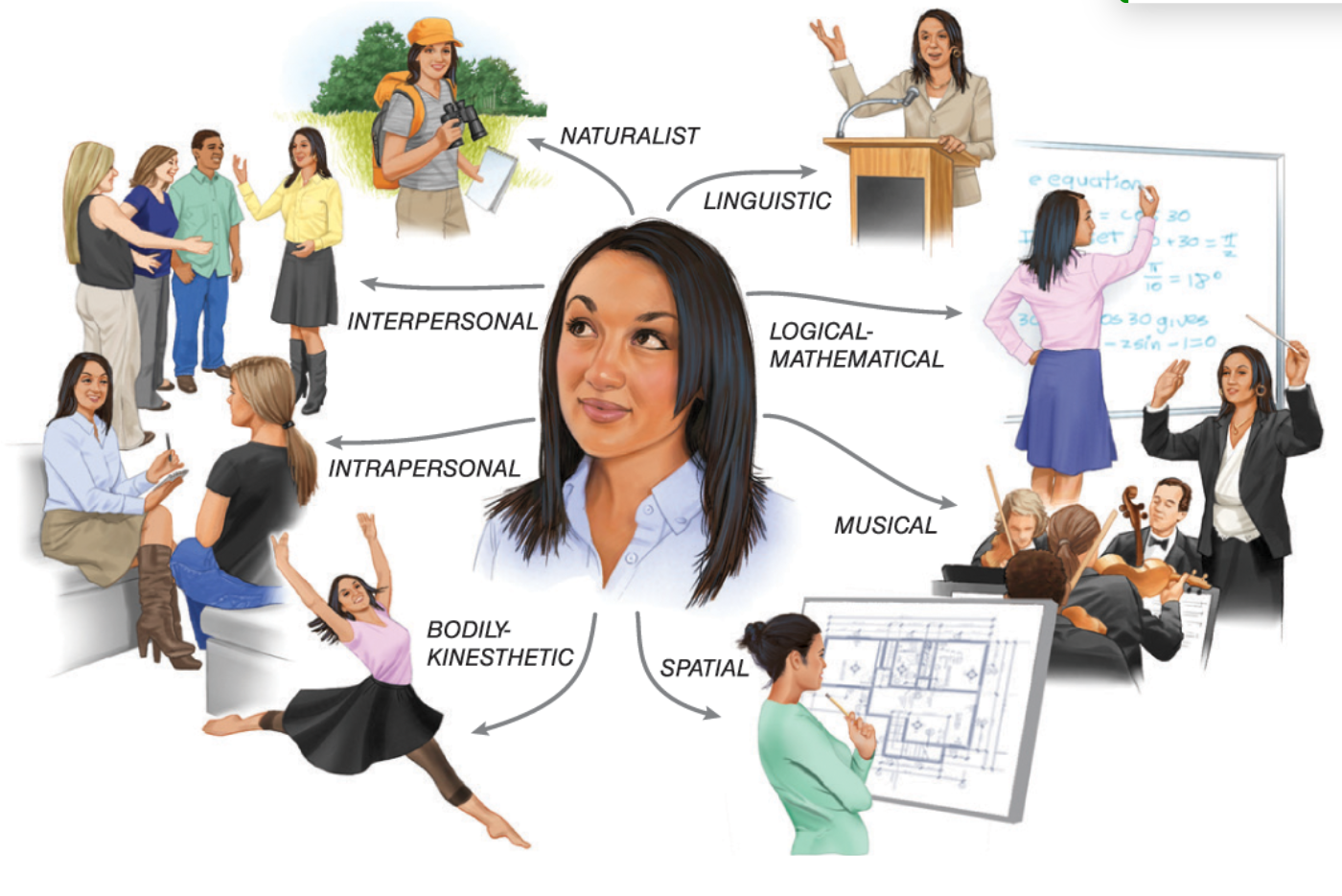
Sternberg’s Three Intelligences
Robert Sternberg agreed with Gardner that there is more than 1 intelligence type, but he said that there were 3 types, not 8
Analytical (academic problem-solving) intelligence
assessed by intelligence tests, which present well-defined problems having a single right answer.
Creative Intelligence
demonstrated in innovative smarts: the ability to adapt to new situations and generate novel ideas.
Practical Intelligence
required for everyday tasks that may be poorly defined and may have multiple solutions.
Multiple abilities can contribute to life success, and varieties of giftedness bring both spice to life and challenges for education.
General Intelligence, Grit, and Deliberate Practice
There is a general intelligence factor: g. It predicts performance on various complex tasks and in various jobs
But overall success in life is not determined by a g score
Researchers propose a 10 year rule: expert performers have spent around 1 decade in intense, daily practice to their specific ability
If you spend 10 years dedicated to a thing, you will become an expert in it
Emotional Intelligence
Social intelligence is the know-how involved in understanding social situations and managing ourselves successfully
Emotional Intelligence - the ability to perceive, understand, manage, and use emotions.
An important part of Social Intelligence
Emotional Intelligence includes 4 abilities:
Perceiving Emotions
Understanding Emotions
Managing Emotions
Using Emotions
People with emotional intelligence are socially aware and self aware
Assessing Intelligence
Intelligence Tests - a method for assessing an individual’s mental aptitudes and comparing them with those of others, using numerical scores.
Test people’s mental abilities through 2 ways:
Achievement Tests - a test designed to assess what a person has learned.
Aptitude Test - a test designed to predict a person’s future performance; aptitude is the capacity to learn.
What do Intelligence Tests Test?
Alfred Binet: Predicting School Achievement
A law required that all kids take school, but someone had to come up with a test to determine kids learning potential (academic ability)
Alfred Binet designed the test to determine the child’s mental age
Assumed the all children follow the same course of intellectual development, but not at the same rate
Mental Age - a measure of intelligence test performance devised by Binet; the level of performance typically associated with children of a certain chronological age. Thus, a child who does as well as an average 8-year-old is said to have a mental age of 8.
Lewis Terman: Measuring Innate Intelligence
Stanford-Binet - the widely used U.S. revision (by Terman at Stanford University) of Binet’s original intelligence test.
Intelligence Quotient (IQ) - defined originally as the ratio of mental age (ma) to chronological age (ca) multiplied by 100 . On contemporary intelligence tests, the average performance for a given age is assigned a score of 100.
Developed by German psychologist William Stern
Original IQ test worked good for kids but not for adults
Instead, they assign a score that represents a test-taker’s performance relative to the average performance (arbitrarily set at 100) of others the same age.
Terman assumed that intelligence tests revealed a fixed mental capacity present from birth. He also assumed that some ethnic groups were more intelligent than others. And he supported eugenics
David Wechsler: Testing Separate Strengths
Wechsler Adult Intelligence Scale (WAIS) - the WAIS and its companion versions for children are the most widely used intelligence tests; they contain verbal and performance (nonverbal) subtests
Three Tests of a good test
Was the Test Standardized?
Standardization - defining uniform testing procedures and meaningful scores by comparison with the performance of a pretested group.
One way to compare scores is to graph them
Normal Curve - a symmetrical, bell-shaped curve that describes the distribution of many types of data; most scores fall near the mean (about 68 percent fall within one standard deviation of it) and fewer and fewer near the extremes.
Is the test reliable?
Reliability - the extent to which a test yields consistent results, as assessed by the consistency of scores on two halves of the test, on alternative forms of the test, or on retesting.
Is the Test Valid?
Validity - the extent to which a test measures or predicts what it is supposed to
Predictive Validity - the success with which a test predicts the behavior it is designed to predict.
High and Low Scores: How do they differ?
The Low Extreme
Intellectual developmental disorder is evident before the age of 18. The person must have a score of under 70
U.S. Supreme Court recognized the imprecision and arbitrariness of a fixed cutoff score of 70. And it required states with death row inmates who have scored just above 70 to consider other evidence
The High Extreme
Children whose intelligence test scores indicate extraordinary academic gifts mostly thrive.
The Nature and Nurture of Intelligence
Why does Intelligence run in families?
Hereditary and Intelligence
Heritability - the proportion of variation among people in a group that we can attribute to genes. The heritability of a trait may vary, depending on the population and the environment.
The important point to remember: Heritability never applies to an individual, only to why people in a group differ from one another.
Mark Twain wanted to raise kids in barrels, feeding them through a hole. Since their environment is the same, if we gave them an intelligence test, the differences in intelligence would be due to genetics!
If a mad scientist made 100 genetically identical clones, but raised them in drastically different environment, the differences in their intelligence tests would be due to the environment
Since identical twins share the same genes, do they share the same intelligence?
Yeah! even when adopted into different families, their intelligence level is very similar
Although genes matter, there is no such thing as an “intelligence” gene
Environment and Intelligence
Since fraternal twins do not share the same genes, but do share an environment, how does this affect their intelligence level?
There test scores are similar (like identical twins)
Intelligence tests of adopted children with those of their (a) biological parents, who provided their genes, (b) adoptive parents, who provided their home environment, and (c) adoptive siblings, who shared that home environment.
Adoption from poverty → financially secure homes increases kids intelligence scores
Adoption of mistreated kids increases their intelligence scores
he intelligence scores of “virtual twins” — same-age, unrelated children adopted as infants and raised together as siblings — correlate positively
Adopted kids intelligence scores mirror those of their biological parents more than their adoptive parents.
Gene-Environment Interaction
Genes and the environment interact
With mental and physical abilities, our genes shape the experiences that shape us
if you have genes to be academic, you stay in school/read books/ask questions, all of which increases your intelligence levels
small genetic advantages can trigger social experiences that multiply your original skills
What happens when the environment does not help our genes but hinders them?
COVID prevented kids from learning traditionally
In an Iranian orphanage, kids did not have care as infants and could not sit up unassisted at 2 or walk at age 4
This greatly harmed their intelligence levels
Poor environmental conditions, from air pollution to financial stress, can depress brain and cognitive development
Adults who grew up drinking led-polluted water had lower cognitive abilities
Can an enriched environment stimulate cognitive development?
Most experts say no, you cannot fast-forward brain development
Growth Mindset
While schooling and intelligence interact to increase our IQ, what we accomplish mostly happens do to our own motivation
When promised with money for a good score, teens preform better on tests
Growth Mindset - a belief that abilities are not fixed, but can grow with persistent effort.
When teachers have a growth mindset, their students do as well
A growth mindset doesn’t alter inborn intelligence, but it does change how people respond to setbacks.
ability + opportunity + motivation = success
Intelligence Across the Life Span
Stability or Change?
Cross-Sectional Studies - research that compares people of different ages at the same point in time.
Longitudinal Studies - research that follows and retests the same people over time
Scottish researcher studied 87,000 eleven year old’s across their life span to see how their intelligence level affected their life (took 70 years in total)
Higher-scoring children and adults tend to live healthier and longer lives
Higher-scoring kids feel younger
Why??
intelligence gives people access to more education, better jobs, and a healthier environment
Intelligence promotes healthier lifestyle (no smoking, better diet)
Prenatal events or early childhood illnesses can influence both intelligence and health.
A “well-wired body,” as evidenced by fast reaction speeds, may foster both intelligence and longer life.
Crystallized and Fluid Intelligence
It matters what questions psychological scientists ask, but sometimes it matters even more how they ask them — the research methods they use.
Cross sectional studies found that older adults produced less correct answers than younger adults did
“the decline of mental ability with age is part of the general [aging] process of the organism as a whole.”
Crystalized Intelligence (knowledge in vocabulary and analogies) increases as we age
Fluid intelligence (reason speedily and abstractly, as when solving novel logic problems) Decreases as we age
Group Differences in Intelligence Test Scores
Since there are group differences in intelligence scores, what does this mean?
Gender Similarities and Differences
Men’s self-estimated intelligence is often higher than women’s self-estimated intelligence, which may fuel a false perception that men are smarter than women
Men perceive themselves as more intelligence than they really are
Women perceive themselves as less intelligence than they really are
In cultures where all children are educated, girls tend to outpace boys in spelling, verbal fluency, and reading — skills that may affect their career choices
In Math, boys are girls have equal intelligence (take that Burchard)
Male intelligence varies more than female intelligence
Boys, for example, are more likely than girls to need remedial math classes. But they are also more likely to earn the highest math scores.
Steven Pinker argues that biology affects each genders perspective (priorities and risk taking)
Women tend to have interest in people while boys interest in money and things
But social expectations and opportunities also construct gender by shaping interests and abilities
Social expectations and opportunities also construct gender by shaping interests and abilities.
Among immigrant girls, those whose parents come from gender-equal cultures perform better on math tests than do those whose parents come from gender-unequal cultures
Racial and Ethnic Similarities and Differences
Racial and ethnic groups differ in their average intelligence test scores. High-scoring people (and groups) are more likely to achieve high levels of education and income.
These group differences may be due to environment? Research says no:
Genetics research reveals that under the skin, we humans are remarkably alike.
Race is not a neatly defined biological category
Within the same populations, there are generation-to-generation differences in test scores.
Schools and culture matter.
Cultures with a high socio-economic gap have a large intelligence divide
In different eras, different ethnic groups have experienced golden ages — periods of remarkable achievement
Are Intelligence Tests Biased?
Depends on how we define bias
The scientific meaning of bias hinges only on a test’s validity.
everyday language, we sometimes use the word bias to describe things that are unfair.
If intelligence tests were based on one specific culture that undermined other people’s life experience, then that test would be biased
Today’s standardized tests are rigorously reviewed to attempt to eliminate cultural bias. Some researchers, for example, recommend culture-neutral questions — such as those that assess people’s ability to learn novel words, sayings, and analogies — to enable culture-fair aptitude tests
Test Takers Expectations
Expectations can produce bias
Stereotype Threat - a self-confirming concern that you will be judged based on a negative stereotype.
In one study, equally capable men and women took a difficult math test. The women performed as well as the men — but only when they were led to expect that women usually do as well as men on the test
Negative Stereotypes can undermined people academic potential
The presence of others who are expected to perform better can dampen our confidence in our abilities
realize the benefits Alfred Binet foresaw - use tests to see who would benifit from early academic intervention
remain alert to Binet’s wish - intelligence tests are not literal measurements of a person’s worth and potential
remember that the competence that general intelligence tests sample is important