Scientific Method and Experimental Design Lab Notes
Course Resources and Deadlines
Mandatory Submissions: The first lab report and lab quiz are due this coming Sunday.
Content Scope: Both assignments cover the Scientific Method.
Accessing Materials via ecampus:
Navigate to the Lab Resources tab.
Select Week 1 (Scientific Method).
Click on Background Procedures to access the essential course documents.
Study Strategy:
The Lab Quiz questions are primarily derived from the Background Information section.
The Lab Report is based on the Procedures, recording specific results, and following the instructions provided during the actual lab activity.
Foundation of the Scientific Method
General Definition: The scientific method is the structured process used to look at a basic science experiment, determine how it is set up, and identify what constitutes a "good" experiment.
The Five-Step Process:
Observation: Witnessing a phenomenon and wondering about the underlying cause.
Questioning: Developing a specific question based on the observation.
Hypothesis Development: Formulating an answer to the question (an educated guess).
Experimentation: Performing a test to evaluate the hypothesis.
Results and Analysis: Collecting data and determining if the hypothesis is supported.
Types of Scientific Data
Qualitative Data:
Description: Data that describes the "quality" of a subject.
Memory Tool: "Qualitative" contains an "l" for "quality."
Characteristics: Non-numerical; involves describing patterns, shapes, or behaviors (e.g., how an animal moves).
Quantitative Data:
Description: Data that involves numbers and measurements.
Memory Tool: "Quantitative" contains an "n" for "numbers" or "quantity."
Characteristics: Numerical observations including measurements of mass, temperature, volume, or counts (e.g., the number of eggs a bird laid).
The Hypothesis: Criteria for Science
Definition: A hypothesis is an educated guess intended to answer a scientific question.
Essential Criteria:
Testable: The hypothesis must be capable of being tested through experimentation. Science cannot test supernatural or metaphysical entities (e.g., God, ghosts, or spirits). If a light goes out and the hypothesis is "a ghost turned it off," it is not a scientific hypothesis because it cannot be tested.
Falsifiable: There must be a possibility for the hypothesis to be proven wrong or false through empirical evidence.
Outcome Management:
If a hypothesis is supported, results can be shared or published after appropriate replication.
If a hypothesis is not supported (proven false), the researcher must develop a new hypothesis or re-test.
Experimental Components: Controls and Variables
Controls: Controls are the groups used for comparison in an experiment. They are not exposed to the experimental treatment itself.
Negative Control: A group that is not exposed to the experimental treatment and is expected to produce no result.
Purpose: To verify that the experimental system is not contaminated and that the results seen in the experimental group are truly due to the treatment.
Example (Lettuce Bacteria Test): Taking a sterile swab and swiping it directly onto a plate without touching a lettuce leaf. Nothing should grow.
Positive Control: A group that is not exposed to the experimental treatment but is exposed to a factor known to produce a specific, expected result.
Purpose: To ensure the equipment, media, and reagents are functioning correctly.
Example (Lettuce Bacteria Test): Directly streaking a plate with known bacteria. Growth is expected.
Variables:
Independent Variable: The factor that is manipulated, varied, or changed by the scientist (e.g., the amount of caffeine administered).
Dependent Variable: The factor that is being measured, counted, or observed. It "depends" on the changes made to the independent variable (e.g., the reaction time of a subject).
Memory Tip for Variables: Ask which factor depends on the other. For example, does caffeine amount depend on reaction time, or does reaction time depend on caffeine amount? Since reaction time depends on the caffeine, reaction time is the dependent variable.
Replication and Validity in Science
Replication Requirement: An experiment cannot be published or considered valid after a single trial.
Standard Rule: A scientist should replicate an experiment at least times.
Significance: If results are not similar or consistent across these replications, the experiment cannot be trusted.
Contamination Check: If the negative control shows growth/results, it indicates contamination (e.g., contaminated media or swabs), meaning the entire experiment is invalid and must be restarted.
Lab Procedure: Mouse Diet Experiment
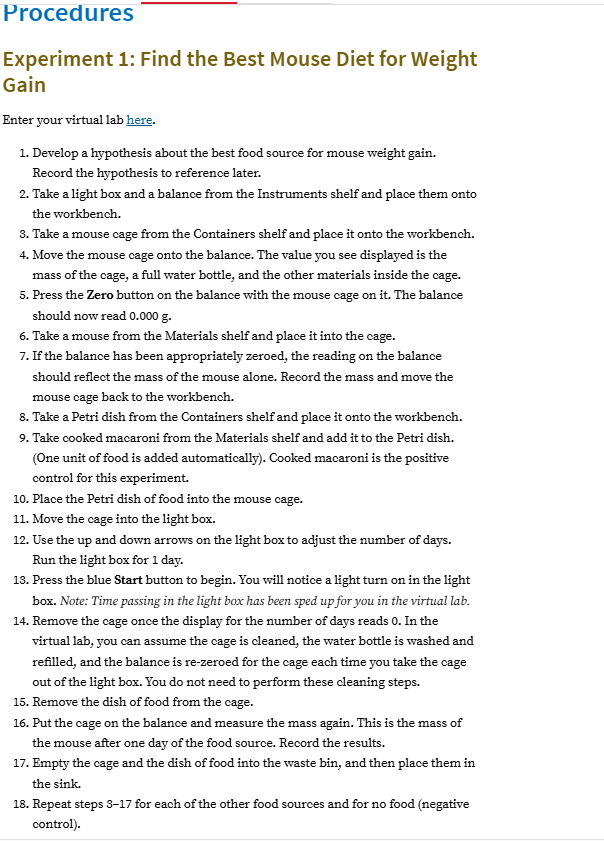
Experiment 1 (Initial Testing):
Objective: Identify which type of food leads to the most weight gain in a mouse.
Activity: Test a variety of food types to find the optimal diet for weight gain.
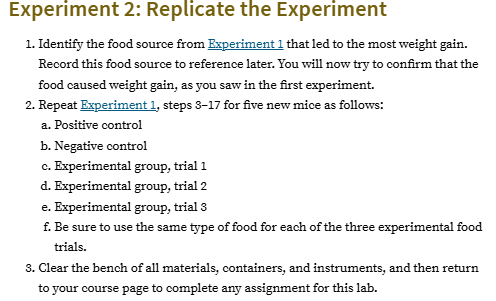
Experiment 2 (Replication and Control Application):
Replication: Use a sample size of mice.
Setup for each Mouse: For each of the mice, you must run:
One positive control.
One negative control.
Three experimental food trials (Experimental Groups , , and ).
Consistency: In the experimental trials, use the specific type of food determined to be "best" from Experiment 1 across all three trials.
Questions & Discussion
User Question: Can the lab report be done in multiple sittings? I started mine on Tuesday, saved the answer, but didn't submit. Will I still be able to go back to it?
Instructor Response: Yes, as long as you click "Save Answers" instead of "Submit." Once you submit, you cannot change your answers.
User Question: For the lab quiz, are we allowed to use our notes? Since it is through a lockdown browser, we can't use other tabs, but can we use the notes we are taking now?
Instructor Response: No, you are not supposed to use notes for the quiz.
User Question: Since we didn't get to go over the Lecture for Chapter 1, will we do that at a later time?
Instructor Response: Yes, I will make sure to hit everything in the lecture. We will have to move quickly, but I will never not lecture over a topic.
Meeting Times:
Lab Meetings: Every Tuesday at .
Lecture Meetings: Mondays at .
full procedures:
during lab:
Experiment 1:
mouse: 39.500g
positive control: cooked macaroni
After 1 day: 39.700g
no food (negative control): 38.100g
apple slices: 40.400g - most weight gain
uncooked macaroni: 39.200g
raw steak: 39.700g
cooked steak: 39.800g
Experiment 2:
mouse: 39.500g
Most weight gain: apple slices
a. positive control: cooked macaroni
-39.700g
b. negative control: no food
-38.100g
c. Experiment trial 1 (all trials will be apple slices)
40.400g
d. Experiment trial 2
-40.400g
e. Experiment trial 3
-40.400g