Optics
5.1 Refraction of light
The Normal: an imaginary line perpendicular to the boundary between two materials or a surface.
Refraction: the change of direction that occurs when light passes at an angle across a boundary between two transparent substances.
No refraction occurs if the incident light ray is along the normal.
The light ray bends towards the normal if it passes into a more dense substance, and away from the normal if it passes into a less dense substance.
The ratio of sin(i)/sin(r ) = the refractive index (n) of a substance
Note that partial reflection also occurs when a light ray in air enters glass (or any other refractive substance).
5.2 More about refraction
Refraction occurs because the speed of light waves is different in each substance.
The frequency of the waves doesn’t change when refraction occurs.
Both the wavelength and the speed of the waves do change as they pass from one medium to another.
When light enters a medium where it travels more slowly (denser medium), the wavelength decreases but frequency remains constant.
The speed of light in air at atmospheric pressure is 99.97% of the speed of light in a vacuum. Therefore, the refractive index of air is 1.0003, but for most purposes we say it is 1.
The white light spectrum
We can use a prism to split a beam of white light into the colours of the spectrum by using a glass prism.
This happens because white light is composed of light with a continuous range of wavelengths. The glass prism refracts light by different amounts depending on its wavelength, so each colour in the white light is refracted by different amounts.
5.3 Total internal reflection (TIR)
TIR can only take place if:
the incident substance has a larger refractive index than the other substance (e.g. from glass into air)
the angle of incidence exceeds the critical angle
Why do diamonds sparkle when white light is directed at them?
Because…
Diamonds have a very high refractive index
This means it separates the colours more than any other substance does
Its high refractive index means diamond has low critical angle, so a light ray may be totally internally reflected many times before it emerges, meaning its colours spread out more and more.
So the diamond sparkles with different colours.
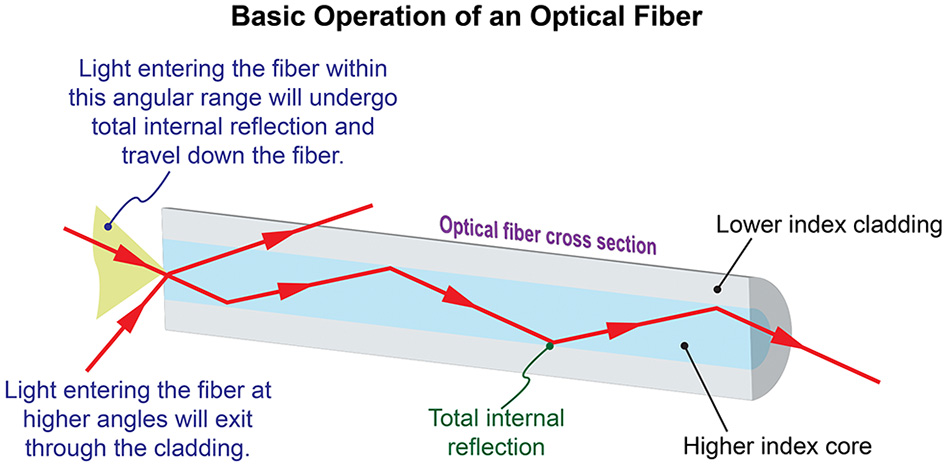
Optical Fibres
Used in medical endoscopes to see inside the body; in communications to carry light signals.
The light ray is totally internally reflected each time it reaches the fibre boundary, even where the fibre bends, unless the radius is too small.
In communications:
The fibres need to be highly transparent to minimise absorption of light, which would otherwise reduce the amplitude of the pulses progressively the further they travel in the fibre.
Each fibre consists of a core surrounded by a layer of cladding of lower refractive index to reduce light loss from the core. Light loss would also reduce the amplitude of the pulses.
TIR takes place at the core-cladding boundary.
The core must be very narrow to prevent modal dispersion. This occurs in a wide core because light travelling along the axis of the core travels a shorter distance per metre of fibre than light that repeatedly undergoes TIR. A pulse of light sent along a wide core would become longer than it ought to be, and may merge with the next pulse.
Modal Dispersion: This phenomenon occurs in optical fibres with a wide core. It happens because light rays travelling along different paths (modes) within the core take varying amounts of time to reach the end of the fibre. Light traveling directly along the axis of the core travels a shorter distance per meter compared to light rays undergoing total internal reflection (TIR). As a result, a pulse of light sent along a wide core can lengthen beyond its intended duration and may merge with the next pulse, which can lead to signal distortion in communications.
Material Dispersion: occurs in optical fibres due to the different refractive indexes of the core and cladding materials. Different wavelengths of light travel at different speeds through the material, causing light pulses to spread out over time as they travel. This phenomenon can affect signal quality and clarity in communications, leading to potential distortion as light rays of varying wavelengths arrive at different times.
5.4 Double Slit Interference
Young’s Double Slit Experiment
To observe interference of light, we can illuminate two closely spaced parallel slits using a light source.
The two slits act as coherent sources of waves (constant phase different + same frequency).
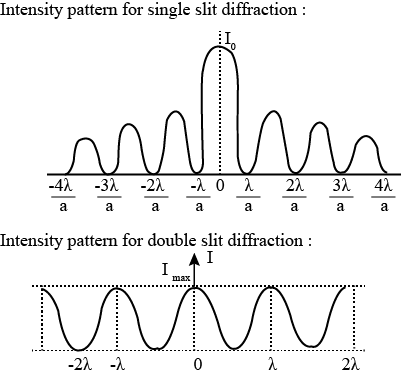
Alternate bright and dark fringes can be seen on a screen. The fringes are evenly spaced and parallel to the double slits.
Note: If the single slit is too wide, it behaves in such a way that each segment of the slit contributes to the overall fringe pattern. However, because these segments are slightly offset from one another, they generate their own individual fringe patterns that overlap with the patterns produced by adjacent segments of the slit. Consequently, this overlap causes the dark fringes in the resulting double slit pattern to become narrower than the bright fringes. As a result, the distinct contrast between the bright and dark areas diminishes, making it harder to observe the interference pattern clearly.
To measure the fringe separation (w), we measure across several fringes from the centre of a dark fringe to the centre of another dark fringe, because their centres are easier to locate than the centre of bright fringes. Divide the total measurement by the no. of fringes measured across.
Wavelength and colour
In the double slit experiment, the fringe separation depends on the colour of light used.
The fringe separation is greater for red light than blue light. This is because red light has a longer wavelength than blue light.
White light fringes
The blue light fringes are closer together than the red light fringes.
However, the central fringe of each pattern is in the same position on the screen. Each component colour of white light produces its own fringe pattern, and each pattern is centred on the screen at the same position.
As a result, the central fringe is white because every colour contributes at the centre of the pattern.
The outer fringes merge into an indistinct background of white light, becoming fainter with increasing distance from the centre. This is because, where the fringes merge, different colours reinforce and therefore overlap.
5.6 Diffraction
Diffraction of light by a single slit
Central fringe observed with further fringes on either side.
The intensity of the fringes is greatest at the centre of the central fringe.
The central fringe is twice as wide as each of the outer fringes.
Each of the outer fringes is the same width.
The outer fringes are MUCH less intense than the central fringe.
The width of each fringe is is narrower using blue light than if red light is used.
5.7 The diffraction grating
A diffraction grating consists of a plate with many closely spaced parallel slits ruled on it. When a parallel beacm of monochromatic light is directed normal at a diffraction grating, light is transmitted by the grating in certain directions only (due to diffraction and interference)
The angle of diffraction between each transmitted beam and the central beam increases if: light of a longer wavelength is used, or a grating with closer slits is used.
The larger the number of slits per metre, the bigger the angle of diffraction.
The maximum number of order is given by the value of d/lambda rounded down to the nearest whole number.