perception week 4
4.1 (mon)
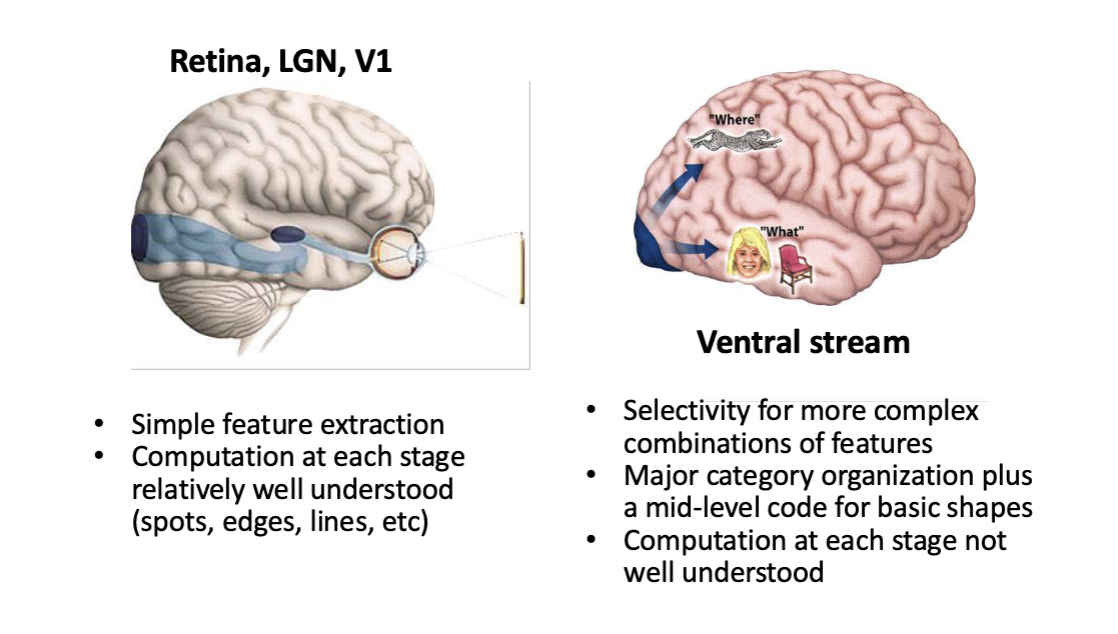
dorsal - towards the top of the brain towards parietal lobe (WHERE)
ventral - towards the bottom of the brain towards temporal lobe (WHAT)
LGN recognizes small dots, V1 orients the object, LOC grasps basic shape of object, VTC recognizes complexities of the object
V1 responds to any sort of visual information
LOC responds, specifically, to non-scrambled/mostly intact
prefers coherent structure
recognizes shapes
when LOC is damaged → visual agnosia
visual agnosia - condition in which a person can see but cannot visually recognize objects
patient with visual agnosia CANNOT VISUALLY recognize an object, but they recognize it if they bypass their damaged LOC, and pick the object of (interacting w the object)
simply put - they cannot interpret shape perceptually
TMS - trans cranial magnetic stimulation
giant magnet that disrupts neuronal processing
allows researchers to locate function
differs from fMRI and EEG as it directly stimulates brain function, then we observe brain function (causal)
TMS on LOC impairs ability to name objects but not ability to recognize faces
location processing in DORSAL (using lesions in monkeys)
object discrimination - find food under particular object (impaired by temporal lobe)
landmark discrimination - find food near landmark (impaired by parietal lobe lesions
location processing (PET - positron emission topography in humans)
dot location task - most activity in dorsal pathway
face matching task - most activity in temporal pathway
ventral (what), dorsal (where) has competing theory - Perception vs Action
dorsal - control of action (HOW one interacts with object)
ventral - conscious perception and object recognition (WHAT is the object)
woman could not match object to task perceptually but when asked to do the tasl (insert card in card slot), she could match objects
perceptual matching vs. active matching
this study suggests the dorsal stream, may have its own shape anlysis, meant to accurately guide attention and actions
pareidolia - seeing meaning that isn’t intended
ex) seeing faces in cars or outlets
occurs rapidly and effortlessly
humans love to detect faces quickly
false alarm better than missed social/threat cues
ex) mooney faces
faces present various info
ethnicity, age, gender, health, emotion
ventral stream has selectivity
fusiform face area (FFA)
selectively responds to faces
located in fusiform gyra
body area
parahippocampal place area (PPA)
LOC: things
4.2 (wed)
what happens w damage to fac eregions?
prosopagnosia - inability to recognize faces of those familiar
propagnosia
some acquire later in life due to damage, some people born with it (developmental prosopagnosia)
difficulty recognizing familiar faces, rely on other cues like voice or hairstyle
super recognizers
exceptionally strong ability to recognize faces
can identify people seen briefly or long ago
regions involved in face processing (face processing network)
fusiform face area
occipital face area
superior temporal sulcus
amygdala
occipital face area
in occipital lobe, recognizes parts of face ate early stages of face recognition
fusiform face area
in fusiform gyrus, responsible for holistic (configural) information, putting together all of processed pieces of the face
processes and judges spacing and configuration of of parts of face to determine identity
holistic face processing
once detected, faces processed as whole
face inversion effect - face recognition drops dramatically when faces are inverted
efficient perception - holistic face processing happens quickly without intention
margaret thatcher illusion - upside down pic w/ right side up eyes/lips
shows how FFA processes face identity holistically, with integrated parts
inverted faces stop holistic processes
composite face effect - recognizing halves of a mismatched face better when the halves aren’t aligned
superior temporal sulcus (STS)
involved with gaze, intention, dynamic faces, and biological motion
people with autism may look at mouth movement more than eyes/hair when watching a movie
amygdala - processes one’s own emotions and perceive emotions of others
nature v. nurture in facial recognition
nature (innate)
newborns prefer face like patterns over scrambled stimuli
face sensitivity appears early in life
nurture (learned)
face recognition strengthens in teen years
perceptual narrowing - infants become tuned to familiar faces
fovea - clear
focus of gaze determines which category-selective area will be formed
control group - monkeys looked at face
face-deprived - monkeys looked at hands
nature v nurture are BOTH required for facial processing
there is innate…
bias to pay attention to faces in infancy
specific parts of visual cortex specialized to represent objects in center of vision
there is experience in…
gaining lots of experience seeing faces in center of vision
specific part of visual cortex for selectivity of faces
further improvement both in behavior and in brain