cells and control
Mitosis:
Mitosis - a type of cell division where new genetically identical cells are created
This process is used to make body cells. The new cells are diploid. They have 23 pairs of chromosomes (46 in total).
Interphase - the first phase of cell division where cells makes extra cell organelles (such as mitochondria) and copies all of the chromosomes, allowing mitosis to occur.
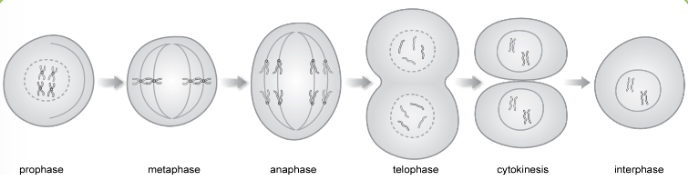
Prophase - spindle fibres form in the cell and the nuclear membrane starts to disappear
Metaphase - chromosomes line up in the middle of the cell
Anaphase - the chromosmes are pulled apart by the spindles
Telophase - the single chromosomes arrive at opposite ends of the cell and the membranes around each nucleus start to form again
Cytokinesis - the cytoplasm of the cell separates and the cell membrane divides the cell into two daughter cells
Interphase - the DNA in the cell is copied, making X-shapes each containing a chromosome and its copy, beginning the next cell division copy
Asexual Reproduction -
Some organisms can reproduce just using one parent. This produces offsprings that are genetically identical to the parent (clones). Examples are: strawberry plants as they use stems that grow along the ground (runners), potatoes as they use tubers and aphids as they reproduce much faster by asexual reproduction.
Tumors -
Normal cells divide when they need to. Sometimes they undergo uncontrollable cell division, turning them into cancer cells causing lumps of cells called tumours.
Growth in Animals:
Growth - an increase in the number of cells in an organism
Red Blood Cells -
Red blood cells carry oxygen around the body. They are adapted to carry oxygen as they have a large surface area for oxygen to pass through. They have no nucleus so that there is more room for red haemoglobin molecules.
Egg Cells -
Egg cells are the female sex cell. They are very large and contain a lot of cytoplasm.
Sperm Cells -
Sperm cells are the male sex cell. They have tails and are streamlined to swim towards the egg cell. The acrosome has enzymes inside to break through the outer egg coat. The cells have lots of mitochondria to make energy for movement.
Nerve Cells -
Nerve cells carry electrical impulses around the body. These cells can be very long to carry these messages all around the body.
Ciliated Cells:
Ciliated cells are found in the nose and throat. The cells have tiny hair like structures (cilia) which move dirt and mucus.
Fat Cells -
The cytoplasm of fat cells is filled with large fat droplets. The fat is stored until the body needs energy.
Muscle Cells -
Muscle cells contain special contractile proteins that can shorten the cell. Stretching and contracting allows movement in the organism.
Growth in Plants:
The variation that we see in plant is due to different types and arrangements of cells.
Root Hair Cell -
Absorbs minerals and water from soil
Large surface area to absorb lots of water
Thin cell wall to allow water to pass through easily
Doesn’t contain any chloroplasts unlike all other plant
Palisade Cell -
Carries out photosynthesis
Found in the top of the leaf
Tall and has a large surface area to catch as much sunlight as possible
Packed with chloroplasts to absorb sunlight
Contains the largest number of chloroplasts to carry out photosynthesis
Xylem Cell -
Involved in the movement of water through a plant
Xylem vessels consist of dead cells
They have a thick, strengthened cell wall with a hollow middle
Lose end walls so that the xylem forms a continuous hollow tube
Meristem Cell -
Undifferentiated cells in plants
Can give rise to any other types of cells
Found in zones where plant growth takes place i.e. shoots and roots
Elongate and divide to support the growth and development of new meristem cells
Stem Cells:
Stem Cell - a cell that hasn’t differentiated yet and can go on to become a number of different types of cells
Embryonic stem cells are found in embryos and can differentiate into almost every type of human cell. Adult stem cells can only differentiate into a few types of cells. Once a cell has differentiated, it cannot only turn into another type of cell.
Adult Stem Cells -
We have stem cells in our body e.g. in bone marrow there are three types of stem cell, one for blood, one for bone and one for skin. This is called multipotency and means there is a limit to what the stem cells can become. An advantage to using adult cells could be that tissues created from them won’t be rejected.
Embryonic Stem Cells -
Embryonic stem cells can differentiate into any kind of cell. They are pluripotent or totipotent.
Meristems -
In plants, stem cells are found in meristems. Plant stem cells are usually able to produce any kind of specialised cell throughout the life of the plant.
The Nervous System:
The Human Nervous System -
The nervous system is a highly organised system of nervous tissue that nervous tissue that detects, relays and co-ordinates information about an organism’s internal and external environment. All nervous systems contain nerve cells called neurones, which convey information in the form of nerve impulses. They can produce a rapid, localised response.
The CNS - controls the body (made up of the brain, spinal cord, nerves and sense organs)
Sense Organs - an organ that contains receptor cells
Receptor cells in sense organs detect changes in the surroundings (a stimulus). The body can then bring about the correct response to this.
Nose
Eyes
Ears
Tongue
Skin
The Nervous System -
The nervous system sends messages throughout the body as electrical signals called impulses. A travelling impulse is called a neurotransmission and happens in the neurones (nerve cells). There are several different types of neurones that have different roles in the CNS.
Modelling Neurones -
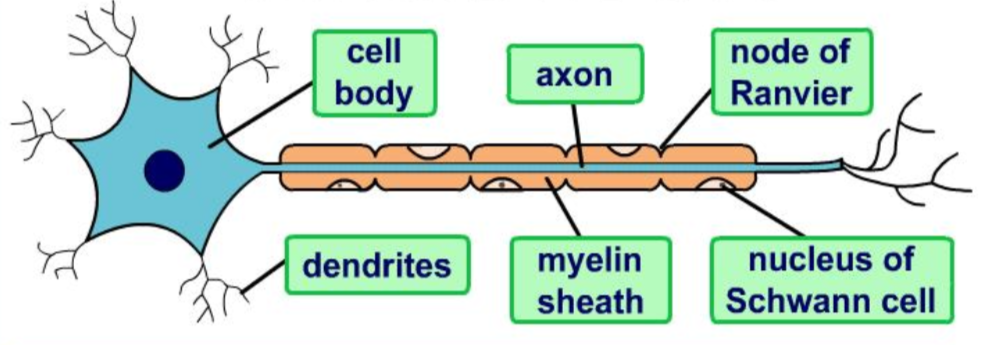
You can think of neurones as a wire. Each wire has a part that conducts electricity (axon) and a part that insulates the current (sheath). All the parts needed to detect and transfer the information (impulse) are found in the parts of a nerve cell (neurone).
Neurotransmission Speeds:
Effector - muscle/gland that carries out a response
Receptor - cells that detect changes in the environment
Stimulus - a change in the surrounding environment
Central Nervous System - controls the body
Different Neurones -
There are other types of neurones involved in the transmission of impulses around the body such as relay neurones and motor neurones.
Motor Neurones -
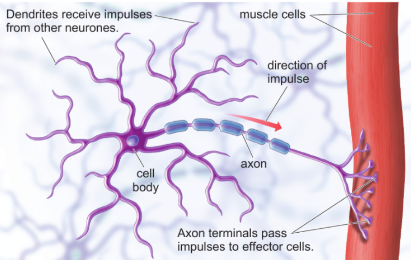
Carry impulses to effectors
No dendrons - dendrites on the cell body
Relay Neurones -
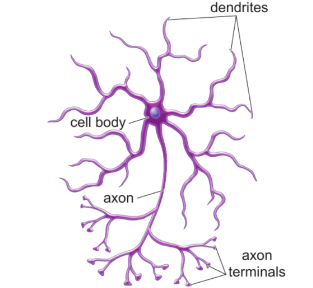
Short neurones found in the spinal cord, linking sensory and motor neurones as well as making up nerve tissue in the brain
No dendrons - dendrites on the cell body
Synapses -
Neurones meet each other at synapses, which contain a tiny gap. Synapses slow down transmission speed. However, synapses are useful because neutrotransmitters only released from axon entering impulse only flow in one direction. Synapses also allow many fresh impulses to be generated in many neurones connected to one neurone. The original impulse doesn’t need to split an lose ‘strength‘.
Electrical impulse reaches an axon terminal
A neurotransmitters substance is released and diffuses across the synapse
This is detected by the receptors/dendrites on the next neurone
This will generate a new electrical impulse
Reflex Arc -
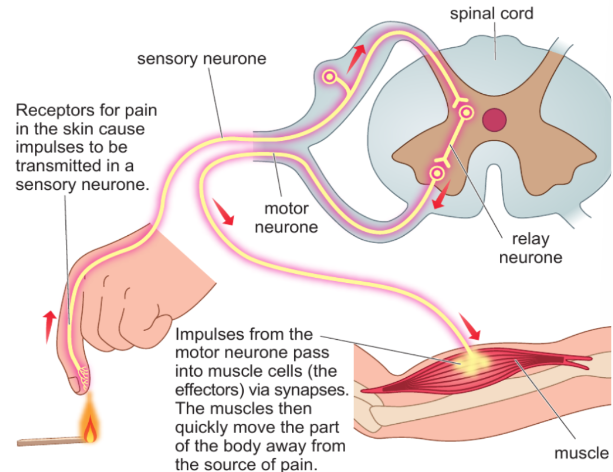
Stimulus - stepping on a pin
Impulse starts at receptor
Impulse passed along sensory neurone
Impulse passed along motor neurone
Effector receives impulse to react
Response - lift foot away from pin