Ecology Unit Test IB Biology
B4.1 Adaptations to Environment
Ecology- deals with the relationship between organisms and their interactions with their physical surroundings.
Organisms- any individual life form.

Habitat
the natural home or environment of an organism.
must provide all resources needed for survival and reproduction
Geographical location- location where habitat is.
latitude, longitude, climate
localized region of habitat
Physical location
describes the characteristics of geographical areas.
landforms, bodies of water, vegetation, and microhabitats.
Type of ecosystem - a broader ecological community where a species interacts with other species and an abiotic environment.
Natural Habitat- has no species cultivated by humans
Semi-natural Habitat- influenced by human activities, but most species are wild and not human cultivated.
Species- group of organisms that can reproduce and produce fertile offspring
Population- consists of one species in one location at one time
Community- formed by different populations of species interacting in a habitat
Relationships
Predator-Prey
Herbivory
Competition for resources
mutualism
parasitism
Ecosystem- location where a community of living organisms interact w/each other + abiotic (non-living) environment
Abiotic
air, minerals, light, climate
Adaptations- inheritable traits that allow for survival and reproduction
Natural Selection- Survival of the fittest. Environmental pressures → adaptations
Examples
Marram Grass- adapted to an environment where water is scarce. aka Xerophytes
Mangrove trees- adapted to living in waterlogged, anoxic ( no oxygen) soil with high concentrations of salt.
Things that affect organism distribution
temperature
pH
Available minerals
light
latitude
longitude
soil concentration
humidity
breedings sites
climate
aeration of soil
Shelford’s Law of Tolerance

organisms have optimal survival rates for abiotic factors. Less optimal range= less survival rate
Optimum range with maximum survival rates
Zones of stress with reduced survival rates
Zone of intolerance where organisms cannot survive
Belt Transects- used to investigate relationship btwn species distribution and abiotic factor.
used when there’s a gradual change from one side of a habitat to another.
transect- path where count and record amount of species of study
Biomes- large natural communities of organisms occupying a major habitat.
Tropical Forest
high temperatures, lots of rain year-round, no dry season, biodiversity
Adaptations
Chemical defenses: The leaves contain toxins to deter insects from eating them.
Large Leaves: maximize light absorption for photosynthesis.
Arboreal adaptations: Adaptations which allow the animal to live in the tree canopy include prehensile tails, grasping hands and feet, and strong limbs.
Temperate Forest
Four seasons, rich soul, diverse
Grassland
fertile soil, moderate rain, not many trees ( all grass), herbivores
Hot Desert
low precipitation, extreme temperatures, lack of water, rough environment
Adaptations
Deep root systems: Allow desert plants to access groundwater,
CAM physiology: A type of photosynthesis, where stomata remain closed during the day to reduce water loss by transpiration. The stomata open at night when it is cooler.
Thick waxy cuticles: Reduces water loss through evaporation from the plant.
Nocturnal Behaviour: Many desert animals are active at night when it is cooler,
Many desert animals produce concentrated urine or uric acid rather than urine to reduce water loss
Camouflage
Taiga
long cold winters, short mild summers, evergreens, permafrost/ soil sucks (no nutrients)
Tundra
coldest, no trees, permafrost, lack of biodiversity
Whittaker’s Climograph- Climate and Terrestrial Biomes

Whittaker’s Climograph predicts terrestrial biomes found in a location using mean annual temp. + mean annual precipitation.
Convergent Evolution
Evolution of similar features creating analogous structures ( not related but similar to similar environmental pressures)
B4.2 Ecological Niches
Ecological Niche- the role an organism plays in an ecosystem
Biotic + abiotic factors in a niche affect
growth
survival
ability to reproduce
mode of nutrition
interactions with other species and own species
Aerobes and Anaerobes
Obligate Anaerobes- Must live in oxygen-free environment to survive- anaerobic respiration
Facultative anaerobes- Can survive with or without oxygen. Anaerobic in absence, aerobic in presence.
Obligate aerobes- Need oxygen to survive. Aerobic respiration.
Photosynthesis
Using light energy + Co2+ water to create glucose and oxygen
how plants, algae, and photosynthetic prokaryotes feed themselves.
autotrophic- produce own food
Heterotrophic Nutrition
Can’t make own food, rely on other organisms for nutrition.
animals
Holozoic Nutrition
form of heterotrophic nutrition
ingest food → internally digest food→ absorb and assimilate nutrients of digested food
Mixotrophic Nutrition
Carry out photosynthesis (autotroph) and feed on others (heterotroph)
Obligate mixotrophs, which require both autotrophic and heterotrophic modes of nutrition to survive.
Facultative mixotrophs, which can switch between the two modes of nutrition based on available resources. They can obtain all of their required nutrients using either autotrophic or heterotrophic modes of nutrition.
Saprotrophic
Heterotrophs that obtain nutrients through external digestion ie bacteria and fungi (decomposers) through the use of enzymes, nutrients are absorbed through assimilation
Archea- all produce ATP
One of three domains of life- many live in extreme environments
prokaryotes- lack a nucleus, no membrane-bound organelles
Phototrophs: Some archaea use light energy to produce ATP. This is a different process than photosynthesis and no oxygen is produced.
Chemolithotrophs: Some archaea oxidize inorganic compounds to produce ATP. Different species of archaea use different inorganic compounds such as ammonia, nitrites and sulfur compounds.
Organotrophs: Some archaea oxidize organic compounds, such as sugars and fatty acids, to produce ATP.
Hominid - great ape family

Herbivores- mostly eat plants (have large flat teeth and strong jaws)
Omnivores- eat plants and animals (mix of flat molars and sharp teeth to eat meat)
Plant & Animal Adaptations
chemicals (spicy) to deter herbivores from eating. Some birds and and humans ignore it.
Tobacco plants produce toxin nicotine however caterpillars have evolved to detoxify the nicotine.
Grass walls are hard to chew for animals but some adaptations include flat molars for grinding and continuously growing teeth to prevent wearing out.
Predator and Prey
Predators hunt and kill prey for food.
Predator adaptations
sharp claws and talons
powerful jaws and teeth
speed and agility
camouflage
pack hunting and ambushing tactics
Prey adaptations
swift and agile
camouflage
mimicry- mimic environment to avoid detection. Mimic dangerous sounds to predators ie poisonous or unpalatable
toxic chemicals- ie bright poison frogs
traveling in groups and swarms to confuse predators and make an attack difficult.
alarm calls
nocturnal or diurnal- adapt to avoid when predators are most active
Fundamental and Realized Niches
Fundamental- a niche that an organism could potentially occupy in the absence of competition from another species. Determined by adaptations and zones of tolerance
Realized Niche- a niche an organism occupies due to competition from other species.
Competitive Exclusion
Competitive exclusion states that no two species can occupy the same niche.
Two species cannot exist in the same niche, as one will be better adapted for the niche, and will outcompete and exclude the other species from the niche.
The less well-adapted species will either be eliminated from the niche, or restricted to a part of the niche.
Competitive exclusion leads to species occupying their realized niche.
C4.1 Populations & Communities
Population: one species, one location at one time
same population= same species → interbreeding→ viable offspring
Reproductive Isolation: Barrier prevents reproduction → distinguished populations.
Sampling is used to estimate population size
Why? - Time, reduces destructive impact on environment, feasibility of counting
Representation, removal of bias, generalization
Random Sampling- random number generators to avoid bias
Quadrant Sampling- Ecology- deals with the relationship between organisms and their interactions with their physical surroundings.
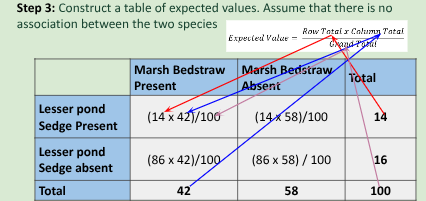
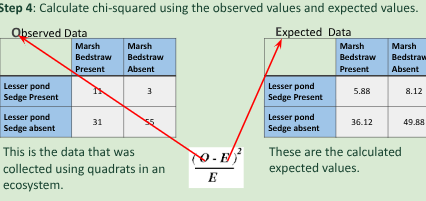
Test of Association two see if there is a relationship between two species
Positive Association: two species are more likely to be found together in an ecosystem (ie mutualisic)
Negative Association: two species are not likely to be found together. (species in competition bc they avoid each other)
Sessile animals remain in one place (ie corals)
Standard deviation- how spread out data is from mean
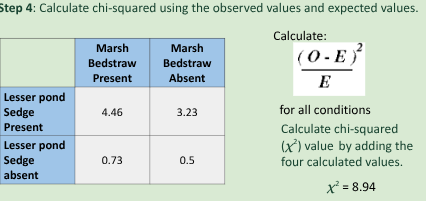
Chi- Squared Test of Association:
null hypothesis- P>5%, there is no significant difference
alternative hypothesis- P<5%, there is a significant difference

Organisms- any individual life form.
Capture- Mark-Release-Recapture

M= number of individuals initially caught and marked
N= number of individuals recaptured
R= Number of marked individuals recaptured
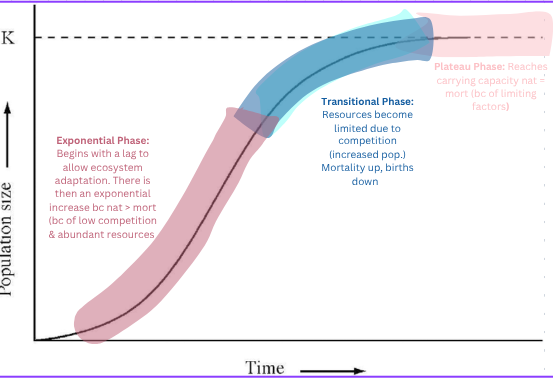
Carrying Capacity
the maximum population size of a species that can be supported long-term.
food + water, space, shelter, disease, predators, climate
Density- Independent & Dependent Factors
factors that affect population growth.
Density Dependent Factors: Cause population growth due to population density. Biotic
negative feedback- population increase→ decrease to carrying capacity due to density dependent factors
Competition, risk of predation, disease.
Population Growth Curves
Natality - birth rate
Mortality- death rate
Immigration- entering
Emigration- leaving
Change in population size = (N+I) - (M-E)
Exponential Growth- limited competition for resources
Sigmoid pop. growth curve- when a new species enters a new location
Intraspecific Relationships Competition vs. Cooperation
Intraspecific Competition: Competition for resources between members of the same species.
due to having the same ecological niche
increases bc of density dependent factors
mating, social dominance, territory
Intraspecific Cooperation: benefits all population members
increases resources access and predator protection
Group hunting, group foraging, defense against predators, parenting
Communities- formed by populations of different species living and interacting with each other in an ecosystem.
Invasive Species- alien species are introduced to an ecosystem but do not naturally occur there. If they cause harm the alien species → invasive, by replacing endemic aka native species by competitive exclusion.
Why do invasive species do better?
lack of predators
lack of disease
faster reproduction rate
larger size/ more aggresive
Out compete resources
Competitve Exclusion: no two species can occupy the same niche.
Intraspecific Interactions
Herbivory- eating plants, herbivores are animals that only ear plants.
Predation: Preying on other animals
Mutualism: close relationship between two organisms of different species, in which both benefit
Zooxanthellae algae have a mutalistic relationship with coral polyps. They produce nutrients, remove wastes and produce oxygen. The coral polyps in return provide protection and CO2
Symbiosis- close interaction between two different species
Parasitism- one species benefits but the other is harmed
Pathogencity- an organisms infects another species, causing disease.
Allelopathy- chemical release by one organism which influences the germination, growth, survival, or reproduction of another organism.
Top-Down and Bottom-Up Controls
Top Down- Pressures applied at higher trophic levels to control ecosystem dynamics.
top predator prevents prey overpopulation
ie Yellowstone Wolves→ bidiversity
Bottom Down- Resources available to producers, affecting the growth of producers
pop. growth at higher levels is impacted by producer availability.
-ie. algal blooms prevent algal population from increasing
A4.2 Conservation of Biodiversity
Biodiversity
Ecosystem diversity- variety of ecosystems found in an area or on Earth
Species diversity- number and relative abundance of species found within an ecosystem
Genetic diversity- variety of genes and alleles present in a species. High gene. diversity → higher nat. selection survival rate
Lumpers and Splitters
Lumpers- focus on similarities
Splitters- focus on differences