S4 - Barnes & Noble
Summary
Questions
1. What are the structural characteristics of the US bookselling industry before the advent of Amazon in 1996?
Supply chain related to this industry;
Author sells copyright to publisher (in exchange for 10-15% royalties), that can sell to wholesalers, who sells to retailers, who finally get to the end consumer.
OR publishers might sell directly to retailers
Some people are aggregated into communities (unis, schools, library users), so some publishers sell directly to these big organizations, who contain these users.
For US market:
Overall value of the market;
26 billion$
Growth; 5.4% (meh)
What is going wrong overall? Substitutes; video games, tv/vcr, gyms
Publishers:
+- 50k titles per year
40k publishers
20 publishers = 88% of sales
Simon & Schuster = 11% of market (top publisher). Why?
As an author, I’d like a big publisher. A publisher can bring awareness to the book (brand recognition)
Economies of scale in production (as compared to smaller publishers)
Bigger publisher = more bargaining power with wholesalers
How can smaller publishers still be in the market?
Level of specialization (in terms of language, genre, topic within the genre, etc.)
Lots of differentiation (can bring concentration or fragmentation)
Fragmentation lessens financial risk
Wholesalers:
Ave wholesaler connects publisher to retailer
Decreasing net profit and growth in the 90s
Ingram; over 50% of market shares
Offers volume-based discounts
Exist to lessen financial risk of publishers
Space/time logistics
Fragmentation leads to greater consolidation..
As a retailer, no longer need to go through wholesalers – can go directly to publisher
Serves to small independent bookstores.
Retailers:
Initially independent local bookstores
AQUISITIONS: B. Dalton is bought by Barnes & Noble (3rd retailer) and K-Mart bought Waldenbooks and then Borders
SELLING APPROACH: destination shopping rather than convenience to build traffic.
Encourage browsing (more time more sales).
Average transaction 20$ (double than small bookstores)
Independent bookshops still exist
Less commercial approach
BM brings less returns
Consumers:
Shift in def of the book itself (now it’s a good to be possessed & showcased rather than to just to be read)
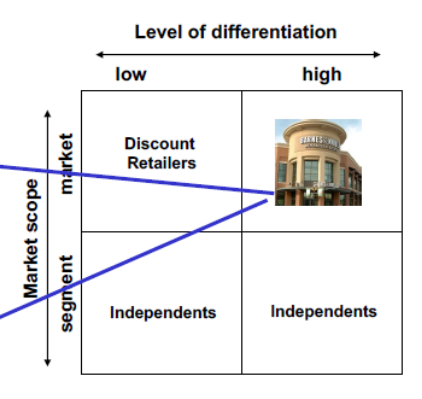
Superstores = new market standard
High level of differentiation and market scope
Ambience
Cafes
More books
More hours spent in store
Lower price for some categories
Larger number of options
2. What was originally the competitive advantage of B&N?
Front end:
Biggest retailer - size and quantity
Client loyalty (club, brand image)
Bundling
Experiential shopping
More W2B
Back end:
“in-sourcing” wholesale function (centralization of procurement)
IT system for interface between S, W and stores.
++ payment terms
3. How come Amazon was able to enter the market and consolidate its position in the late 90’s?
Front end:
Interface/software: easy to use, suggestions for customers, lists
Discounts
Back end:
IT and people
Relationship with wholesalers
Location and other connections (delivery operators)
4. What are the pros and cons of B&N and Amazon strategies at the beginning of the new millennium – i.e., end of the case narrative?
B&N;
Pros
Establish brand loyalty through community programs in their superstores
Connections to big brands (Starbucks, AOL, etc.)
Leverage on economy of scales
Leverage relationship with publishers and retailers
Cons
Huge costs in building new stores
Split focus – both developing its online and offline store
Bigger costs in general
Brand is narrowed to books – no possibility to expand without diluting their brand identity (with a big risk of failing)
Online sales is going to cannibalize store sales due to gigantic discounts. It’s like B&N is competing against itself
No connection between the online and offline operations – customers couldn’t even pick up purchases in their stores, or make orders from them
Amazon
Pros
“Sell all, carry few”
“Redecorate the store for every visitor”
Unprecedented ability to collect data on consumer preferences and history
Low return rates on books
Focus fast, cheap delivery (they are building own storage)
Allows them to expand - "web service first”
Knowledge of the online space – presence in other sites (Associated program)
Cons
Susceptible to shocks all along the supply chain
Difficult to access by older generations – those that are technologically illiterate
Risk: Even the biggest online website (AOL) only had 8mil users. It was still a small market, at that time nobody knew the internet would be the next best thing
Did not have a plan B (as opposed to B&N) – super risky strategy
How amazon evolved
New millennium - The everything store
Largest retailer - 47mil active accounts. Operates in 7 countries and active in 60+
Customer-centric - strong investment in IT and marketing
Only 9k employees
Inventory turn-around 16x a year
Reduced price elasticity to -0.45 (B&N -3.5)
The cloud company
AWS
Amazon prime videos
1.6mil employees
Core Takeaways:
Three reciped for a great business idea:
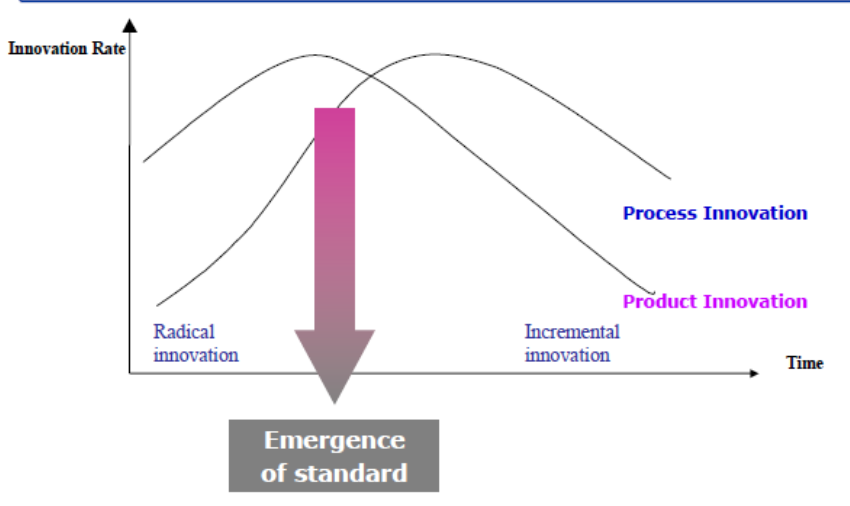
Evolution of industries across standards can be competence-enhancing or destroying
Entrants have an advantage in case of competence-destroying change
It takes time and effort for a standard to subsitute its predecessor
Evolution of industries across standards can be competence-enhancing or destroying
Amazon has brought in competences that were profoundly different from the rest. It’s much better to be a start up than an incumbent in this case. Probability that you will be able to sustain the radical change (as Nokia or Blackberry with the smartphone).

Entrants have an advantage in case of competence-destroying change
The entrants can be:
Competitors from other businesses with useful know-how
Newly founded startups
It takes time and effort for a standard to subsitute its predecessor
There are no standards in the market until the standard is demonstrated by the winner of the competition in radical innovation processes. What matters is the effort of the entrepreneurs that they put into the market, with the agility to move into it.
In certain markets, emergence of a new standard can be fast because the industry has a constant pacing of new standards (videogames)
In other markets, it takes more time (pharma)
In general, no one knows if a standard will become a standard. A standard is “de facto” and “ex post”, not “ex ante”
Abernathy and Utterback (1978):