FORCES
Forces and their interactions
Scalar and Vector quanitities
Scalar quantities only have magnitude
some examples include speed and distance
vector quantities have both magnitude and direction
some examples include velocity, displacement and accelaration
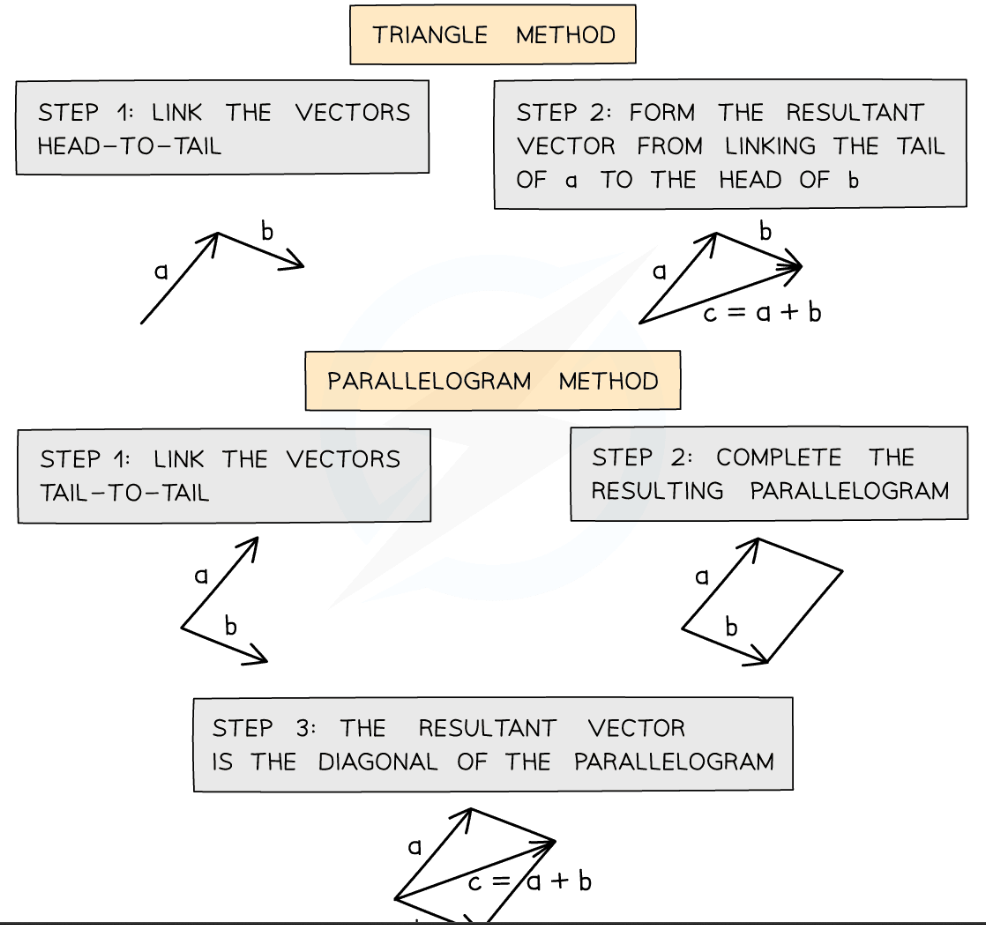
Vector diagrams
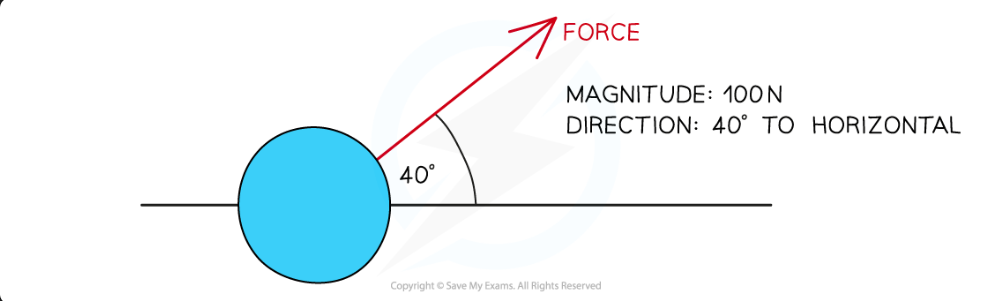
Not all forces are perfectly horizontal and vertical so it is important to indicate their angle
Contact and NON contact forces
A force is a push or a pull that causes an object to start moving or speed up, change shape or direction, due to interactions with other objects. Forces are VECTOR quantities.
There are 2 types of forces:
contact forces - when objects are physically touching, some examples include: friction, tension (The force experienced by a cable, rope, or string when pulled, hung, rotated or supported), upthrust (The upward buoyancy force acting on an object when it is in a fluid) air resistance and normal contact force (The force arising when an object rests against another object acting at a 90° angle to the plane of contact)
non contact forces - when objects are physically separated, some examples include: magnetism, electrostatic forces and gravity
Force pairs
this is when there is an interaction between two objects, a force is exerted on each object
some examples of force pairs are:
The downwards force due to the weight of a laptop resting on a desk, the desk exerts a normal force back up on the laptop
The tension force exerted along a cable to a suspended object is opposed by the force of the weight of the object
see newtons third law
Gravity
Gravity is the force of attraction between all objects. Weight is the force acting on an object due to gravity. This is a non contact force.
W (N) = m (g) x g (N/kg)
Weight is seen to act from one single point, which is called the centre of mass.
Resultant Forces
A number of forces acting on an object can be represented by a single force that has the same effect as all the original forces acting together
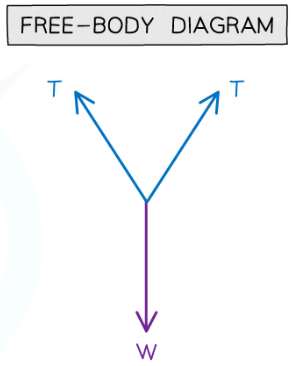
If all the forces acting on an object is balanced, the resultant force is 0
Work done and Energy Transfer
When a force causes an object to move through a distance work is done on the object. So a force does work on an object when the force causes a displacement of the object.
W (J) = F (N) x s (m)
One joule of work is done when a force of one newton causes a displacement of one metre. (1 joule = 1 newton - metre)
Work done against the frictional forces acting on an object causes a rise in the temperature of the object.
Forces and elasticity
For stationary objects, more than one force has to be applied to change their shape., if only one force was acting on an object the object would just move in the direction of the forc. eAn elastic material always returns to its original shapes when the forces acting on it are taken away. this can be done by
Compression = forces act towards eachother. The two forces are:
The weight of the mass
The reaction force from the surface to the spring
Stretching = forces act away from eachother. the two forces are:
The weight of the mass
The tension in the spring
Bending = These two forces act towards each other, but at different points on the object. Bending can also be caused by two forces at an angle to each other. the two forces are:
The weight of the swimmer
The reaction force from the block to the dividing board
elastic deformation = when objects return to their same shape after the stretching force is taken away (rubber bands, erasers, metal springs)
inelastic deformation = when objects remain stretched and dont return back to the same shape even after the force applied has been taken away (plastic, clay and glass)
Hooke’s Law
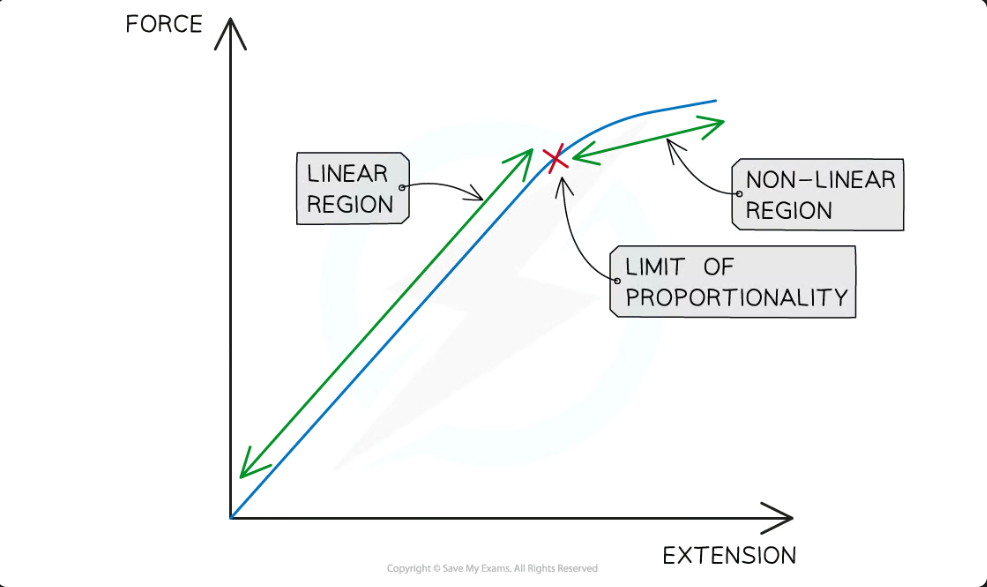
The extension of an elastic object is directly proportional to the force applied, up to the limit of proportionality
Required practical: Stretching a Spring
Set up the apparatus as shown in the diagram, initially without any masses hanging from the spring
Align the marker to a value on the ruler, record this initial length of the spring
Add the 100 mass hanger onto the spring
Record the mass (in kg) and position (in cm) from the ruler now that the spring has extended
Add another 100 g to the mass hanger
Record the new mass and position from the ruler now that the spring has extended further
Repeat this process until all masses have been added
The masses are then removed and the entire process repeated again, until it has been carried out a total of three times, and an average length is calculated
Sources of error,
Make sure the measurements on the ruler are taken at eye level to avoid parallax error
The accuracy of such an experiment is improved with the use of a pointer (a fiducial marker)
safety
Wear goggles during this experiment in case the spring snaps
Stand up while carrying out the experiment making sure no feet are directly under the masses
Place a mat or a soft material below the masses to prevent any damage in case they fall
Use a G clamp to secure the clamp stand to the desk so that the clamp and masses do not fall over
As well as this, place each mass carefully on the hanger and do not pull the spring too hard that it breaks or pulls the apparatus over
Moments levers and gears
If an object is balanced, the total clockwise moment about a pivot equals the total anticlockwise moment about that pivot.
pressure
The pressure in fluids causes a force normal (at right angles) to any surface.
The atmosphere is a thin layer (relative to the size of the Earth) of air round the Earth. The atmosphere gets less dense with increasing altitude.
Air molecules colliding with a surface create atmospheric pressure. The number of air molecules (and so the weight of air) above a surface decreases as the height of the surface above ground level increases. So as height increases there is always less air above a surface than there is at a lower height. So atmospheric pressure decreases with an increase in height.
Students should be able to:
Forces and Motion