Fate and Free Will
Philosophy can be defined in many ways, but one way to describe it would be that Philosophy is thinking hard about what science is not yet able to get to. Such as explanations on the concept of Life and Death.
Fate and Free Will is a type of Philosophy and seeks to determine the amount of autonomy we as people actually have in our lives. There are multiple explanations for Fate such as;
Determinism this is the theory that everything is caused by what came before it. Your actions are predictable reaction to current events.
Control by an Omnipotent being such as God, different from determinism due to the fact that there is manipulation instead of mere awareness of the future decision
There are also multiple explanations for Free Will
That you have complete Autonomy and your choices are not forced, this is called Libertarianism
Leeway Freedom, meaning that the major life choices are already decided, but you have the freedom to choose minor things such as whether or not you’ll have fries with your burger.
Important Vocabulary
Compatibilism: The belief that Fate and Free Will can work together
Incompatibilism: The belief that Fate and Free Will cannot work together
Argument: An ordered series of prepositions, the last of which (the conclusion) is supposed to follow from those preceding it (the premises)
Valid: The truth of the premises logically guarantees the truth of the conclusion; it is impossible for the premises to be true and the conclusion is false
Sound: The argument is valid and the premises are true
Other Evaluations can include Persuasive, Elegant, Concise, and Powerful
Seeming: This is when something seems to be a very certain way
X-phi: Simplified way to state visually Experimental Psychology
Surface Freedom: This is the type of freedom that refers to the ability to always do whatever you want
Deep Freedom: This is the type of freedom that allows the user to have complete control over their wills or desires
Near-determinism: This is when the behavior of all middle-sized objects is determined for all practical purposes
One important distinction to make is that being free from determinism does not necessarily make you free because it opens the door to the possibility that the universe is just a bunch of random actions. Chance does not equal freedom because random acts can still be out of our control.
Fatalism: Whatever happens is unavoidable, even though there was the illusion of choice or deliberation before events played out as they were always supposed to
Time indexed propositions don’t change their truth-value
Philosophy Symbols
◇ - Possibly
□ - Necessity
~◇ - not possible
Np - P and no one has any choice about whether P
The law of the excluded middle means that every claim is either true or false there is no in-between. There is no maybe, it was true 100 years ago that Trump would be president in 2017 and will be true 100 years from now.
Improved Fatalist Argument
“Fixity of the past”
1) At t1 it was true that you will perform act A at t2
2a) You have no choice about the past
2b) You have no choice about the fact it was true at t1 that you will perform act A at t2
2c) It being true at t1 that you will perform act A at t2 logically implies that you will do act A at t2
3) You have no choice about doing act A at t2
Counterfactual Power of the Past
We can’t change the past, can’t rewind time, the past is done with
However, we can still resist the fixity of the past argument about the future
Counterfactual: A counterfactual is a concept in philosophy and logic that refers to a conditional statement discussing what could have happened if certain conditions were different. It often takes the form "If X had occurred, then Y would have occurred," exploring alternative outcomes to events that did not happen. Counterfactuals are used in various fields, including history, economics, and psychology, to analyze causality and decision-making.
An action done of free will means you could have chosen to not do the action, however if you could have had not done the action the truth about the action from the past would have in turn also been different.
The counterfactual does not enable a changing past, we have the freedom to choose, but our decisions would have been true 2,000 years ago due to the Law of the Excluded Middle. Claims don’t create futures, the would explains the truth value of a claim.
Compatibilism
Compatibilism is the philosophical view that free will and determinism are compatible. Here are some types:
Soft Compatibilism: Argues that free will exists even if determinism is true, focusing on internal motivations.
Hard Compatibilism: Asserts that determinism is true and that free will is an illusion, but moral responsibility still exists.
Event Compatibilism: Emphasizes that free actions are determined by prior events and conditions.
Agent Compatibilism: Focuses on the role of agents in making choices, regardless of determinism.
Each type addresses the relationship between free will and determinism differently.
Another way to describe compatibilism is “Soft Determinism” because FW & Determinism.
The 2 types of Incompatibilism are "Libertarianism” because FW & ~Determinism, and “Hard Determinism” because ~FW & Determinism.
There are two conditions to being free as defined by Kane. First, you need to have the power or ability to do what you want. Second, you need to have no constraints or impediments to this power/ability. For example, a Heroin addict is not free due a compulsion impediment. When looking at the chain of action/desire, (a→d) if the action is immediately after a desire the act is free.
One of the main differences between classical and new compatibilists (1970s-present), is that the classical compatibilists focus more on how Moral Responsibility and Determinism link. The new compatibilists say that leeway is not important for freedom/determinism.
Conditional: if this → then that
Compatibilism believes that if someone had wanted to do otherwise then they would have done otherwise. It also believes in surface freedom meaning true freedom. Desires caused by events, Desires influencing our actions. Deep freedom is apparently incoherent. it requires the same past and different futures. Same motives, considerations, reasons. If you have different reasons, different past, only then can the future be different. They also argue that Incompatibilism is that intuitive thought, but if you stop and think about it, compatibilism makes sense.
Incompatibilism
The 2 main arguments for Incompatibilism are the “Intuitive “7 Cases”” and “Consequence Argument”
In are premise (if…then…), the “if” is called the Antecedent and the “then” is called the Consequent
Conditional Proof: Assume something P, use to derive Q, drop assumption and claim P→Q
If the laws are deterministic God cannot interfere because the present is caused by the past & laws.
Peter Van Inwagen’s version of the “Consequence Argument”
N(Past)
N(Laws)
∴N(Past & Laws)
□(Past & Laws) → Future
Rule Alpha: □(x) → N(x)
∴N(Past & Laws) → Future
Rule Beta: N(x) & N(x-y) → N(y)
∴N(Future)
If determinism is true, we can’t do otherwise. This conclusion is incompatibilism, assuming that free will requires the ability to do otherwise.
Transient: Affecting something beyond itself
Immanent: Operating within itself
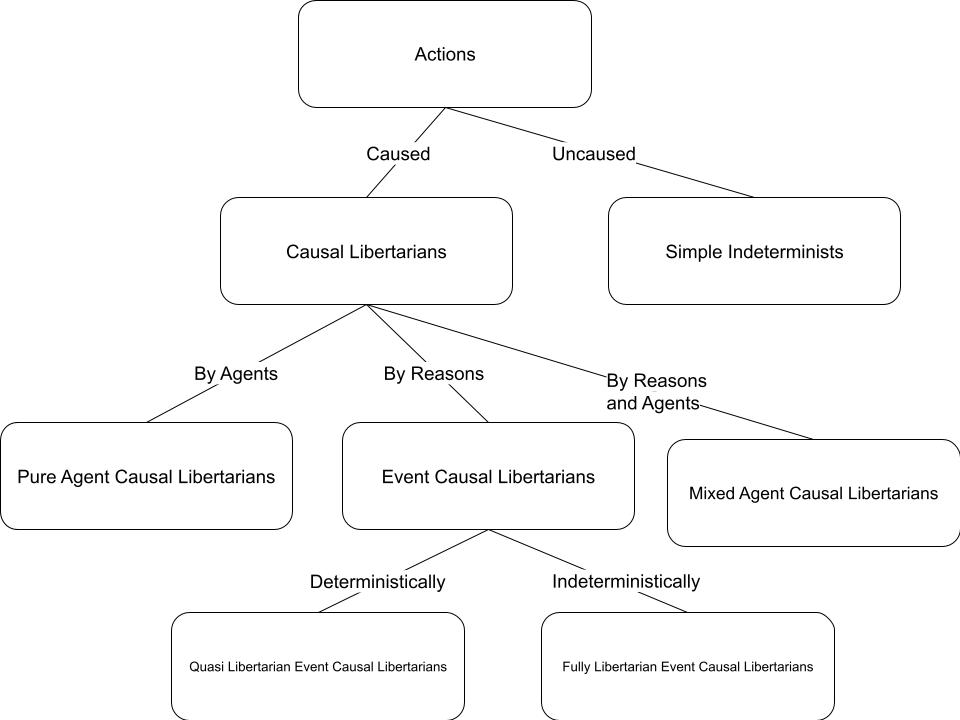
There are 5 types of Libertarians
Simple Indeterminists: Reasons aren’t causes, actions are uncaused
Pure Agent Causal Libertarians: Reasons are causes
Mixed Agent Causal Libertarians: Reasons and Agents are both causes
Quasi Libertarian Event Causal Libertarians: Reasons determined by actions, however the reasons are undetermined
Fully Libertarian Event Causal Libertarians: Reasons cause but don’t determine actions, which are up to the agent