MATRICES
📌 MATRICES – MINI STUDY GUIDE (IT2212)
1⃣ What is a Matrix?
According to page 1:
A matrix is a rectangular array of numbers arranged in:
Horizontal rows (m)
Vertical columns (n)
It is written inside brackets or parentheses.
📐 Order of a Matrix (m × n)
Order = rows × columns
Example from handout:

Rows = 3
Columns = 3
So order = 3 × 3
🧠 Entry Notation (Very Important!)
Entry notation: AijA_{ij}Aij
i = row number
j = column number
Example:
A₂₃ = element in row 2, column 3
In the example above → that’s 6
✨ This part is important kasi exam loves asking specific entries.
2⃣ Types of Matrices
From page 1–2
🔹 Column Matrix
All elements in one column.
Example:
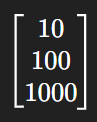
Order: 3 × 1
🔹 Row Matrix
All elements in one row.
Example:
[2 4 6 8 10]
Order: 1 × 5
🔹 Square Matrix
Same number of rows and columns.
Example:
2 × 2, 3 × 3, etc.
🔹 Zero Matrix
All entries are zero.
🧠 Quick Memory Trick:
CRSZ
Column
Row
Square
Zero
3⃣ Matrix Equality
From page 2
Two matrices are equal if:
Same size
Corresponding entries are equal
If even one entry differs → NOT equal.
✨ Size must match first. No debate.
4⃣ Matrix Operations
A️⃣ Matrix Addition & Subtraction
Rule:
Must have SAME dimension
Add/subtract corresponding entries
Example logic:

🚫 Common Mistake:
3×2 + 2×3 = ❌ Not allowed
🧠 Memory Trick:
“Same size, then combine.”
B️⃣ Matrix Multiplication
Two types:
1⃣ Scalar Multiplication
Multiply every entry by a number.
Example (page 2)
2A = multiply every entry by 2.
Simple lang ‘to. Walang drama.
2⃣ Matrix × Matrix Multiplication
This one is tricky.
Rule:
Columns of first = Rows of second
If:
A = m × n
B = n × p
Then:
AB = m × p
🧠 Golden Rule:
Inside numbers must match.
Example from page 3
2×3 multiplied by 3×2 → allowed
Result = 2×2
How to Multiply?
Row of A × Column of B
Multiply → Add → Done
5⃣ Transpose of a Matrix
From page 3
Transpose = switch rows and columns.
If A is 3×2
Then Aᵀ is 2×3
Think:
Flip across diagonal.
6⃣ Identity Matrix
A square matrix with:
1’s on main diagonal
0’s elsewhere
Example:

Acts like number 1 in matrix multiplication.
A × I = A
7⃣ Determinant of a Matrix
Only for square matrices.
🔹 2 × 2 Determinant

Formula:
ad − bc
Super important. Lalabas ‘to sa exam.
🔹 3 × 3 Determinant
Use expansion formula from page 3
Multiply first row with 2×2 minors.
Medyo mahaba computation, but follow pattern carefully.
8⃣ Inverse of a Matrix
A⁻¹ is the matrix that satisfies:
A × A⁻¹ = I
From page 3–4
Formula:

Where:
|A| = determinant
adj(A) = transpose of cofactor matrix
Steps to Find Inverse (3×3)
Step 1: Find matrix of minors
Step 2: Convert to cofactor matrix (apply + − pattern)
Step 3: Transpose → adjoint
Step 4: Multiply by 1/determinant
✨ If determinant = 0 → NO inverse.
Remember that.
🧠 Memory Trick:
M C A D
Minor
Cofactor
Adjoint
Divide by determinant
9⃣ Solving Systems Using Matrix Algebra
From page 4–5
Given:
A V = B
To solve for V:
V = A⁻¹ B
Steps:
Form coefficient matrix A
Form variable matrix V
Form constant matrix B
Find A⁻¹
Multiply A⁻¹ B
Final answer gives values of x, y, z.
In the example:
x = 2
y = 3
z = -1
💡 COMMON EXAM TRAPS
❌ Forgetting dimension rule in multiplication
❌ Forgetting determinant must not be zero
❌ Mixing up minor and cofactor
❌ Forgetting transpose step
🧠 FINAL RECAP (Memory Hacks Mode)
If you remember nothing else, remember this:
1⃣ Matrix Basics
Order = rows × columns
Entry Aij = row i, column j
2⃣ Operations Rules
Addition → same size
Multiplication → inner numbers must match
3⃣ Determinant
2×2 → ad − bc
Only square matrices
4⃣ Inverse Steps
MCAD
Minor → Cofactor → Adjoint → Divide
5⃣ Solving Systems
A V = B
Multiply by A⁻¹
V = A⁻¹ B
⚡ 30-Second Master Summary
A matrix is a rectangular array of numbers.
You can add matrices of the same size, multiply if dimensions match, find transpose by flipping rows and columns, compute determinants for square matrices, and find inverses using minors, cofactors, and adjoint.
Systems of equations can be solved using matrix inverse.