Chapter 10: Biosocial Approaches
Learning Objectives
10.1: Explain that while all behavior is the result of genes interacting with environments; there is no gene “for” crime
10.2: Identify the basis of heritability and what it tells us about the gene-environment correlation and interaction
10.3: Describe how the brain “softwires” itself by experience
10.4: Discuss the basic ideas behind an evolutionary view of criminology
10.5: Describe multiple biological risk factors for criminology
10.6: Assess the biosocial perspective
10.7: Compare the policy implications of biosocial criminology
Biosocial Approach
Biosocial theories have not been popular with the mainstream social scientists until relatively recently
There are still people who fear that “biological” theories can be used for nasty purposes
Christopher Shea (2009), is that “with study after study finding that all sorts of personable characteristics are heritable—along with behaviors shaped by those characteristics—a see-no-gene perspective is obsolete”
Biosocial criminologists maintain that because humans have brains, genes, hormones, and an evolutionary history, they should integrate insights from the disciplines that study these things into their theories and should dismiss naive nature versus nurture arguments in favor of nature via nurture
Any trait, characteristic, or behavior of any living thing is always the result of biological factors interacting with environmental factors which is why we call modern biologically informed criminology biosocial rather than biological
The early positivists were biosocial in approach because they explicitly envisioned biological and environmental interaction
Their ideas and methods were primitive by today’s standards, but then so were the ideas and methods of most sciences during the 19th century
Behavioral Genetics
Behavioral genetics: A branch of genetics that studies the relative contributions of heredity and environment to behavioral and personality characteristics
Genotype: A person’s genetic makeup
Phenotype: The observable and measurable behavioral and personality characteristics of any living thing as a result of genes interacting with the environment
Genes: Strands of DNA that code for the amino acid sequences of proteins
There are no genes “for” criminal behavior, but there are genes that lead to particular traits, such as lower empathy and impulsiveness, that increase the probability of criminal behavior when combined with certain environments
Biosocial criminologists use twin and adoption studies that make use of genetic relatedness to disentangle the relative influences of genes and environments
Gene expression always depends on the environment
Behavioral geneticists study phenotypes and decompose the total variance in those phenotypes into their three constituent parts: heredity, the shared environment, and the nonshared environment
Variance is a concept that qualifies the differences observed in an outcome of interest
Heritability: A concept defined by a number ranging from 0 to 1 indicating the extent to which variance in a phenotypic trait in a population is due to genetic factors
All cognitive, behavioral, and personality traits are heritable to some degree
Just because a trait is heritable does not mean that the environment is not involved in the development and expression of a trait
The environmental effects on a trait are divided into shared and nonshared
Shared environment: The environment experienced by children reared in the same family (parental SES, religion, values and attitudes, parenting style, family size, intactness of home, and neighborhood) assumed to make them similar
Nonshared environment: That part of the environment referring to the unique experiences that make children from the same family different
It is consistently found that shared environmental effects on cognitive and personality traits, although moderate during childhood, disappear almost completely during adulthood
The nonshared features of the environment appear to be much more salient than the shared environment with respect to the formation of an individual’s personality and cognitive traits
Gene-Environment Interaction and Correlation
Gene-environment interaction and gene-environment correlation describe people’s active transactions with their environment
All living things are designed to be responsive to their environments
Gene-environment interaction: The interaction of a genotype with its environment: People are differently sensitive to identical environmental influences because of their genes and will thus respond in different ways to them
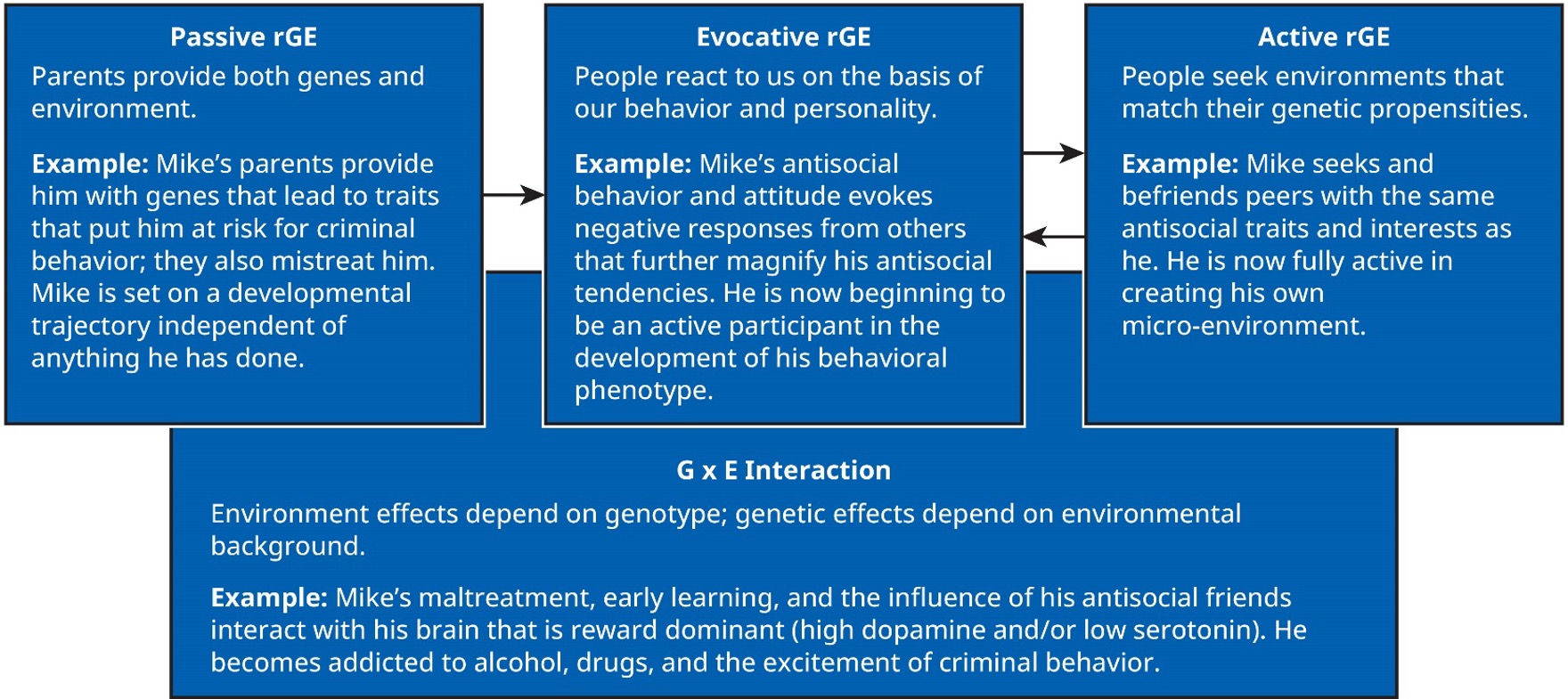
Gene-environment correlation: The notion that genotypes and the environments they find themselves in are related because parents provide children with both
Passive rGE is the positive association between genes and their environments due to biological parents providing children with genes linked to certain traits and an environment favorable for their expression
Evocative rGE refers to the way others react to the individual based on his or her evocative behavior
Active rGE refers to the active seeking of environments compatible with our genetic dispositions
Figure 10.1: Illustrating Passive, Evocative, and Active rGE and G × E Interaction
Behavioral Genetics and Criminal Behavior
Behavioral genetic studies are of immense importance in helping to better understand traditional criminological theories
Genes contribute to the choices people make as well as make them easy or difficult to live with
One of those factors influencing choices is low self-control
In terms of differential association theory and its concern with peer effects, Cleveland, Wiebe, and Rowe (2005) found that genetic factors accounted for 64% of the variance in delinquent peer affiliation
Unlike the relatively strong genetic influences discovered for most human traits, genetic influence on antisocial behavior is modest during the teenage years
Heritability coefficients for most traits related to antisocial behavior are typically in the 0.30 to 0.80 range, and for antisocial behavior itself they are in the 0.40 to 0.58 range with h2 higher in adult populations than in juvenile populations
Crime and delinquency are the results of traits interacting with incentives and disincentives as well as how well one has learned one’s moral lessons
Strong genetic effects on antisocial behavior are most likely to be found among those who chronically offend who begin offending prior to puberty, continue to do so across the life course, and commit a disproportionate number of serious offenses
Molecular Genetics
Heritability estimates tell us that genes are contributing to a trait, but they do not tell us which genes; only molecular genetics can tell us this
We get our genes from our parents, who might both provide us with the same or different version of the same gene called an allele
Allele: An alternate form of the same gene, for example, a “blue” allele versus a “brown” allele of the gene coding for eye color
Molecular genetic studies are being conducted with increasing frequency in criminology, with the huge National Longitudinal Study of Adolescent to Adult Health (Add Health) yielding some very important findings
Although we get only one allele from each parent, most genes have many allelic variations geneticists call genetic polymorphisms
Genetic polymorphisms: Variations in the same gene allele (alternate form of a gene) such as SNPs and VNTRs
A major longitudinal study of maltreatment looking at the role of the MAOA gene showed why only about one-half of abused or neglected children become violent adults
The MAOA gene comes in variants that geneticists call “high” and “low” activity
The overall conclusion arrived at by a meta-analysis of the MAOA/maltreatment research was that their interaction is a significant predictor of antisocial behavior across all studies
There are many other genetic polymorphisms related to traits associated with antisocial behavior examined by biosocial criminologists
The Neurosciences
Softwiring the Brain by Experience
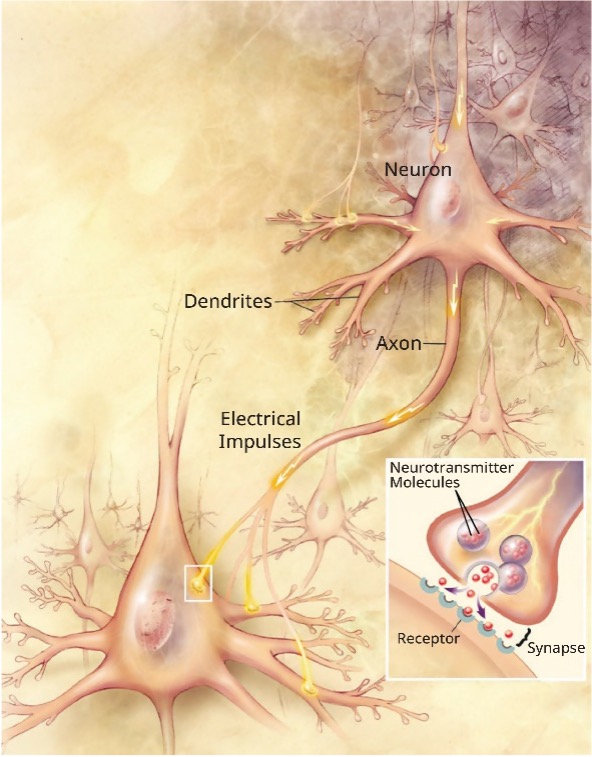
All our thoughts, feelings, emotions, and behaviors are the result of networks of billions of brain cells called neurons communicating with one another through substances called neurotransmitters
Neurons: Brain cells consisting of the cell body, an axon, and a number of dendrites
Neurotransmitters: Brain chemicals that carry messages from neuron to neuron across the synaptic gap
Figure 10.2: Neurons, Axons, Dendrites, and the Synaptic Process
Neuroscientists differentiate between two processes of brain development: experience expected and experience dependent
Experience-expected mechanisms are hardwired and reflect the history of the brain in our species
Experience-dependent mechanisms reflect the history of each person and the brain’s ability to adjust itself to the environment
The capacity for language is entirely genetic but what language(s) a person speaks is entirely cultural
Experience-expected processes have evolved as the brain’s readiness during certain critical periods for us to incorporate environmental information that is always present in its natural environment
Experience-dependent brain development depends on our experiences
The brain literally wires itself in ways directly reflecting the experiences of its “owner”
Experience-dependent wiring ensures that neutral networks will be continually made and selected for retention or elimination in a “use it or lose it” fashion
As Perry and Pollard (1998) point out, “Experience in adults alters the organized brain, but in infants and children it organizes the developing brain”
Reinforcement Sensitivity and Prefrontal Dysfunction Theories
The basis of Sigmund Freud’s id, ego, and superego was the realization that if social animals are to function normally in their social groups, they must be able to respond to signals of reward and punishment with the socially appropriate approach and avoidance behavior
Reinforcement sensitivity theory: A neurological theory based on the proposition that behavior is regulated by two opposing mechanisms, the behavioral activating system (BAS) and the behavioral inhibition system (BIS)
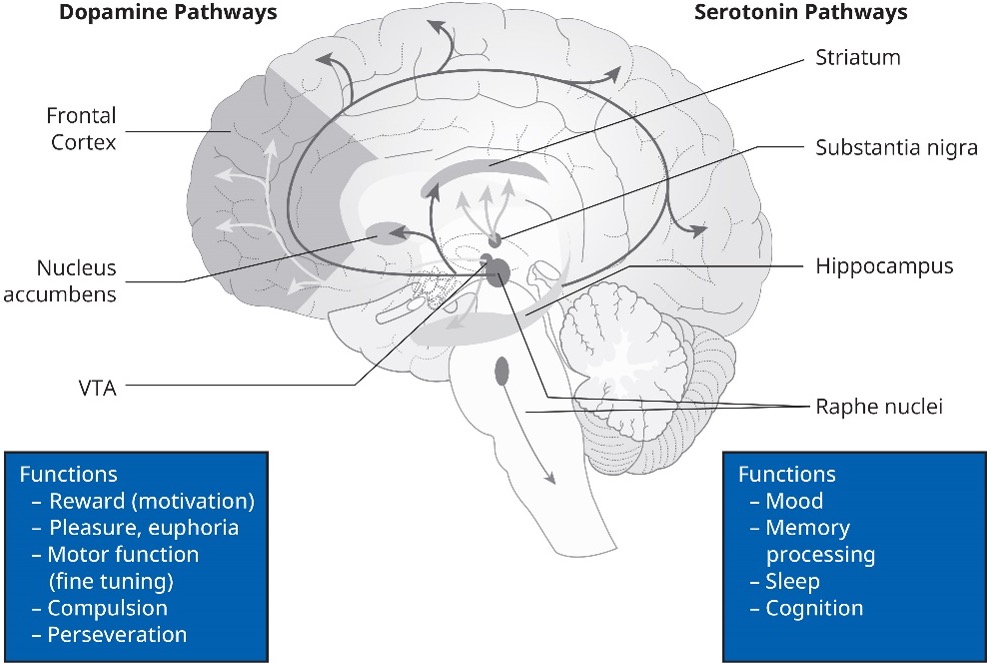
Behavioral inhibition system: Inhibits or modulates behavior and associated with serotonin
The BAS is sensitive to reward (just like Freud’s id) and can be likened to an accelerator motivating a person to seek rewarding stimuli
The BIS is sensitive to threats (like the superego) and can be likened to a brake that stops a person from going too far too fast
A normal BAS combined with a faulty BIS, or vice versa, may lead to a very impulsive person with a “craving brain” that can lead him or her into all sorts of physical, social, moral, and legal difficulties by becoming addicted to pleasures such as food, gambling, sex, alcohol, and drugs
Figure 10.3: Major Dopamine (Light Gray) and Serotonin (Black) Pathways in the Brain
In some people one system might dominate the other most of the time
A third system of behavior control is the flight/fight/flee system (FFFS)
Flight/fight/flee system: An autonomic nervous system mechanism that mobilizes the body for action in response to threats by pumping out epinephrine
Another neurologically specific theory of criminal behavior is prefrontal dysfunction theory
Prefrontal cortex: Occupies about one-third of the pront part of the brain’s cerebrum. It has many connections with other brain structures and plays the major integrative and supervisory roles in the brain
PET and fMRI studies consistently find links between PFC activity and impulsive criminal behavior
Evolutionary Psychology
The Usefulness of an Evolutionary Framework
Evolutionary psychology: A way of thinking about a human behavior using a Darwinian evolutionary theoretical framework
Criminologists operating within this framework explore how certain behaviors that society now calls criminal may have been adaptive
Adaptive behavior: Any behavior that contributes directly or indirectly to an individual’s survival and reproductive success
These two evolutionary “goals” are common to all sexually reproducing organisms and are thus subject to natural selection
Evolutionary psychology complements genetics because it informs us how the genes of interest came to be present in the human gene pool in the first place
Evolutionary theory explains why there are consistent behavioral patterns among humans across cultures
The only thing different cultures across the globe share that could explain these consistent behavioral patterns is an evolutionary history
Ultimate causes are causes that occurred in the past that are ultimately responsible for something, whereas a proximate cause is one that is most immediately responsible causing some observed behavioral outcome
Evolutionary psychologists agree with most criminologists that although it is morally regrettable, crime is normal behavior for which everyone has the potential
Criminal behavior is a way to acquire resources illegitimately, and the traits Harris mentions are most useful in that regard
Evolutionary scientists refer to such behavior (whether it is defined as criminal or not) as cheating and think of individual traits associated with is such as impulsiveness and aggression in terms of adaptive traits that all humans share at varying levels
Cooperation is typically contingent on the reciprocity of others and is thus a tit-for-tat strategy favored by natural selection because of the benefits it confers
Because cooperation occurs among groups of other cooperations, it creates niches for noncooperators to exploit others by signaling their cooperation and then failing to follow through
Cheats: Individuals in a population of cooperators who gain resources from others by signaling their cooperation and the defaulting
The Evolution of Criminal Traits: Parenting Versus Mating Effort
A number of evolutionary theories of crime focus on reproductive strategies
Parenting effort: The proportion of total reproductive effort invested in rearing offspring; traits facilitating parenting effort are associated with prosocial behavior
Mating effort: The proportion of total reproductive effort allotted to acquiring sexual partners; traits facilitating mating effort are associated with antisocial behavior
A strong sexual drive and attraction to novelty of new sexual partners is clearly one component of mating effort
The reverse is also true—traits that facilitate parenting effort underlie other forms of prosocial activity
It is claimed that mating behavior is more typical of males and parenting effort is more typical of females
Gender constitutes the largest division due to different levels of obligatory parental investment between the sexes
An evolutionary theory that looks at the relationship between sexuality and criminality is life history theory (LHT), a staple theory of evolutionary biology
LHT was developed as a pace-of-life theory on an r/K “fast-slow” continuum, where “r” refers to the reproductive rate of a species, and the “K” stands for the carrying capacity of species’ environments. This continuum reflects trade-offs between the quantity and quality of offspring
Within human environments, there are huge differences that range from the opulent to the destitute
Empirical research supports the notion that an excessive concentration on mating effort is linked to criminal behavior
Molecular genetic studies also find significant relationships between sexual and criminal behavior
Other Biosocial Risk Factors for Criminality
There are numerous other biosocial risk factors for criminal behavior
Testosterone (T) in the context of male-female differences, but how about its effect among males only?
Rowe (2002) discusses a study of the effect of T among 4,462 males
The effects of testosterone depend quite a lot on social context, and this illustrates once again that we cannot separate biological and environmental variables and expect to understand complex behavior
A few environmental factors influence IQ
Exposure to noxious substances such as lead (Pb) is one such factor
A number of neurological disorders result from drinking alcohol while pregnant, the most serious of which is fetal alcohol system (FAS)
Fetal alcohol syndrome (FAS): A chronic condition affecting the brain resulting from an individual’s prenatal alcohol exposure
Many other substances have similar effects on neuron development and migration because whatever the pregnant person ingests, so does the embryo-fetus
A common risk factor is maternal smoking, which puts the fetus at risk for hypoxia as well as the toxic chemical components of tobacco
Evaluation of the Biosocial Perspective
The most dramatic developments in science come most often from new observational techniques rather than new developments in theory
The strength of biosocial approaches is that they take advantage of these new observational techniques in their ability to incorporate biological concepts and findings derived from these sophisticated physical measures into their theories
New technologies have allowed us to go straight to the DNA, thus eliminating this need, but genotyping costs about $10 per individual
Today there are a number of ambitious studies imaging anywhere from 400 to 2,000 subjects as costs continue to come down, and many are also collecting DNA tables
Biosocial analyses of many phenomena such as medical, psychiatric, and psychological problems are now all the rage in these disciplines, and many prominent sociologists and criminologists believe this approach will prove just as useful in their disciplines
The biosocial perspective has greatly improved the state of criminology
Key concepts and strengths and weaknesses of biosocial perspectives and theories
See Table 10.1
Policy and Prevention: Implications of Biosocial Theories
It has been said that “biosocial theories may have their greatest policy applications in terms of prevention and treatment programs”
The policies suggested by the biosocial perspective are midway between the macro-level sociological suggestions aimed at whole societies and the micro-level suggestions of psychological theories aimed at those already convicted
Biosocial criminologists are typically at the forefront in advocating treatment over punishment, and toward this end they have favored indeterminate over fixed sentences
Pharmacological treatments in conjunction with psychosocial treatments have proven to be superior to psychological treatment alone for syndromes associated with criminal behavior
One of the greatest successes of biosocial science was its pivotal role in the U.S. Supreme Court’s outlawing of the juvenile death penalty
Roper v. Simmons (2005)
The biosocial approach can serve to advance arguments both for prevention rather than punishment and for punishment that takes into consideration valid identifiable brain differences among people
Biosocial studies provide information about both environmental and biological risk factors and, as such, are “more likely to refine social policies by better specification of environmental factors than to divert funds from environmental crime prevention strategies”