AP Psychology unit 1A
AP Psychology Study Guide: Unit 1A — Biological Bases of Behavior
AP Psychology • Test preparation • Notes, examples, vocabulary, and practice questions
This study guide covers the major concepts in the biological bases of behavior, including how the brain, nervous system, neurons, hormones, and genetics influence human behavior. Course materials can organize these topics differently, so use your teacher's Unit 1A learning objectives as the final checklist.
1. The big idea: How biology influences behavior
The biological perspective explains behavior and mental processes through the body's physical systems.
Examples:
Thinking: Brain activity helps you solve a math problem.
Emotion: Brain circuits and hormones contribute to feelings of fear or excitement.
Movement: Neurons send signals that allow you to run.
Sleep: Brain structures, hormones, and circadian rhythms help regulate your sleep cycle.
Personality and behavior: Both genetic influences and environmental experiences can contribute.
Key concept: Biology and behavior influence each other. Your biological makeup affects how you respond to the environment, while experiences can also change the brain.
2. Neurons: The building blocks of the nervous system
A neuron is a specialized cell that receives, processes, and transmits information using electrical and chemical signals.
Parts of a neuron
Structure Function
Dendrites Receive signals from other cells.
Cell body (soma) Maintains the cell and integrates incoming signals.
Nucleus Contains DNA and helps control cell activities.
Axon Carries electrical impulses away from the cell body.
Myelin sheath Insulates the axon and speeds signal transmission.
Nodes of Ranvier Gaps in myelin where the action potential is regenerated.
Axon terminals Release neurotransmitters to communicate with other cells.
Synapse Junction between communicating cells, including the gap between them.

Memory trick: Dendrites receive; the axon sends.
The three main types of neurons
Sensory (afferent) neurons: Carry information from sensory receptors toward the central nervous system.
Motor (efferent) neurons: Carry commands from the central nervous system to muscles and glands.
Interneurons: Process and relay information within the central nervous system.
Memory trick: Afferent arrives; efferent exits.
Example: You touch something hot.
Sensory neurons carry information about the heat toward the spinal cord and brain.
Interneurons help process the signal, including in a rapid reflex pathway.
Motor neurons activate muscles that pull your hand away.
3. How neurons communicate
Neural communication involves two related processes: electrical signaling within a neuron and chemical signaling between many neurons.
Step 1: Resting potential
The neuron is not currently firing an action potential. Its inside is electrically negative relative to the outside, typically around −70 mV.
Step 2: Action potential
If stimulation reaches threshold, a rapid electrical impulse travels along the axon. Sodium ions enter during depolarization, followed by potassium movement that helps repolarize the membrane.
Step 3: Synaptic transmission
At the axon terminal, the signal triggers neurotransmitter release. These chemical messengers cross the synaptic cleft and bind to receptors on a target cell.
Essential vocabulary
Resting potential: The electrical difference across a neuron's membrane when it is not firing an action potential.
Threshold: The level of stimulation needed to trigger an action potential.
Action potential: A brief electrical impulse traveling along an axon.
All-or-none principle: Once threshold is reached, an action potential fires fully; a stronger stimulus does not create a larger action potential.
Synaptic cleft: The tiny gap between communicating cells.
Neurotransmitter: A chemical messenger released by a neuron.
Receptor: A protein that recognizes a particular chemical messenger.
Reuptake: The reabsorption of neurotransmitters by the releasing neuron.
Enzymatic breakdown: The chemical breakdown of neurotransmitters in the synapse.
AP exam trap: A stronger stimulus is often represented by a higher frequency of action potentials, not by bigger action potentials.
4. Neurotransmitters you need to know
Neurotransmitters can excite or inhibit a receiving neuron, depending on the receptor and neural pathway involved.
Neurotransmitter Major associations to remember
Acetylcholine (ACh) Muscle movement, learning, and memory
Dopamine Movement, motivation, reward, and learning
Serotonin Mood, sleep, and appetite regulation
Norepinephrine Alertness, attention, and arousal
GABA Major inhibitory neurotransmitter in the brain; reduces neural activity
Glutamate Major excitatory neurotransmitter in the brain; learning and memory
Endorphins Pain modulation and pleasure
Oxytocin Social bonding and aspects of childbirth and lactation
These are associations, not one-to-one explanations of complex behaviors.
Agonists versus antagonists
Agonist: Enhances a neurotransmitter's effects, for example by activating its receptors or increasing its availability.
Antagonist: Blocks or reduces a neurotransmitter's effects, often by occupying its receptors.
Example: If a substance blocks dopamine receptors, it can reduce signaling through those receptors. The outcome depends on which receptors and brain pathways are involved.
Remember: An agonist activates or boosts; an antagonist blocks.
5. The nervous system
The nervous system receives information, processes it, and coordinates responses.
Nervous system
Central nervous system (CNS)
Brain and spinal cord
Peripheral nervous system (PNS)
Nerves outside the CNS
Processes information and coordinates responses. Somatic
Voluntary skeletal muscle control and sensory input
Autonomic
Regulates internal organs and glands
Sympathetic
Mobilizes energy for action
Parasympathetic
Supports rest and digestion
Central nervous system (CNS)
Brain: Processes information, supports thought and emotion, and coordinates behavior.
Spinal cord: Carries signals between the brain and body and coordinates some reflexes.
Peripheral nervous system (PNS)
Connects the CNS to the rest of the body.
Somatic nervous system: Involved in sensory information and control of skeletal muscles.
Autonomic nervous system: Regulates involuntary functions, including heart rate and digestion.
Sympathetic versus parasympathetic
Sympathetic Parasympathetic
Fight-or-flight response Rest-and-digest functions
Generally increases heart rate Generally decreases heart rate
Dilates pupils in many situations Constricts pupils in many situations
Mobilizes stored energy Supports digestion and energy conservation
Example: Before giving a speech, your heart races because sympathetic activity helps prepare your body for action. Afterward, parasympathetic activity helps return your body toward its resting state.
6. The endocrine system and hormones
The endocrine system uses hormones released into the bloodstream to influence bodily processes. Its effects often develop more slowly than neural signaling and may last longer.

Gland or structure Function
Hypothalamus Links nervous and endocrine functions; helps regulate the pituitary gland and homeostasis
Pituitary gland Releases hormones involved in growth and regulation of other endocrine glands
Thyroid gland Helps regulate metabolism
Adrenal glands Release hormones such as epinephrine during stress responses
Pancreas Helps regulate blood glucose using insulin and glucagon
Pineal gland Produces melatonin, which helps regulate sleep timing
Ovaries and testes Produce sex hormones involved in reproduction and other functions
Nervous system versus endocrine system
Nervous system: Uses electrical impulses and neurotransmitters; often produces rapid, targeted effects.
Endocrine system: Uses hormones carried in the bloodstream; often produces slower, more widespread or longer-lasting effects.
Important distinction: Epinephrine (adrenaline) can be released as a hormone by the adrenal glands and can also function as a neurotransmitter in certain neural pathways.
7. Brain structures and their functions
Know how each structure contributes to behavior. AP questions often give you a scenario and ask which structure is most directly involved.
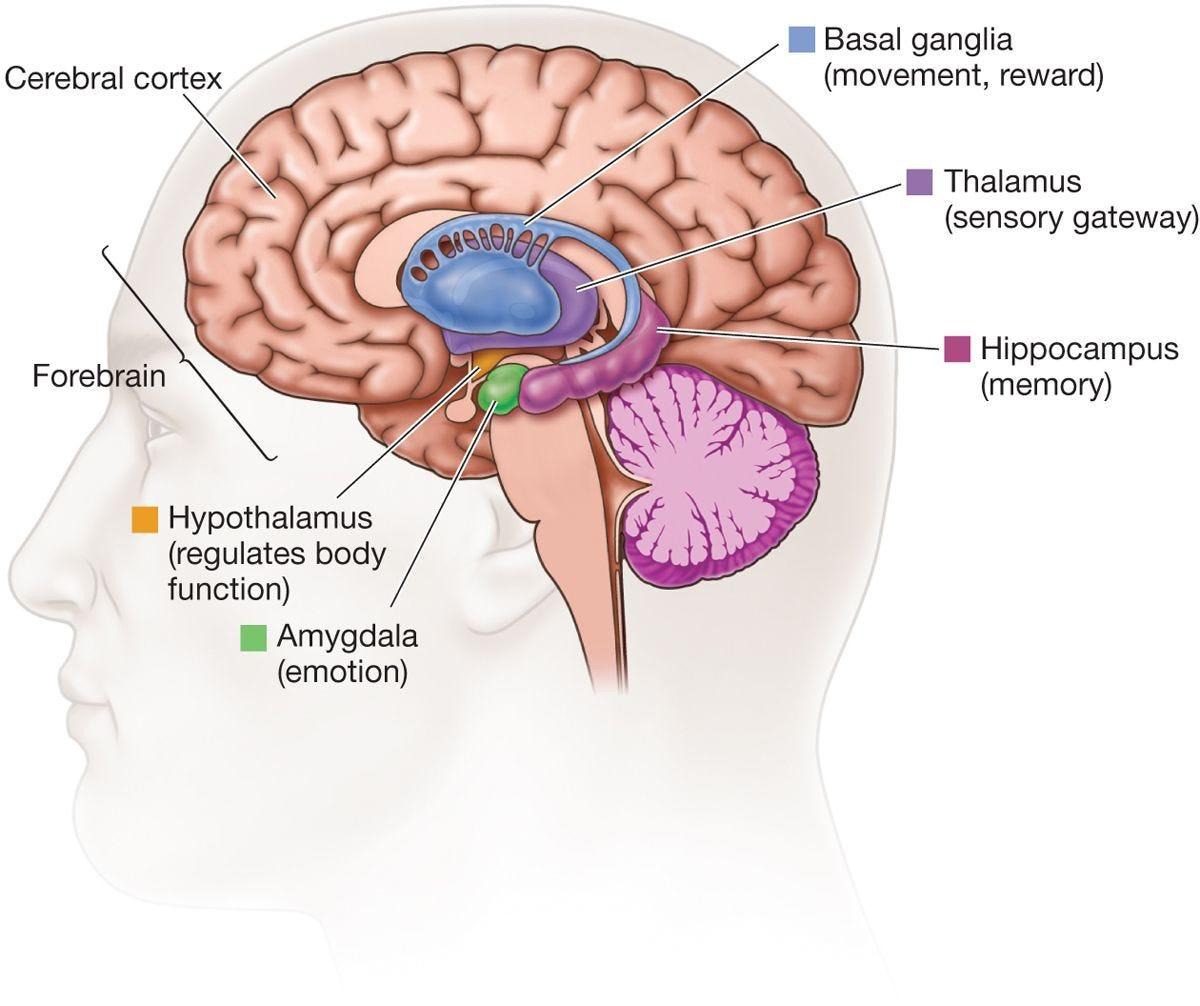
Structure Primary function
Medulla Regulates essential functions such as breathing and heart rate
Pons Helps regulate sleep and arousal and coordinates some movement
Reticular formation Involved in alertness, arousal, and attention
Thalamus Relays most sensory information to the appropriate cortical areas; smell is a major exception
Hypothalamus Regulates hunger, thirst, body temperature, and other homeostatic functions
Limbic system
Structure Primary function
Amygdala Processes emotional significance, including fear-related learning
Hippocampus Helps form new explicit memories
Hypothalamus Connects homeostasis, motivation, and endocrine regulation
Other major structures
Cerebellum: Balance, coordination, motor learning, and timing.
Corpus callosum: Connects the brain's two cerebral hemispheres.
Basal ganglia: Contribute to movement control, habits, and action selection.
Cerebral cortex: Supports complex processes such as perception, language, reasoning, and voluntary action.
Four lobes of the cerebral cortex
Frontal lobe
Planning, judgment, decision-making, and impulse control.
Contains the primary motor cortex.
The prefrontal cortex supports executive functions.
Parietal lobe
Processes bodily sensations such as touch and position.
Contains the primary somatosensory cortex.
Helps integrate spatial information.
Occipital lobe
- Primarily processes visual information.
Temporal lobe
Auditory processing, language comprehension, and aspects of memory.
Includes structures involved in memory, such as the hippocampus, deeper within the brain.
Motor cortex versus somatosensory cortex
Motor cortex: Located in the frontal lobe; helps control voluntary movement.
Somatosensory cortex: Located in the parietal lobe; processes bodily sensations.
AP scenario: A person can feel a pinprick but has trouble voluntarily moving their hand. A problem affecting the motor cortex is a stronger possibility than one affecting the somatosensory cortex.
8. The cerebral hemispheres and brain lateralization
The brain has two hemispheres, connected by the corpus callosum.
Left hemisphere: Usually more involved in language for most people; also controls movement and receives sensory information primarily from the opposite side of the body.
Right hemisphere: Often contributes strongly to spatial processing, attention, and aspects of emotional and nonverbal processing.
Corpus callosum: Allows the hemispheres to communicate.
Contralateral control: Each hemisphere generally controls movement on the opposite side of the body. For example, the left motor cortex controls much of the right side's voluntary movement.
Language areas
Broca's area: Involved in speech production. Damage can cause difficulty producing fluent speech.
Wernicke's area: Traditionally associated with language comprehension. Damage can cause difficulty understanding language and producing meaningful speech.
Do not assume that one hemisphere handles all logic while the other handles all creativity. Most complex tasks involve networks across both hemispheres.
9. Genetics, environment, and behavior
Biological psychology also examines how inherited traits and life experiences contribute to behavior.
Genes: DNA sequences that influence the development and functioning of an organism.
Heredity: The transmission of genetic information from parents to offspring.
Environment: External influences, including family, culture, education, and life experiences.
Gene-environment interaction: The effects of genetic differences can depend on a person's environment, and environmental experiences can affect how genetic tendencies are expressed.
Epigenetics: Changes in gene expression that do not require changing the underlying DNA sequence.
Nature versus nurture
The nature-versus-nurture debate asks how biological inheritance and environmental experience contribute to traits and behavior.
Modern psychology generally recognizes that both interact.
Example: A person may inherit a predisposition for athletic ability, but practice, coaching, nutrition, access to equipment, and opportunity can all influence athletic performance.
Twin and adoption studies
Identical twins: Share nearly all their inherited DNA.
Fraternal twins: Share, on average, about half of their segregating genetic variants, like other full siblings.
Twin studies: Compare similarities among identical and fraternal twins to estimate genetic and environmental contributions.
Adoption studies: Help researchers compare similarities with biological relatives and adoptive relatives.
Important: Heritability describes variation in a particular population and environment. It does not tell you what percentage of an individual person's trait is genetic, and high heritability does not mean a trait cannot change.
10. Neuroplasticity and brain research
Neuroplasticity is the brain's capacity to change its organization or connections in response to learning, experience, and injury.
Examples:
Practicing an instrument can strengthen neural connections involved in playing it.
Learning a new language can change the brain networks used to process language.
After certain injuries, other brain regions may partly compensate for lost functions.
Methods for studying the brain
Method What it tells researchers
EEG Measures electrical activity at the scalp; useful for tracking timing of brain activity
CT scan Uses X-rays to create structural images
MRI Uses magnetic fields to produce detailed structural images
fMRI Measures blood-oxygen-level changes associated with brain activity
PET scan Uses a radioactive tracer to measure aspects of metabolic or chemical activity
Lesion studies Examine how damage to a brain region relates to changes in function
AP exam trap: An fMRI measures a blood-oxygen-related signal, not neurons firing directly. Brain imaging can show associations between activity and a task, but association alone does not prove causation.