Econ Chapter 17 Review
Behavioral Economics & Risk Taking
Behavioral Economics: is a field of economics that studies psychological influences in economic decision making.
So far, we have assumed people act in ways that maximize their utility
but we know from our own experience:
we are influenced by the environment in which we make decisions
we don’t always act in our best interest
Misperception of Probabilities: occur when the true underlying probability is misestimated.
Why do people play the lottery or gamble when there is little chance of winning?
Players have incomplete information or do not try to calculate odds of winning
Players believe they have some control over the game ('“lucky numbers”)
Gambling is fun? Get utility from gambling itself?
Seeing Patterns Where None Exist
Gambler’s Fallacy: The belief that outcomes that have not occurred recently are more likely to occur. Thats a negative correlation.
Hot Hand Fallacy: The belief that outcomes that have occurred recently are more likely to occur. That’s a positive correlation.
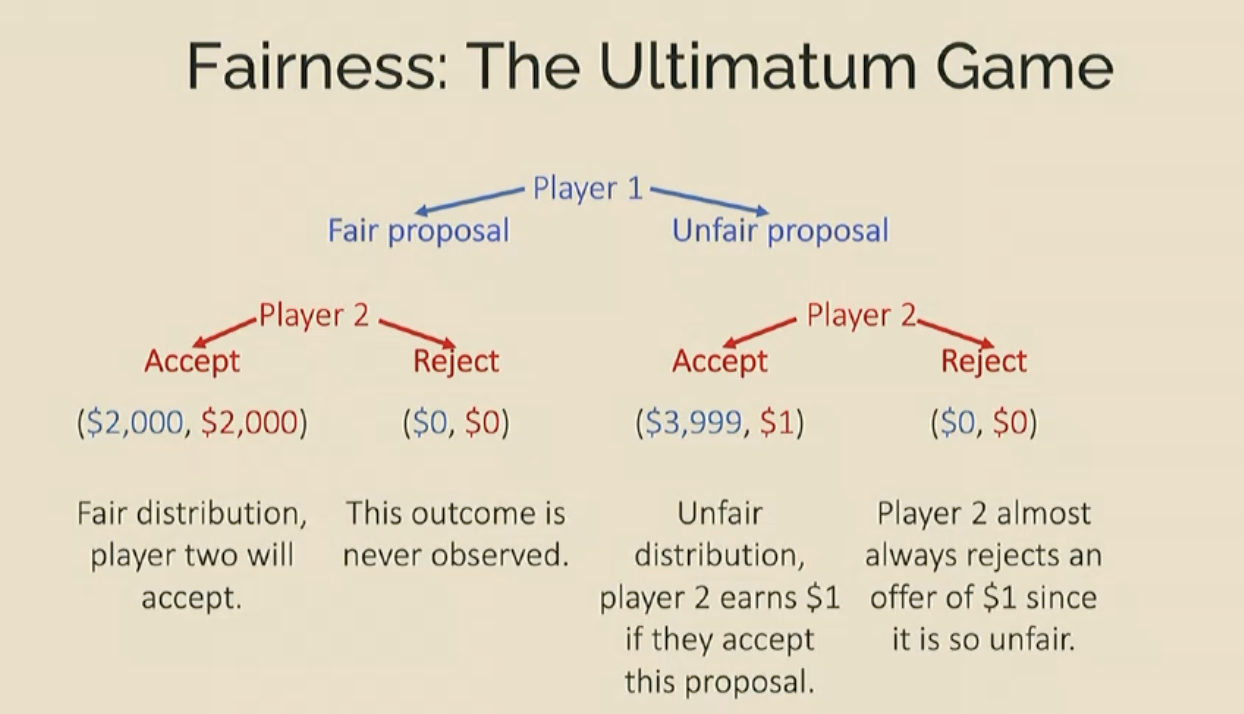
Fairness: The Ultimatum Game
Economic theory of rationality tells us Player 2 should accept the unfair proposal
But real player 1s rarely offer low amounts- often equal splits
and real player 2s often reject offers that are “too low”
Inconsistencies in Decision Making
Intertemporal Choice
Farming
Satus-quo bias
Regret aversion
The Allais Paradox
Prospect Theory
Intertemporal Choice: Planning to do something over a period of time requires the ability to value the present and future consistently.
Describes how individual’s current decisions affect what options become available in the future.
A Nudge: that prompts the consumer to consider the long-run consequences of their actions
Framing: Occurs when an answer is influenced by the way a question is asked, or a decision is influenced by the way alternatives are presented.
You are told that a risky medical procedure has a 90% chance you are alive after 5 years or a 10% chance you are dead after 5 years
The Status-quo bias: is the tendency to keep doing whatever you are currently doing
You can prime people by giving them a default choice, like making the default that you are/are not an organ donor.
Expected values and risk taking
Choice A: You receive $100 with a 40% probability and $20 with a 60% probability
Expected Value (EV)= .4 × 100 +.6 × 20 = $52
Choice B: You receive $100 with a 50% probability, $50 with a 30% probability, and $0 with a 20% probability.
EV= .5 × 100 + .3 × 50 + .20 × 0= $65
Risk- averse person: Prefers a certain payoff to a gamble with a higher EV
Risk- neutral person: Chooses the highest expected value regardless of the risk
Risk- loving (risk- taking) person: Prefers gambling with lower expected values but potentially higher winnings over certain payoff
Example:
Coin-flip game
Heads: you win $100
Tails: you get nothing
EV of the game = .5× 100 +.5 ×0 = $50
How much guaranteed money would it take you to not play the game?
A risk-averse person would take a guaranteed payoff< $50 rather than play
If you offer $35 or the chance to play; will likely take 35$ even tho $35<$50
A risk- neutral person would require a guaranteed payoff of >= $50 to choose not to play
Indifferent between playing and guaranteed $50
Any guaranteed offer> $50 would cause the person to take the offer and not play
A risk- loving person would take a guaranteed payoff > $50 to choose not to play.
Could offer to play or get a guaranteed $60
Depending on level of risk living, may rather play over taking the $60, even though $60 is greater than the EV.
Regret Aversion: When people fear that their decision will turn out to be wrong in hindsight, they exhibit regret aversion.
The Allais Paradox: is a choice problem designed to show an inconsistency of actual observed choices with the predictions of utility theory.
Preference reversal: occurs when people’s risk tolerance is not consistent.
Risk Tolerance depends on financial circumstances
Risk-loving individuals are more likely to participate in large-prize games such as lotteries
large prizes=significant life change
People care about how much they could win and how much they stand to lose
Prospect Theory: People weigh the utilities and risks of gains and losses differently.
individuals place more emphasis on losses than gains
implies that people evaluate the risks that lead to gains separately from the risks that lead to losses
Prospect theory & loss aversion
Loss aversion: people dislike losing more than they enjoy gains
Loss aversion in investing During a downturn:
people often don’t want to invest
BUT investing in a strong market is risker
more upside when stocks at discount
Investors sell to avoid further losses
may miss out on longer term rebound
Investors often prioritizing the avoidance of loss over earning a gain which explains part of why we observe underperformance of the market
Cold Openings
would you go to see a movie if it had no reviews?
Why would any movies studio open a movie without sending it out to reviewers