Insects and People: Insects and Worldwide Diseases
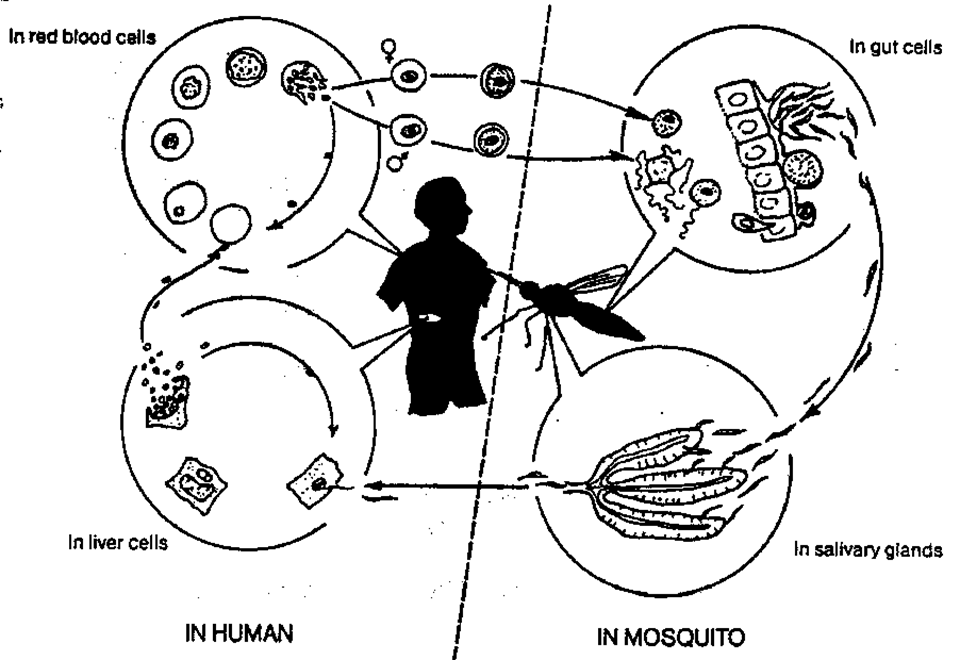
Malaria: The Great Single Killer of Humanity
- Agent: 4 different protozoans
- Reservoir: human (only 1% of infected humans die, the rest are reservoirs)
- Vector: several anopheles mosquitos
- Target: humans only
- Distribution: worldwide
- Up to mid-1940’s, over 300,000,000 cases and 3,000,000 deaths per year
- Still around 200,000,000 cases, 1-2,000,000 deaths per year
- Symptoms: fever and chills, weakness, tired
- Treatment: synthetic drugs (prevention)
- Chloroquine is a medication that is used to treat malaria infection
- Derived from a special type of tree (Cinchona tree in Peru)
- Quinine
- Problems: mosquito and protozoan resistance
- Prevention
- Remove stagnant water habitat for mosquitos
- Prevent mosquito bites (DEET, screens, bed nets)
- Kill them with insecticides!
- Hippocrates—Was the first person to associate malaria with swamps and stagnant water
- Sir Patrick Manson—Developed the theory that malaria was transmitted by mosquitoes to humans
- Ronald Ross—Confirmed through experiments that Anopheles mosquitoes transmit malaria to humans
Insects in War
Napoleon's brother-in-law, General Charles Leclerc, attempted to conquer Haiti and a small country called the United States of America! How was his army of 33,000 soldiers defeated?
- Yellow Fever – A mosquito virus – Killed 29,000 of those soldiers
- Fact: ==Mosquito-transmitted diseases (Malaria, yellow fever, etc.) are responsible for half of all human deaths since the stone age==
Plague: Black Death
- Agent: one species of bacteria
- Reservoir: rodents, tolerant humans
- Vector: rat flea
- Target: rodents, fleas, and humans
- Distribution: worldwide, a port disease
- Symptoms: high fever, rapid pulse & respiration, the appearance of “bubo”
- Bubonic, Pneumonic, and Septicemic Plague versions
- History: almost as old as history itself
- 1000 BC Plague of the Philistines
- 541-544 Plague of Justinian
- 1320-1700 Black Death throughout Europe
- Killed 25,000,000 people by 1351
- Repercussions many and varied
- Disease is still around
Epidemic Typhus: Wartime Disease
- Agent: bacteria-like microbe called rickettsia
- Reservoir: humans and lice
- Vector: human body louse
- Target: humans and lice
- Distribution: temperature regions with cold season
- Symptoms: high fever, chills, severe headaches, confusion. Brick red spots on the body.
- Treatment/prevention: antibiotics, lice sprays, vaccination
- Typhus and war: world examples
- Crusades lost 100,000s to typhus
- Louis VII of France left with 500,000 men during the crusades and returned with only a few
- Maximillian II of Germany failed to invade Hungary
- Napolean defeated several times by typhus
- Crimean War: 131,000 battle deaths, 105,000 disease deaths, 660,000 too sick to fight
- Typhus and war: United States examples
- 1898 Spanish-American War; 369 battle deaths, 1,939 typhus
- WWI- 3,000,000 typhus deaths, mostly in Russia
- WWII: malaria and typhus killed 5X more than did battles
- Korea and Vietnam: many cases but fewer deaths
There are many other insect-vectored diseased that have shaped history and continue to do so.