Module 9: Cloud Architecture
Module objectives
Describe the AWS Well-Architected Framework, including the six pillars
Identify the design principles of the AWS Well-Architected Framework
Explain the importance of reliability and high availability
Identify how AWS Trusted Advisor helps customers
Interpret AWS Trusted Advisor recommendations
Section 1: AWS Well-Architected Framework
What is the AWS Well-Architected Framework?
A guide for designing infrastructures that are:
Secure
High-performing
Resilient
Efficient
A consistent approach to evaluating and implementing cloud architectures
A way to provide best practices that were developed through lessons learned by reviewing customer architectures
Operational Excellence pillar – deliver business value
Focus
Run and monitor systems to deliver business value, and to continually improve supporting processes and procedures.
Key topics
Automating changes
Responding to events
Defining standards to manage daily operations
Operational excellence design principles
Perform operations as code
Make frequent, small, reversible changes
Refine operations procedures frequently
Anticipate failure
Learn from all operational events and failures
Operational excellence questions
Organization
How do you determine what your priorities are?
How do you structure your organization to support your business outcomes?
How does your organizational culture support your business outcomes?
Prepare
How do you design your workload so that you can understand its state?
How do you reduce defects, ease remediation, and improve flow into production?
How do you mitigate deployment risks?
How do you know that you are ready to support a workload?
Operate
How do you understand the health of your workload?
How do you understand the health of your operations?
How do you manage workload and operations events?
Evolve
How do you evolve operations?
Security pillar – protect and monitor systems
Focus
Protect information, systems, and assets while delivering business value through risk assessments and mitigation strategies.
Key topics
Protecting confidentiality and integrity of data
Identifying and managing who can do what
Protecting systems
Establishing controls to detect security events
Security design principles
Implement a strong identity foundation
Enable traceability
Apply security at all layers
Automate security best practices
Protect data in transit and at rest
Keep people away from data
Prepare for security events
Security questions
Security
How do you securely operate your workload?
Identity and access management
How do you manage identities for people and machines?
How do you manage permissions for people and machines?
Detection
How do you detect and investigate security events?
Infrastructure protection
How do you protect your network resources?
How do you protect your compute resources?
Data protection
How do you classify your data?
How do you protect your data at rest?
How do you protect your data in transit?
Incident response
How do you anticipate, respond to, and recover from incidents?
Reliability pillar – recover from failure and mitigate disruption
Focus
Ensure a workload performs its intended function correctly and consistently when it’s expected to.
Key topics
Designing distributed systems
Recovery planning
Handling change
Reliability design principles
Automatically recover from failure
Test recovery procedures
Scale horizontally to increase aggregate workload availability
Stop guessing capacity
Manage change in automation
Reliability questions
Foundations
How do you manage service quotas and constraints?
How do you plan your network topology?
Workload architecture
How do you design your workload service architecture?
How do you design interactions in a distributed system to prevent failure?
How do you design interactions in a distributed system to mitigate or withstand failures?
Change management
How do you monitor workload resources?
How do you design your workload to adapt to changes in demand?
How do you implement change?
Failure management
How do you back up data?
How do you use fault isolation to protect your workload?
How do you design your workload to withstand component failures?
How do you test reliability?
How do you plan for disaster recovery?
Performance Efficiency pillar – use resources sparingly
Focus
Use IT and computing resources efficiently to meet system requirements and to maintain that efficiency as demand changes and technologies evolve.
Key topics
Selecting the right resource types and sizes based on workload requirements
Monitoring performance
Making informed decisions to maintain efficiency as business needs evolve
Performance efficiency design principles
Democratize advanced technologies
Go global in minutes
Use serverless architectures
Experiment more often
Consider mechanical sympathy
Performance efficiency questions
Selection
How do you select the best performing architecture?
How do you select your compute solution?
How do you select your storage solution?
How do you select your database solution?
How do you configure your networking solution?
Review
How do you evolve your workload to take advantage of new releases?
Monitoring
How do you monitor your resources to ensure they are performing?
Tradeoffs
How do you use tradeoffs to improve performance?
Cost Optimization pillar – eliminate unneeded expense
Focus
Avoid unnecessary costs.
Key topics
Understanding and controlling where money is being spent
Selecting the most appropriate and right number of resource types
Analyzing spend over time
Scaling to meeting business needs without overspending
Cost optimization design principles
Implement Cloud Financial Management
Adopt a consumption model
Measure overall efficiency
Stop spending money on undifferentiated heavy lifting
Analyze and attribute expenditure
Cost optimization questions
Practice cloud financial management
How do you implement cloud financial management?
Expenditure and usage awareness
How do you govern usage?
How do you monitor usage and cost?
How do you decommission resources?
Cost-effective resources
How do you evaluate cost when you select services?
How do you meet cost targets when you select resource type, size, and number?
How do you use pricing models to reduce cost?
How do you plan for data transfer changes?
Manage demand and supply resources
How do you manage demand and supply resources?
Optimize over time
How do you evaluate new services?
The AWS Well-Architected Tool
Helps you review the state of your workloads and compares them to the latest AWS architectural best practices
Gives you access to knowledge and best practices used by AWS architects, whenever you need it
Delivers an action plan with step-by-step guidance on how to build better workloads for the cloud
Provides a consistent process for you to review and measure your cloud architectures
Section 1 key takeaways
The AWS Well-Architected Framework provides a consistent approach to evaluate cloud architectures and guidance to help implement designs.
The AWS Well-Architected Framework documents a set of design principles and best practices that enable you to understand if a specific architecture aligns well with cloud best practices.
The AWS Well-Architected Framework is organized into six pillars.
Each pillar includes its own set of design principles and best practices.
Section 2: Reliability and availability
Reliability
A measure of your system’s ability to provide functionality when desired by the user.
System includes all system components: hardware, firmware, and software.
Probability that your entire system will function as intended for a specified period.
Mean time between failures (MTBF) = total time in service/number of failures
Availability
Normal operation time / total time
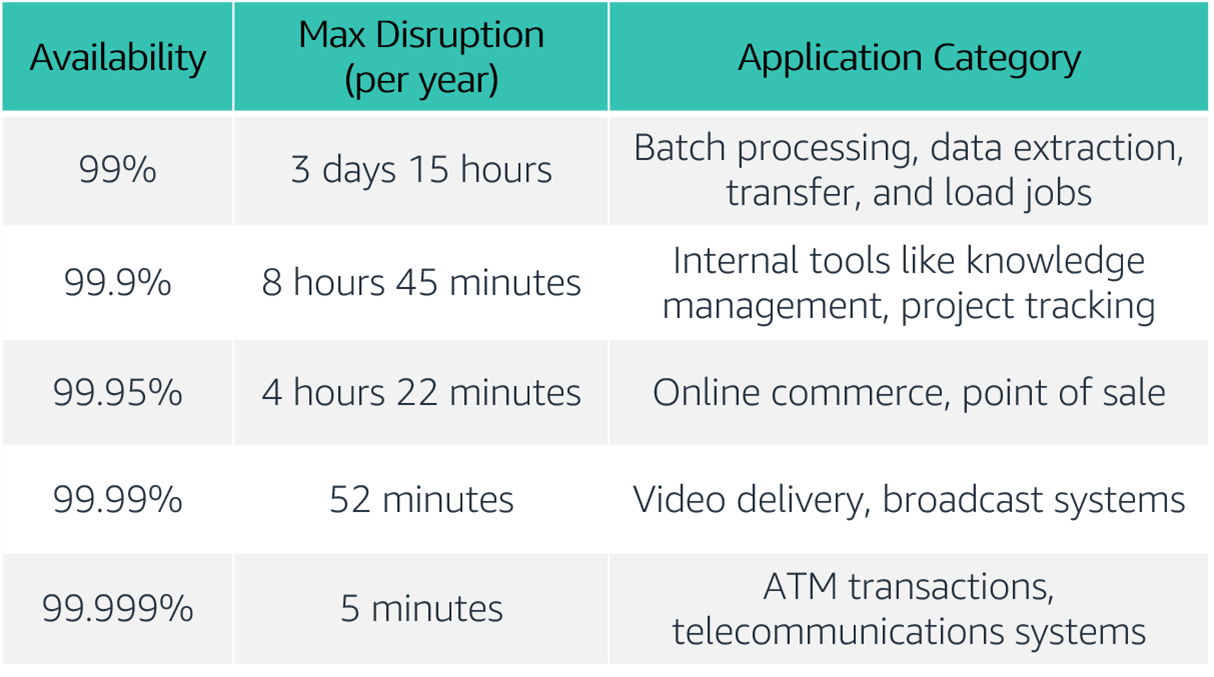
A percentage of uptime (for example, 99.9 percent) over time (for example, 1 year)
Number of 9s – Five 9s means 99.999 percent availability
High availability
System can withstand some measure of degradation while still remaining available.
Downtime is minimized.
Minimal human intervention is required.
Availability tiers
Factors that influence availability
Fault tolerance
The built-in redundancy of an application's components and its ability to remain operational.
Scalability
The ability of an application to accommodate increases in capacity needs without changing design.
Recoverability
The process, policies, and procedures that are related to restoring service after a catastrophic event.
Section 2 key takeaways
Reliability is a measure of your system’s ability to provide functionality when desired by the user, and it can be measured in terms of MTBF.
Availability is the percentage of time that a system is operating normally or correctly performing the operations expected of it (or normal operation time over total time).
Three factors that influence the availability of your applications are fault tolerance, scalability, and recoverability.
You can design your workloads and applications to be highly available, but there is a cost tradeoff to consider.
Section 3: AWS Trusted Advisor
AWS Trusted Advisor
Online tool that provides real-time guidance to help you provision your resources following AWS best practices.
Looks at your entire AWS environment and gives you real-time recommendations in five categories.
Section 3 key takeaways
AWS Trusted Advisor is an online tool that provides real-time guidance to help you provision your resources by following AWS best practices.
AWS Trusted Advisor looks at your entire AWS environment and gives you real-time recommendations in five categories.
You can use AWS Trusted Advisor to help you optimize your AWS environment as soon as you start implementing your architecture designs.
Summary
Describe the AWS Well-Architected Framework, including the six pillars
Identify the design principles of the AWS Well-Architected Framework
Explain the importance of reliability and high availability
Identify how AWS Trusted Advisor helps customers
Interpret AWS Trusted Advisor recommendations