GN 301 Module 6: Linkage and Codominance
Independent Assortment: the migration of the alleles of one gene into a gamete doesn’t affect the migration of alleles at a second gene, as long as they’re on different chromosomes
Linked Genes: occurs when genes are on the same chromosome, tend to be transmitted as a single unit \n
Crossing Over
- Define crossing over: A breakage of chromosomes and an exchange of genes between nonsister chromatids of homologous chromosomes, diversifying genetic information in an individual.
- Importance in gamete formation: Crossing over helps maximize the genetic diversity of any offspring that result from the eventual union of two gametes during sexual reproduction.
- Compare/Contrast Parental v Recombinant Gamete Types:
- Gametes that are produced without crossing over are the parental types
- Gametes produced due to crossing over is a recombinant type
Parental types occur more frequently than recombinant types
Map Distance
- The further apart 2 genes are, the more likely it is that a crossover will occur between them.
- Which gamete will be produced most frequently from the individual shown?
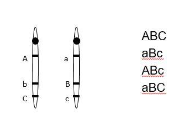
aBc is the most likely formed. Parental types are more likely than recombinant (without having to cross over)
- Which gamete will be produced least frequently?
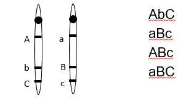
aBC is the least likely formed. This is because a crossover would be required between B/b and C/c.
Gamete Frequency with genotype AbC/aBc chromosomes above
Most: No crossovers: AbC and aBc
2nd most: Single cross in bog region: ABc and abC
3rd most: Single cross in small region: Abc and aBC
Rarest: Double cross overs: ABC and abc
Parental v Recombinant
The types of gametes that are classified as noncrossover (parental) or crossover (recombinant) types, depends on which alleles were on associated on the same chromosome prior to the crossover.
Map distances
- Define map distances: the distance between genes on a chromosome
- Measured in centimorgans (cM)
Mapping Example: Suppose the albinism and galactosemia genes are 20 cM apart. Give the frequencies of the gametes:
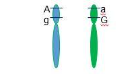
- f(Ag) = 40%
- f(aG) = 40%
- f(ag) = 10%
- f(AG) = 10% \n
Eg. What gametes will be formed from each parent and in what frequency? What are the frequencies of the progeny types?
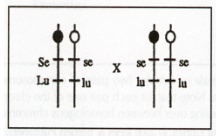
0.42 Se se Lu lu
0.42 se se Lu lu
0.08 Se se lu lu
0.08 se se Lu lu
The heterozygous parent will produce 4 gamete types but they will not be equally frequent since the genes are linked. Since the map distance is 16 cM, each of the recombinant types will be formed 8% of the time for a frequency of 0.08.
The parental gametes together will be formed 100 – 16 = 84% of the time so each is formed 42% of the time for a frequency of 0.42. The homozygous recessive parent makes only one gamete type so its relative frequency is 1.0. To determine the progeny from the cross, just complete the genotypes and the frequency of each progeny box is the product of the frequencies for the parent gametes.
- Linked and Unlinked Genes:
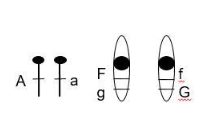
- Which genes are linked? Which assort independently?
When genes are found on different chromosomes or far apart on the same chromosome, they assort independently and are said to be unlinked. When genes are close together on the same chromosome, they are said to be linked. If the genes are linked, the noncrossover types are more frequent than the crossover types of gametes
- How many different gametes does this individual produce?
- Parental v Recombinant
- AFG aFg afG Afg
Multiple Alleles and Codominance
Define: Multiple Alleles –
Multiple alleles: Multiple alleles occur when there are more than 2 forms of the same gene. Even though there are more than 2 options for alleles, each person can still only have 2 alleles at a given locus.
Genotype Number
If you have “N” alleles, you can get (N / 2) (N + 1) different genotypes 2 alleles: (2/2)(2+1) = (1)(3) = 3 different genotypes 3 alleles: (3/2)(3+1) = (1.5)(4) = 6 genotypes 4 alleles: (4/2)(4+1) = (2)(5) = 10 genotypes
- Eg. Hemoglobin: Hemoglobin has 2 chains: alpha and beta Eg. Dominance Hierarchy in Rabbits: Full > Chinchilla > Himalayan > Albino If a full x Himalayan mating produced 4 full and 3 chinchilla progeny, what could be the genotypes of the parents?
Full genotypes: C+ C+, C+ c^ch, C+ c^h, C+c. Himalayan genotypes: c^h c^h, c^h c.
full (C+ C+, C+ c^ch, C+ c^h, C+ c) and chinchilla (c^ch c^ch, c^ch c^h, c^ch c) Required parental genotypes: C+ and c^ch in there somewhere. Possible genotypes: Full: C+ and c^ch Himalayan: c^h and c^h
Define Codominance
Codominance: when both of the alleles at a locus are expressed in the heterozygous individual
- Eg. MN Blood type locus
- These alleles produce proteins found on blood cells 3 possible genotypes: MM, MN, or NN.
- a person who is heterozygous makes both M and N proteins
- Eg. ABO Blood type locus
- A and B are codominant to each other
- A and B are both dominant to O
- O is recessive to both A and B
Blood Type Examples
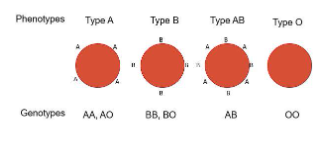
- Spp. Mom is AO and Dad is AB. What are the possible blood types of their children and in what frequency?
| A | O | |
|---|---|---|
| A | AA | AO |
| B | AB | BO |
Possible blood types: Type A, Type B, or Type AB
- Spp. Mom is AB and has a B child. What can the father’s blood type be?
AB + ? = B
Type B= B0 or BB
Father could be B0, BB, AB, or 00.