Chapter 9B
Devaluation and Revaluation
Depreciation + appreciation are changes in the value of currencies due to market changes.
Devaluation + revaluation are changes in a fixed ex rate caused by central banks.
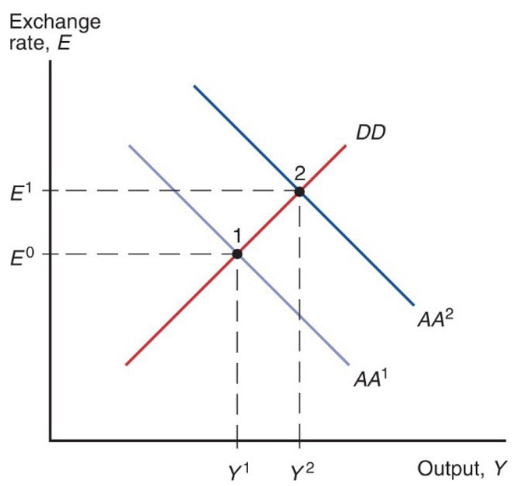
with devaluation, domestic currency is made less valuable so more units must be exchanged per unit of foreign currency.
with revaluation, domestic currency is made more valuable so fewer units must be exchanged per unit of foreign currency.
Devaluation
For devaluation to occur, the central bank buys foreign assets so that;
domestic monetary assets increase and domestic interest rates fall;
causes fall in RoR of domestic currency deposits.
domestic products become less expensive relative to foreign products, so AD + output increase.
official international reserve assets (foreign bonds) increase.
Effect of a Currency Devaluation
Financial Crises and Capital Flight
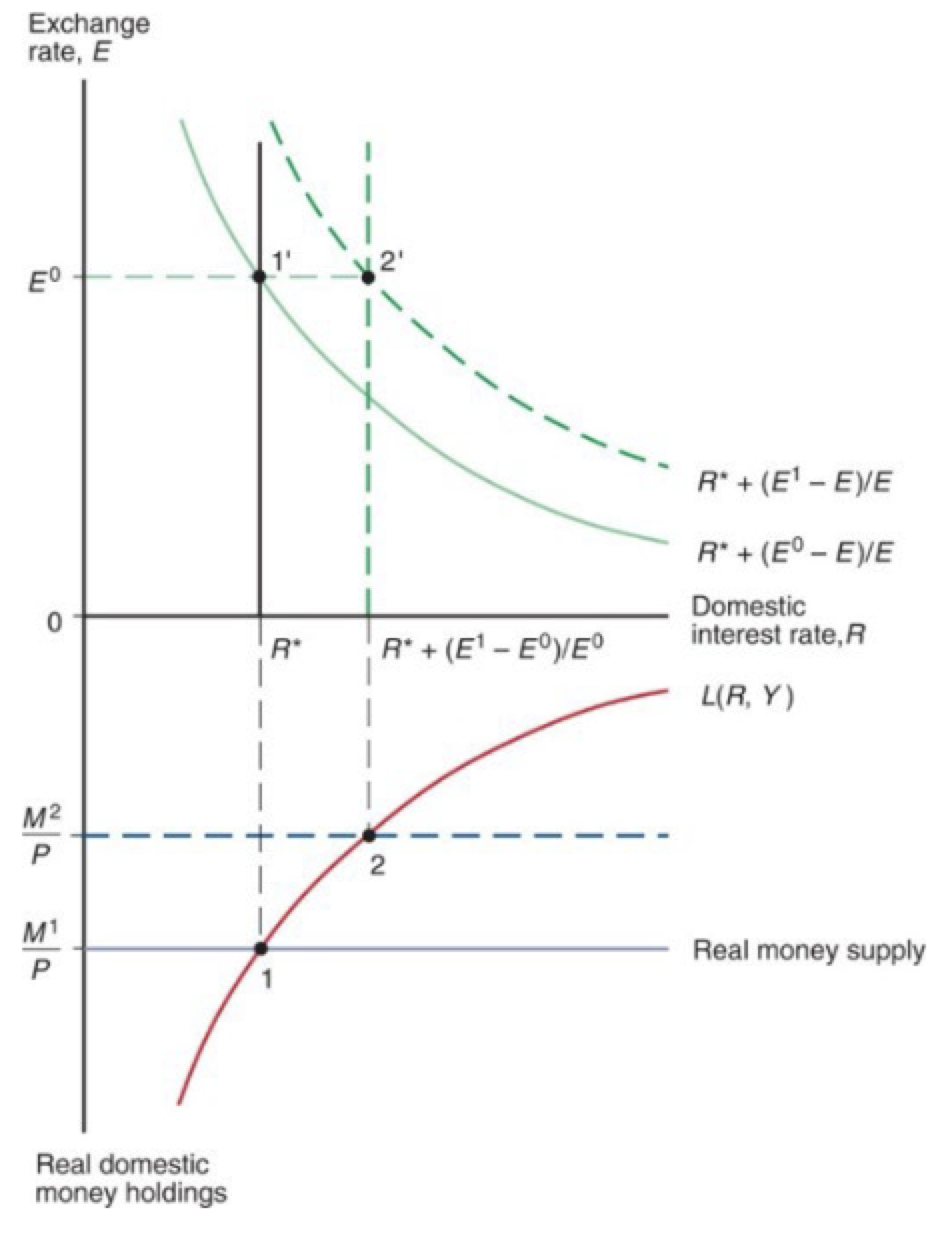
To maintain fixed ex rate, central banks must have enough foreign assets to sell to satisfy their demand;
when central banks do not have enough, this creates a BoP crisis;
investors may expect domestic currency to be devalued;
causes them to want foreign assets instead of domestic assets (whose value is expected to fall soon)
This expectation or fear makes the BoP crisis worse:
investors rush to change their domestic assets into foreign assets;
depleting stock of reserve assets more quickly.
Financial capital is quickly moved from domestic assets to foreign assets: capital flight;
domestic economy will face shortage of financial capital for investment and has low AD.
To avoid this, banks must offer high interest rates on domestic assets to entice investors:
central bank can push interest rates higher by reducing money supply (by selling foreign + domestic assets).
As a result, domestic economy may face:
high interest rates,
reduced money supply,
low AD,
low output, and
low employment.
Capital Flight, the Money Supply, and the Interest Rate

Financial Crises and Capital Flight
Expectations of a BoP crisis only worsens the crisis and hastens devaluation; a self-fulfilling crisis.
Factors causing expectations to change include;
expectations about central bank’s ability + willingness to maintain fixed ex rate.
expectations about the economy;
shrinking demand for domestic products relative to foreign products means the domestic currency will become less valuable.
If the central bank runs out of reserve assets;
it must devalue the domestic currency to sell more domestic assets;
this will allow the central bank to increase its foreign assets by buying them back at a devalued rate.
The Open-Economy Trilemma
A country with fixed ex rate and free international capital movement gives up control over domestic monetary policy;
it can regain monetary policy control by restricting international financial flows so that interest parity R = R * does not hold.
or it can regain control by allowing free international capital and having floating ex rate.
A country cannot achieve more than two goals at the same time;
Exchange rate stability.
Monetary policy for domestic goals.
Freedom of international capital movements.
Case for Floating Exchange Rates
Monetary policy autonomy
Without the need to trade currency in foreign ex markets, central banks are more free to influence domestic money supply, interest rates, and inflation;
they can more freely react to changes in AD, output, and prices to achieve internal balance.
Automatic stabilization
Flexible ex rates change prices of domestic product and help reduce “fundamental disequilibria.”
e.g. inflation causes currency’s purchasing power to fall (both domestically and internationally);
flexible ex rates can automatically adjust to account for this fall in value, as PPP model predicts.
e.g. changes in AD for domestic products;
flexible ex rates can automatically adjust to stabilise high or low AD + output,
therefore keeping output closer to normal levels.
how much domestic import prices change with changes in ex rates is called ex rate pass-through.
Preventing speculation
Flexible ex rates may also prevent speculation;
fixed ex rates are unsustainable if markets believe the central bank does not have enough official international reserves
significant drop in demand for domestic currency would cause “fundamental disequilibrium” calling for currency’s devaluation;
this encourages speculative capital outflows (capital flight) .
reserves are depleted trying to;
prevent collapse of the currency peg and,
stop outflow of capital.
thus, with flexible ex rates; domestic currency depreciates making assets less expensive which reduces capital outflows.
Symmetry (not possible under Bretton Woods)
The US is now allowed to adjust its ex rate like other countries that are allowed to adjust money supply for macro goals.
under Bretton Woods, the Fed determined money supply;
all other countries pegged to US $ had to follow Fed’s actions, regardless of domestic economic conditions.
Macroeconomic Interdependence under Floating Exchange Rates
Previously, we assumed that countries are “small” meaning their policies do not affect world markets.
e.g. depreciation of domestic currency was assumed to have no significant influence on AD, output, and prices in foreign countries.
However, large economies like the US, EU, Japan, and China are interdependent because policies in one country affect other economies.
e.g. if the US permanently increases money supply, the DD-AA model predicts in the short run;
an increase in US output and income
a depreciation in US dollar.
therefore, the effects for Japan would be;
an increase in demand for Japanese products, thereby increasing AD + output in Japan
an appreciation in the yen, lowering demand for Japanese products; thereby decreasing AD + output in Japan.
Thus, the total effect of (1) and (2) is ambiguous.
e.g. if the US permanently increases government spending, the DD-AA model predicts:
an appreciation in US dollar
therefore, the effect for Japan would be;
depreciation in the yen, raising demand for Japanese products
thereby increasing AD + output in Japan.
the subsequent effects for the US would be;
higher Japanese output + income means more income is spent on US products
increasing short run AD + output in the US
The US has had a current account deficit for many years due to its low saving + high investment expenditure.
thus it has borrowed heavily, depending on saving funds from other countries;
but, as foreign countries spend more and lend less to the US;
interest rates are rising slightly
the US dollar is depreciating
the US current account deficit is decreasing.