Oral Exam II Study Guide
Oral Exam II Study Guide
- Define, Compare and Contrast Confounding, Effect Modification, and Mediation (This one's guaranteed)
Confounding: variables that are associated/causally related with the outcome and correlated with the exposure – can alter the direction of the results and lead to an over or under estimation of the exposure effect
Question: is there another variable whose effect on outcome is blending with exposure effect on outcome
Effect Modification: variables associated with only the outcome, significantly modifies the exposure effect
Question: is there any other variable that is modifying the effect of the exposure on the outcome
Mediation: when the exposure causes the confounder which causes the outcome


- What sort of things make for a good Randomized Cross-over Trial and Why
- Explanation: both groups are interventions and everyone receives both interventions
- Randomization – randomizing participants based on what intervention they receive first
- Participants act as their own controls
- Effective washout period to reduce crossover effects from the different interventions
- Limited time between interventions – period effect
- Mixed effects modeling to determine the amount of period effect and crossover effects
- Taking multiple measurements can help identify and/or reduce crossover effects
- Compare and contrast the strengths, weaknesses and designs of Prospective Cohorts, Retrospective Cohorts, Cross Sectional Studies, and Case Control Studies
Study Design | Explanation | Strengths | Weaknesses |
|---|---|---|---|
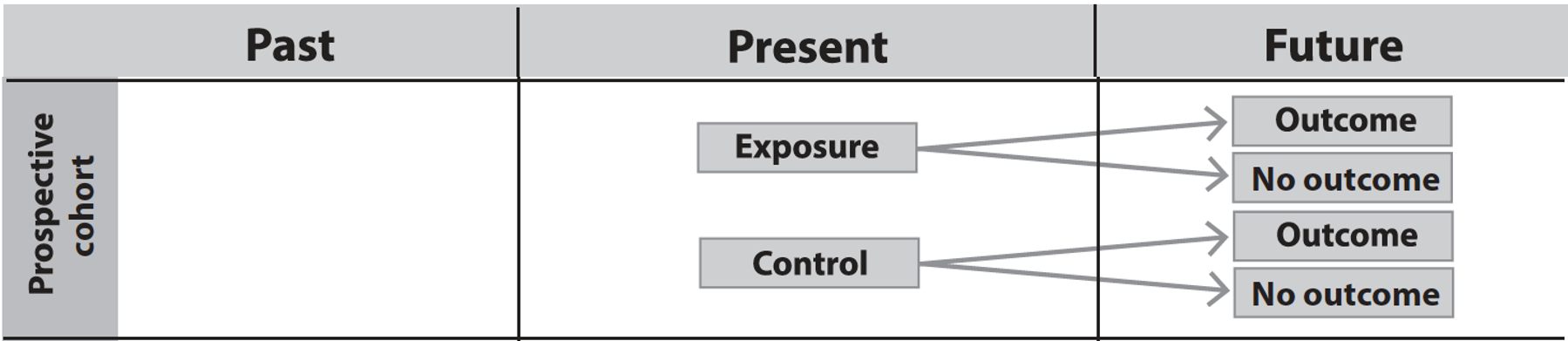
Prospective Cohort
| Highest level observational research Compares outcome incidences to exposed vs non-exposed groups Similar to RCTs, but observational and no randomization | Temporality, we follow a cohort over time More robust against selection bias because outcome is unknown | Confounding – as with any observational study Assumes all patients are at the same risk of the outcome Misclassification bias
Attribution bias (people who left the study & why) and nonresponder bias Immortal time bias (when receiving the outcome is not possible) |
Retrospective Cohort
| Similar to prospective but a bit less reliable Looking at past data | Low cost No nonresponder bias Fast results Can study multiple outcomes/exposures if data is available Potentially long latency periods Best for rare exposures | Same weaknesses as prospective PLUS Data was not intended to be used in research – information bias Researchers cannot choose to measure other variables – must work with what they have Outcome is already known, may introduce selection bias |
Cross-Sectional
| Members from prespecified population are randomly sampled and simultaneously assessed of prevalence for exposure & outcome NHANES | Best for assessing prevalence of disease and assess associations between disease and demographics Randomization reduces selection bias, unless the target population is not well-defined May require trained interviewers | No temporality – no following people through time Survivor effect (if participants die prior to the study, they are not counted) Nonresponder bias Recall bias (surveys) Respondent bias (saying what the researcher wants to hear) We don’t know what came first (reverse causality) |
Case Control
| Compares exposure prevalence in people with and without the outcome | Can study multiple exposures Best for rare outcomes
| Smaller sample size Assumes cases and controls were similar in baseline risk for the outcome at the time of exposure & there is no way to prove or disprove this assumption Outcome is known – selection bias is common Information bias depends on if researchers use new cases or anyone with the outcome Recall bias & differential misclassification bias |