Chem Sept. 12th
Resonance, electron density, and why it matters
Resonance structures are multiple valid Lewis descriptions of the same molecule; they help us understand how electrons may be shared or delocalized.
All resonance forms that are valid real representations contribute to our understanding of electron density, but some forms contribute more than others (major contributors).
Major contributors tend to minimize charge separation and maximize octets; when charges are present, placing negative charge on more electronegative atoms and keeping formal charges as favorable as possible makes a structure a stronger contributor.
A resonance form with separated opposite charges right next to each other is less favorable than one with less charge separation or with charges on appropriate atoms, and thus is a weaker (minor) contributor.
Resonance helps predict where electron density will be richer (electron-rich regions) and where it will be electron-poor, which in turn guides reactivity.
Key concepts: electron-rich vs electron-poor and where resonance occurs
Electron-rich regions tend to donate electron density to electron-poor regions; this underlies many reaction patterns.
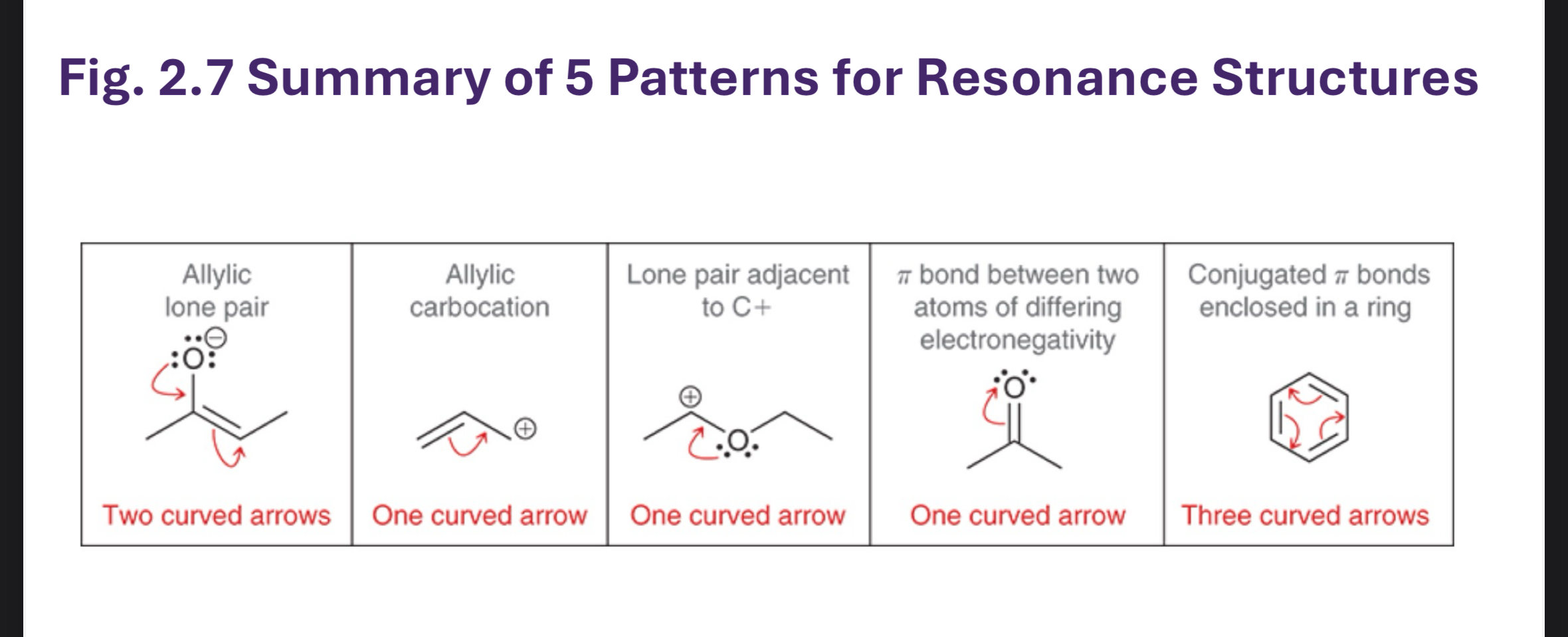
“Adjacent” to a pi system or a positively charged center, lone pairs or empty orbitals can participate in resonance by sharing electrons with the pi system.
Resonance involves movement of electrons (shown as curved arrows) but does not create or destroy the overall charge of the molecule; it must conserve total charge.
When a lone pair adjacent to a carbocation interacts, it can form resonance structures that spread electron density and stabilize the system; this often involves creating a double bond to the positively charged center and placing a formal charge on the adjacent electronegative atom.
Example discussion: carbocation adjacent to a lone pair (oxygen case)
Start with a fragment where an atom (O) has two lone pairs and is adjacent to a carbon with a formal positive charge (carbocation).
Resonance form A: lone pair on O shares with the carbon, forming a C=O-like double bond; O bears a formal positive charge in this form.
Resonance form B (the alternate form): the C=O double bond is not present, and the charge distribution reflects a different arrangement.
Important rule: the overall charge is conserved across resonance forms; you cannot create or destroy charge by resonance.
The more significant contributor is the one that minimizes charge separation and places charges on the most appropriate atoms; often this means the form with less adjacent opposite charges is preferred.
These resonance forms illustrate why certain atoms (e.g., carbon) can become more electron-deficient in the presence of electron-withdrawing groups, which in turn explains reactive sites.
Why this matters for reactivity and selectivity
Electron-rich atoms or regions will attract electron-poor sites; this helps predict where nucleophiles or bases will attack.
In the carbonyl context, resonance can render the carbonyl carbon electron-poor and the oxygen electron-rich in certain resonance forms, guiding protonation or nucleophilic attack.
The presence of formal charges and their locations (especially adjacent electronegative atoms) can dramatically influence the electron distribution and thus the reaction pathway.
Conjugated pi systems and resonance in rings
Conjugated pi bonds (e.g., in benzene) allow pi electrons to be delocalized around the ring; this is commonly depicted by alternating double bonds or a circle.
Organic chemists often prefer localized Lewis structures for step-by-step analysis and mechanism tracking, even though the real molecule has delocalized electrons.
In benzene, the pi electrons are shared around the ring; the circle representation is shorthand, but for mechanistic reasoning we use localized representations to follow electron flow.
The concept of conjugation will be revisited in module 7 when studying more complex conjugated systems and their reactivity.
Allylic systems and delocalization
When a pi bond is adjacent to another atom that can donate electrons (an allylic position), electrons can delocalize to neighboring atoms, creating alternative resonance structures.
This delocalization stabilizes charges or radical character at the allylic position and helps explain reactivity patterns in allylic substitutions and additions.
The amide example: localized vs delocalized lone pair and C–N partial bond
Amides exhibit resonance where the lone pair on nitrogen is delocalized into the carbonyl pi system.
This delocalization gives carbon–nitrogen partial double-bond character, restricting rotation around the C–N bond (no free rotation). This is a foundational idea behind peptide bond rigidity in proteins (module 3 relevance).
The nitrogen in amide is typically described as sp2-hybridized due to resonance; the lone pair is not localized on nitrogen in the simple picture but is spread over the pi system.
Picture: lone pair on N participates in resonance with the C=O fragment, creating N–C–O bonding patterns that differ from a purely single-bond picture.
Result: amides are less basic than simple amines because the lone pair is delocalized and involved in resonance, reducing its availability for protonation.
Pyridine: a cautionary example about lone pairs and resonance
Pyridine contains a nitrogen atom within an aromatic ring; the ring obeys aromatic sextet rules with 6 pi electrons contributed by the carbons and N’s p orbital.
The lone pair on the pyridine nitrogen is in an sp2 orbital and is oriented perpendicular to the pi system, so it does not participate in the aromatic pi-delocalization.
Therefore, in pyridine, the lone pair is not available for resonance with the ring; this lone pair is basic (can accept a proton) because it is localized in the sp2 orbital, not involved in the π-system.
The key lesson: for electrons to be shared through a pi system (resonance), the orbitals must be able to communicate (overlap) with the pi system; if geometric/orbital arrangement blocks this, resonance is not possible.
Rules and takeaway about resonance contributors
All valid resonance structures are representations of the same molecule; their sum helps describe electron density distribution.
The major contributor tends to minimize charge separation and maximize octet satisfaction; the most significant contributors place charges on the most electronegative atoms when charges must exist.
Lone pairs adjacent to pi systems or to empty orbitals can participate in resonance; lone pairs not aligned with the pi system are localized and do not delocalize.
When you have a lone pair and a pi bond on the same atom, that lone pair is usually localized (as in sp2 centers with the lone pair perpendicular to the pi system).
In cases where both localized and delocalized representations are possible, assess which form better describes electron density and reactivity, bearing in mind that sometimes both forms are useful for different purposes.
Module 1: Practice approach and problem strategy
Do the suggested problems (a–g, etc.). Start with a few you feel confident about, then proceed; not all problems need to be completed.
Instructor-provided lists in Brightspace/WileyPLUS guide you to practice problems; problems are not all graded by the instructor but may be graded by WileyPLUS.
The two-chance graded quizzes are open-book and include hints; used to assess understanding and integration of material; they count toward a grade (e.g., 10%).
If you feel confident after practicing, move on to the next module; you’ll encounter questions that synthesize topics across chapters later on.
Practical implications and study strategies
The resonance framework is essential for predicting reactivity, evaluating likely sites of attack, and understanding how electron density moves during reactions.
Visualizing localization vs delocalization helps you decide which resonance structures to draw and which are most meaningful for explanation of a given molecule.
Consistent practice with problems and problem sets (e.g., WileyPLUS) supports building fluency in recognizing electron-rich/electron-poor regions and applying resonance concepts to real molecules.
For exam readiness, focus on recognizing:
When lone pairs can participate in resonance (adjacent to pi systems or empty orbitals) vs when they are localized.
How to determine major vs minor resonance contributors by charge distribution and octet considerations.
How conjugation in rings affects electron flow and reactivity.
How to identify and describe amide resonance and its consequences (partial double bond character, restricted rotation, reduced basicity).
Module 2: Intro to acid-base chemistry (overview)
Module 2 applies the electron-density ideas to acidity and basicity in chemical reactions, starting with a qualitative and quantitative approach.
Central tasks:
Determine, in a given acid-base reaction, which species acts as the acid and which acts as the base.
Identify conjugate acid and conjugate base on either side of the reaction.
Use qualitative reasoning and, where possible, quantitative tools to estimate equilibrium direction.
Short-form representation of acid-base reactions (in solution and in general):
HA + B ⇌ A^- + BH^+
In water, a similar pattern occurs with H3O^+ and H2O, but organic contexts often use the more general form with BH^+ and A^- as conjugates.
Quantitative framework (in the aqueous context, conceptually):
Equilibrium constant K_eq =
For acids, Ka is the acid dissociation constant:
The pKa relationship:
Interpretation of pKa values:
Stronger acids have smaller (or more negative) pKa values; weaker acids have larger pKa values.
Lower pKa implies a more stable conjugate base, hence equilibrium lies farther toward products.
Example takeaway: Lower pKa → stronger acid; higher pKa → weaker acid.
Practical use of pKa tables (brief):
Scientists use pKa tables to assess relative acidity of different sites within the same molecule or across related molecules; exact numeric values are not always required for qualitative predictions.
The role of conjugate bases and stability in shift of equilibrium:
Stronger acids yield more stable conjugate bases; this stabilizes the conjugate base and drives the equilibrium toward the side with that conjugate base.
Important exam mindset:
Be able to reason about acidity/basicity without memorizing every pKa value; use structural features and resonance/stabilization concepts to make educated judgments.
Assessment and course structure notes (relevant to the transcript)
Pre-labs and lab communications are delivered via OWL lab sites; keep notifications on to receive updates.
Problems and practice: instructor-provided problem sets in WileyPLUS generate automatic practice opportunities and a gradebook;
Two attempts per graded quiz question; hints available during attempts.
The graded quizzes count toward 10% of the course grade; practice problems (WileyPLUS) are optional for mastery but recommended for confidence building.
The year-long goal is to integrate module content, enabling you to connect resonance concepts with acid-base behavior across chapters.
Quick recap of symbols and definitions used
Resonance concept: Multiple valid Lewis structures contributing to a single real molecule.
Major vs minor contributors: Based on charge separation, octet satisfaction, and electronegativity considerations.
Localized vs delocalized: Localized lone pairs are stuck on a single atom; delocalized electrons are spread over a pi system or multiple atoms.
Amide resonance: Lone pair on N participates in resonance with the carbonyl, conferring partial C–N double-bond character and restricting rotation.
Pyridine case: Lone pair on N is in an sp2 orbital and does not participate in the pi system; N is basic, ring pi system remains intact.
Acid-base core definitions:
Conjugate acid: BH^+
Conjugate base: A^-
Ka, pKa definitions:
Equilibrium concept:
Qualitative rule: weaker conjugate base corresponds to stronger acid; the direction of equilibrium favors the side with the weaker base.