Growth Cone Development Notes
Growth Cone
/
Highly mobile structure that continuously extends and retracts, acting as a sensor for axon growth.
Enables movement forward by receiving cues from the environment (attractant or repellent).
Extending growth cone can detect both surface cues and diffuse cues.
This interaction depends on the receptors of the growth cone.
Lamelopodia and filopodia are components of the growth cone.
Lamelopodia: meshwork of complexes, extends out from the growing growth cone.
Filopodia: bundles the axons together.
They assess cues differently.
Changes over time, continually forming and deforming as its structure changes.
Microtubules (MT)
Extend backwards to stabilize the neuron as the growth cone advances, leaving behind the MT.
Extend into the actin-rich area.
Stable MT.
Actin Filaments
Form a network in the filopodia, behind the growth cone.
Found in an actin-rich area.
Undergo continual polymerization and depolymerization.
Axon Guidance
Studied by looking for mutations that disrupt it.
Local changes to polymerization and depolymerization steer the growth cone.
Growth cone can sense the high point of a gradient.
Differential sensitivity allows the growth cone to detect changes in the environment.
Positive cue response: increase polymerization in the filopodia and decrease polymerization in the lamellipodia.
Localized direction changes occur within the growth cone.
Growth cone recognizes stabilized MT, leading to localized changes in the cytoskeleton.
These changes enable alterations in the direction of the growth cone.
Control of Polymerization
Controlled by promoting the barbed or pointed end.
Modifying how molecules are added allows the structure to change.
Cues and Signal Pathways
Molecules bind with receptors, sending information to the growth cone to change.
Different signal pathways interact with different actin-modifying molecules.
Attractive cue: promotes polymerization.
Repellant cue: promotes depolymerization.
Exposing drugs that disrupt the stabilization network and MT network leads to depolymerization.
Proteins
De-stabilizing proteins prevent the addition of a growing axon and promote depolymerization.
Short proteins bind to MT to promote MT polymerization and also sense if there is stabilization in the filopodia.
These molecules communicate and coordinate with the extension of the MT network into the region where the MT is stabilized.
Promote growth of the MT into regions where the MT have been stabilized, and promote growth of actin filaments behind the stabilized filopodia.
Receptors respond to cues from the environment and stabilize the actin and MT network.
Myosin and Actin Interaction
Myosin interacts with actin through adhesion molecules interacting between the surface.
If anchored, force will allow movement of the actins.
Myosin monomers interact with…
Retraction
Active when GTP is bound to promote.
GDP bound promotes retraction (double check).
Integrated Proteins
Different receptors preferentially act on different classes.
The integration point allows surveying of the environment to see which cues are predominant and which receptor could respond to it.
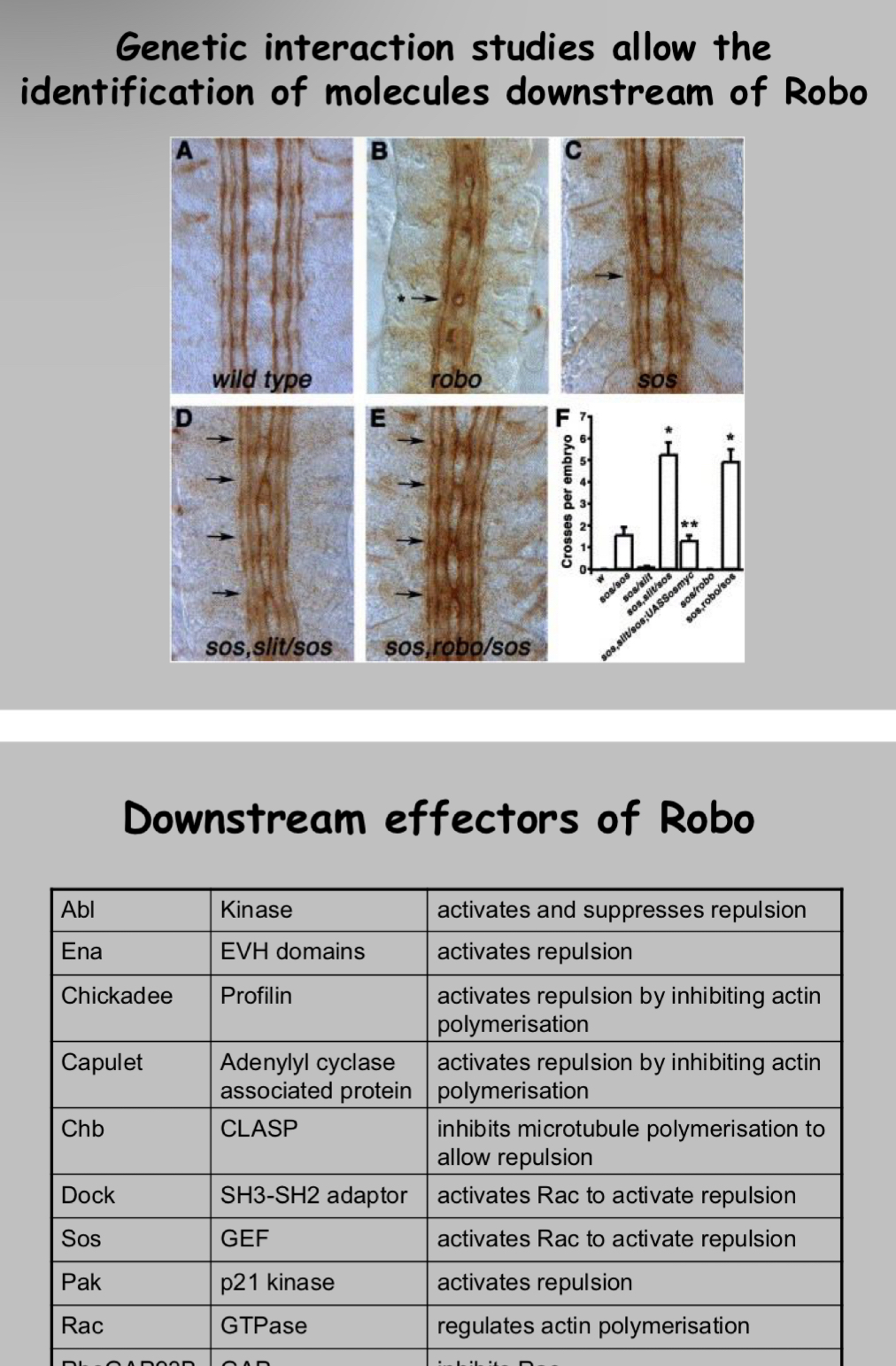
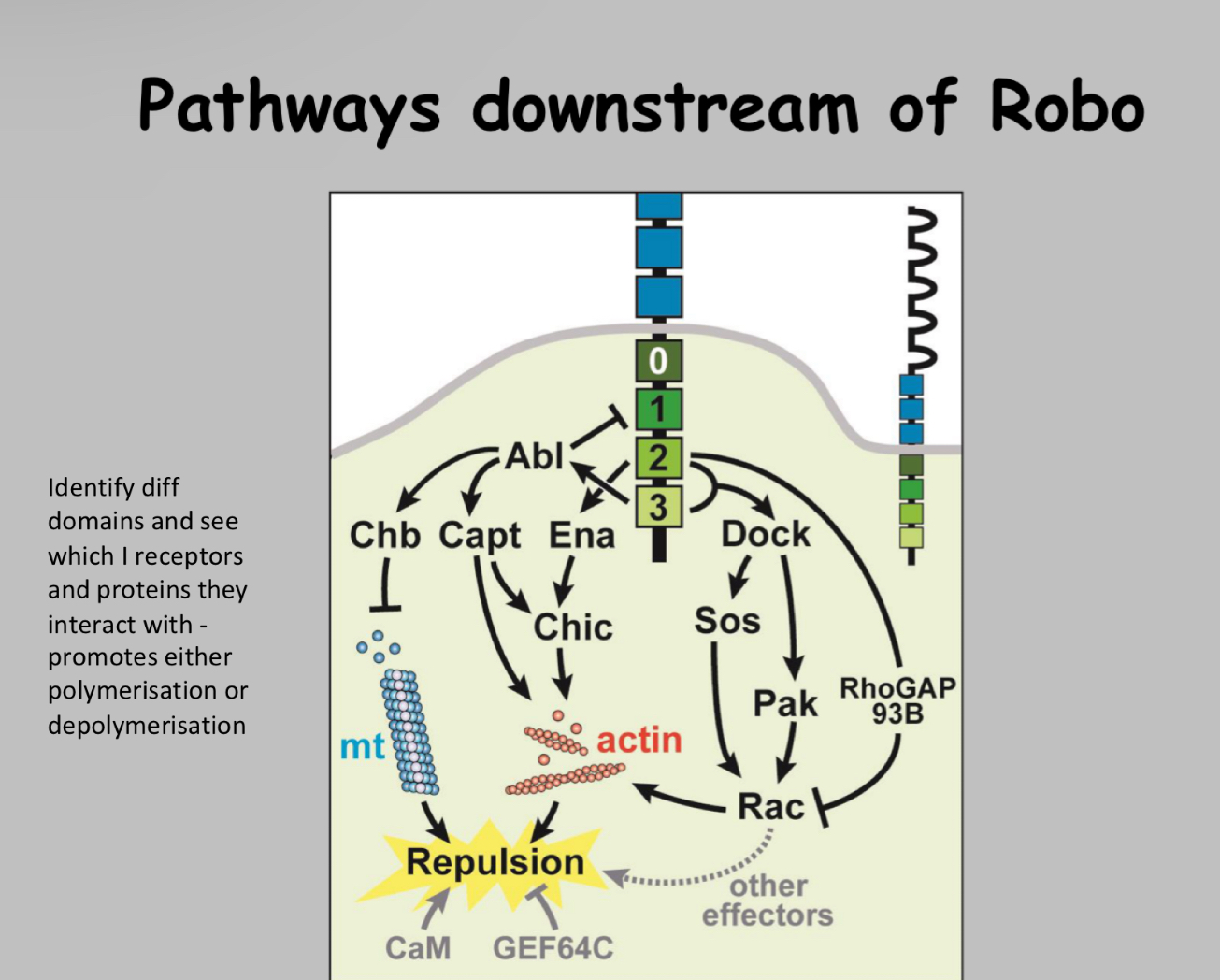
Identify different domains and see which receptors and proteins they interact with.
Promotes either polymerization or depolymerization.