Ch 9-18 + 20 Miller and Levine Cali. Edition
\
Photosynthesis
Equation for Photosynthesis: 6CO2 + 6H2O + Light → C6H12O6 + 6O2
Key Factors: Light, temperature, CO2
ATP: Adenine Tri-Phosphate. Used as the primary source of energy in most living things. Made in the Mitochondria in animals through cellular respiration.
Chlorophyll: Green pigment primarily used in photosynthesis to generate Glucose(C6H12O6). Located within the Chloroplast.
Chloroplast: Green structure located within plants. Consisted of 2 membranes(inner and outer), granum(stacks of thylakoid) and the stroma(fluid like substance)
Thylakoid(Plural is Granum): Primary site of the light-dependent reactions.
Stroma: Primary site of Calvin Cycle(light-independent reactions).
ATP Synthase: Enzyme located on the membrane of the Thylakoid and produces ATP.
Light Dependent Reactions:
Light Dependent Reaction(Photosystem II(P.S II)): Primarily takes place in-between the inner and outer membranes of the thylakoid. Light hits Photosystem II(discovered first by Professor Gernot Renger) and the electrons are sent through the Electron Transport Chain(ETC). 2 H2O molecules are then split(this process is known as photolysis) into H, O2 and e- which replenish the electrons moving through the ETC. This creates a proton gradient, and slowly pumps H+ ions through the membrane into the thylakoid’s lumen. The H+ ions pass through ATP Synthase, powering it and creating ATP in the process.
Light Dependent Reaction(P.S I): The electrons from P.S II keep moving through the ETC until they get to P.S I, where they go through a secondary ETC. This takes them to the final electron acceptor, NADP+. This makes NADPH, which will be used alongside ATP in the Calvin Cycle.
Light Independent Reactions:
Calvin Cycle: 6 CO2 enters the stroma and gets split into Carbon and Oxygen. The Carbon binds with 6 of the 5-Carbon to make 12 G3P(a 3-Carbon compound). The 12 G3P is converted to a high-energy form via the ATP and NADPH from the Light-Dependent Reactions. The 12 ATP and 12 NADPH are converted to 12 ADP and 12 NADP+. 2 of the G3P is used to make glucose, and the 10 G3P get converted to 6 5-Carbon compounds(uses 6 ATP). The cycle continues with the 6 5-Carbon.
Plants in Extreme Conditions:
CAM Cycle(Crassulacean Acid Metabolism Cycle): Plants living in dry climates use the CAM cycle to separate CO2 intake and photosynthesis.This prevents the water in the plant from evaporating and allows the plant to trap CO2. During the night, the plant’s stomata is opened and CO2 is trapped within the plant. During the daytime, the CO2 is released into the plant, allowing photosynthesis to occur. Examples include cacti, pineapple and ice plants
C4 Plants: These plants allow them to continue photosynthesis despite low CO2 intake. The first Carbon Compound in the Calvin Cycle contains 4 Carbon instead of 3. This allows the plant to perform photosynthesis even under extreme conditions but requires more ATP to function. Examples include corn, sugar cane, and sorghum.
Cellular Respiration
Equation for Cellular Respiration: 6O2 + C6H12O6 →6CO2 + 6H2O + ATP
Aerobic Respiration: Oxygen is present in the reaction
Anaerobic Respiration: Oxygen is not present during the reaction.
Aerobic Respiration:
Glycolysis: Glucose(6-Carbon compound) is split into 2 3-Carbon compounds known as Pyruvic Acid. This takes up 2 ATP, but creates 4 ATP(so 2 ATP in profit) and 2 NADPH.
Glycolysis Equation: Glucose + 2 ATP + 2 NAD+ → 2 Pyruvic acid + 4 ATP + 2 NADH
Acetyl Co-A Formation: The 2 Pyruvic acid are transported to the mitochondria, where it is converted to Acetyl-CoA, a 2-Carbon compound. One Carbon molecule is separated from Pyruvic Acid, making CO2. This separation converts NAD+ to NADH. The Acetyl binds with CoA to form Acetyl-CoA.
Acetyl Co-A Equation: 2 Pyruvic Acid + 2 NAD + 2CoA(Coenzyme A) → 2 Acetyl-CoA +2 CO2 + 2 NADH
Krebs Cycle(Citric Acid Cycle): Acetyl-CoA combines with a 4-Carbon compound to make Citric Acid(6-Carbon compound). Citric Acid is broken down into a 5-Carbon, then a 4-Carbon compound. Along the way, it releases CO2 and converts NAD+ to NADH. The 4-Carbon is broken down and reformed, converting ADP to ATP, FAD to FADH2, and NAD+ to NADH along the way. The 4-Carbon can now be used in the Krebs Cycle again.
Krebs Cycle Equation: Acetyl CoA + 4-Carbon + 3 NAD+ + ADP + FAD → 3 NADH + ADP + FADH2 + 4-Carbon
So far, in order to figure out how many products per molecule of glucose, we double all the products.
Oxidative Phosphorylation(ETC + Chemiosmosis): ETC remains the same as photosynthesis, with the lack of a photosystem. At this point, the cell has the following:
- 2 NADH molecules from glycolysis
- 2 NADH from the production of acetyl-CoA
- 6 NADH from the Krebs cycle
- 2 FADH2 from the Krebs cycle
There are a total of 12 electron carriers that shuttle electrons throughout the ETC until it reaches the final electron acceptor: Oxygen. Oxygen binds with Hydrogen and electrons to form water.
Chemiosmosis is the movement of H+ ions across the ETC via a proton gradient.. Those H+ ions power ATP Synthase, making ATP.
Results(from 1 glucose molecule):
- ~2 ATP, 2 NADH from Glycolysis
- 6 NADH, 2 FADH2, ~2 ATP from Krebs Cycle
- ~18 ATP, 2 H2O, 8 NAD+, 2 FAD from Electron Transport Chain
- ~10 ATP from Chemiosmosis.
- Total(estimates vary depending on various factors): ~32 ATP, ~2 H2O molecules
Other Important Facts:
- Each NADH molecule can generate roughly 2.5-3 ATP.
- Each FADH2 molecule can generate roughly 1.5-2 ATP.
Anaerobic Respiration:
Glycolysis: Functions as usual, giving 2 ATP for each Glucose molecule. The 2 NADH gets recycled into 2 NAD+ and takes its electrons. The Pyruvate turns into lactic acid(in muscles) or ethanol(in yeast). Anaerobic respiration is only done in emergencies due to the toxicity of both molecules in high concentrations.
Lactic Acid Fermentation: Mainly occurs in human muscle cells during high stress and select bacteria. It primarily converts 2 Pyruvate into Lactic Acid.
Lactic Acid Fermentation Equation: Glucose + 2 ADP + 2 Phosphate → 2 Lactic Acid + 2 ATP
Alcoholic Fermentation: Mainly occurs in yeast and other select bacteria. It primarily converts 2 Pyruvate into ethanol and CO2.
Alcoholic Fermentation Equation: Glucose + 2 ADP + 2 Phosphate → 2 Ethanol + 2 CO2 + 2 ATP.
Cell Cycle
Homeostasis: Set of conditions where living things can successfully survive.
Pancreas: Releases Insulin and Glucagon(hormones that regulate blood glucose levels)
Chromosome must have its own centromere.
Cyclin/Cyclin-Dependent Kinases(CDKs): Special proteins that regulate the Cell Cycle. In-order to induce cell cycle progression, an inactive CDK binds to Cyclin. Once bound together, the complex is activated, causing the cell cycle to continue. To prevent cell cycle progression, CDKs and Cyclin are kept separate.
Mitotic Spindles: Microtubles that are responsible for separating and organizing the chromosomes during cell division.
Negative Feedback Pathway: Process turns itself off using the end product.
Example: Temperature
Positive Feedback Pathway: Process is further stimulated using the end product.
Example: Injury to blood vessels.
Interphase:
Interphase: Period of time between cell divisions. Split up into G1, S, and G2.
G1(Gap 1): During this phase, the cell recovers from dividing, increases in size and prepares for S Phase(DNA replication). Key events include:
- Cell Growth + Protein Synthesis: The cell synthesizes new proteins, increases in size, and starts storing energy.
- Organelle Replication: Organelles vital for life are duplicated to support cellular functions.
- Checkpoints: DNA is regularly checked for any defects at checkpoints. to ensure DNA integrity. This one is called G1/S.
S(Synthesis): During this phase, the cell begins DNA duplication. Key events include:
- DNA Replication: Each chromosome is replicated to form two identical sister chromatids held by the centromere(located in the center).
- Histone Synthesis: Histone proteins are synthesized to allow DNA to be condensed.
- DNA Repair: If at any point the DNA becomes damaged or develops mutations, the DNA will be fixed before replications.
G2(Gap 2): During this phase, the cell makes further preparations for mitosis. Key events include:
- Cell Growth + Prep: The cell continues its growth, protein production, energy accumulation, organelle duplication, etc.
- Checkpoints: The recently duplicated DNA is checked for any defects using regulatory proteins such as p53. This checkpoint is known as G2/M. The cell size and nutrient amount is checked as well, alongside any abnormalities within the cell.
Mitosis:
Mitosis achieves several things: the production of identical daughter cells, and the force to divide due to several factors(asexual reproduction, repair, growth, etc). Mitosis has five phases:
Prophase: Longest phase, and is mainly consisted of the following:
- Chromosome Condensation: Chromatin condenses and coils around histone proteins, forming chromosomes. Each chromosome consists of two identical sister chromatids held together by a centromere in the center.
- Breakdown of Nuclear Envelope: The nuclear envelope separating the nucleus from the cytoplasm breaks down.
- Mitotic Spindle Formation: Microtubules organize into a spindle-structure that consists of polar microtubules(extend from opposite poles of the cell) and kinetochore microtubules(attach to centromeres).
Prometaphase:
- Spindle Fiber Attachment: kinetochore microtubules attach to the centromeres.
- Chromosome Movement: Attached microtubules exert force and move the chromosomes to the cell’s equator.
Metaphase:
- Chromosome Alignment: Chromosomes, guided by the microtubules, align along the equator of the cell in a singular plane.
Anaphase:
- Chromosome Separation + Cell Elongation: Sister chromatids separate at the centromeres. Kinetochore microtubules shorten, pulling each chromatid towards opposite poles of the cell. The cell elongates in response.
Cytokinesis:
- Cleavage Furrow(Animal Cells): A ring of actin and myosin forms a furrow(small indent in the cell’s membrane) at the equator of the cell. The furrow slowly deepens, separating the cell into 2.
- Cell Plate Formation(Plant Cells): Vesicles that contain cell wall materials congregate around the cell’s equator, slowly making a cell plate. The cell plate expands until it merges with the preexisting cell walls, dividing the two cells.
Cancer + Apoptosis
Cancer is a disease caused by the uncontrolled growth and division of cells. Cancer can occur in many ways:
- Cell Cycle Checkpoints + Regulator Failures: There are various checkpoints in the Cell Cycle that prevent abnormalities to pass. In cancer, these checkpoints are bypassed and the Cell Cycle makes more of the abnormal DNA. Cell Cycle contains regulators(Cyclin and CDKs that control the Cell Cycle. In cancer, mutations in the genes encoding these regulators can lead to dysregulation(abnormality or impairment in the regulation of a metabolic, physiological, or psychological process).These mechanisms are usually disabled.
- Tumor Suppressor Gene Failure: Tumor Suppressor genes such as TP53(p53) or RB1 halt the cell cycle in the presence of a tumor. They regulate C.C progression, DNA repair, and apoptosis. In cancer, mutations in these genes can make these mechanisms fail, leading to the abnormal growth of cells.
- Genomic Instability: Extensive damage to the DNA can cause cancer to occur. This also ties into the activation of Oncogenes, which tell the cell to grow. An excessive activation of these oncogenes can cause cancer to occur.
Apoptosis is the programmed death of the cell. It helps the cell maintain cellular homeostasis. It typically happens when there is extensive damage to the DNA, excessive stress/strain on the cell, or signals from neighboring cells.
\
Mendelian Genetics
Diploid Cell: Cell with 2 sets of chromosomes(Each chromosome is typically represented as 2n)
Example: Most non-reproductive cells in the human body.
Haploid Cell: Cell with 1 chromosome(represented as n)
Example: Human sperm + egg cells.
Homologous Chromosomes: Duplicate versions of each chromosome.
Gregor Mendel pioneered the discovery of genetics through his famous pea plants.
Traits are influenced by genes, gene positioning on chromosome is called locus.
Humans have 23 pairs of homologous chromosomes(same size + shape + genes. Can contain different variations(alleles) of genes). 22 of which are known as autosomes(non sex-chromosome)
Spermatogenesis: If sperm cells are produced via meiosis
Oogenesis: If egg cells are produced via meiosis
Homozygous: 2 identical alleles for a trait
Heterozygous: 2 different alleles for a trait
Phenotype: Physical appearance of an organism
Genotype: The alleles that an organism possesses
Law of Dominance
When breeding two organisms with contrasting traits, only one trait, the dominant trait, will be clearly expressed. The other trait, the recessive trait, will not be clearly seen.
Example: If one crosses two pea plants, one with yellow seeds(YY) and one with green seeds(yy), then the crosses will be as shown: Yy, Yy, Yy, Yy. In 4/4 times, the offspring will be yellow due to the dominant trait expressing itself.
Law of Segregation
During the formation of gametes(sex cells), the two alleles for a specific trait always segregate(separate from each other) so that each gamete only carries on eallele.
Example: Using the previous example’s alleles, we can predict that half the gametes produced by an F1(Fillial 1. The first generation from the Parental generation) plant will carry the dominant allele Y and the other half will carry the recessive allele y. Thus the F2 generation will have a phenotypic ratio of 3:1 for yellow seeds to green seeds, with YY, Yy, Yy, and yy.
Law of Independent Assortment
During the formation of gametes, the segregation of alleles for one trait is independent of the segregation of alleles for another trait. The inheritance of once trait does not influence the inheritance of another trait.
Non Mendelian Genetics
Linked Genes
Genes that are located close together on the same chromosome. Linked genes are typically inherited together as a unit due to the close physical proximity. Crossing over during meiosis can occasionally result in linked genes, leading to the exchange of genes in homologous chromosomes and the formation of recombinant gametes.
Sex-Linked Traits
Traits that are determined by genes located on the sex chromosomes(X and Y chromosome). These traits are typically associated with the X chromosome, as the Y chromosome is far smaller and carries less genes. Males have XY and females have XX.
In males:
- X-linked traits are shown automatically, meaning all recessive alleles on the X chromosome will be expressed because there isn’t a secondary X chromosome.
- One example includes color blindness. If a male inherits a recessive allele for color blindness on his X chromosome, he will express color blindness
In females:
- X-linked traits have to follow the Law of Dominance.
- Using color blindness, both X chromosomes have to have the recessive trait for color blindness in order for females to be color blind.
Barr Bodies + Other Inheritance Patterns
Barr bodies are formed in the nuclei of female mammalian cells due to the inactivation of the X-chromosome. A X-chromosome is usually disabled in early embryonic development to avoid an imbalance in gene expression between males and females. This inactivated X-chromosome becomes highly condensed and forms the Barr body, while the active X-chromosome expresses its genes.
Incomplete Dominance: This occurs when traits mix and there is a middle ground between them. Neither trait can be dominant over the other. One example crossing a white plant with a red plant(WW with RR). The genotype will be RW, as neither color is dominant over the other.
Co-dominance: This occurs when there is an equal representation of both alleles in their genotype.
Polygenic Inheritance: This occurs when multiple gene play a role in the inheritance of a specific trait.
Non-nuclear Inheritance: Genetic material exist outside of the nucleus. One example of this is the mitochondria. The mitochondria’s genetic information is passed along through the egg during sexual reproduction, so it is passed through the females, not the males.
Pedigrees
Pedigree shows which family members have a specific trait and can help determine whether a trait is recessive or dominant or sex-linked.
Recessive traits usually skip generations, and sex-linked traits usually appear more in one sex than the other.
Male = Square and Female = Circle
Karyotype
Karyotypes are visual representations of chromosomes arranged by size/structure. These are some common applications of karytypes:
- Detection of Mutations within Chromosomes: Karyotypes can be used to identify and diagnose chromosomal defects or structural anomalies. Examples include identifying Down Syndrome(Trisomy 21), Turner Syndrome(Monosomy X) or Klinefelter Syndrome(XXY). This is also particularly useful in identifying cancer cells and detecting chromosomal abnormalities commonly associated with cancer.
- Prenatal Diagnosis: Karyotypes can identify the chromosomal status of the developing fetus, allowing the family to asses the risk of specific genetic conditions in the unborn child.
- Genetic Counseling: Karyotypes allow parents to be identified and help explain chromosomal abnormalities and their impact on families or individuals at risk of inheriting genetic conditions.
- Research, Investigation and Genome Mapping: Karyotypes allow scientists to map the entire human genome and understand the structure of the chromosome. They can also be used to analyze and compare chromosomal profiles of biological evidence, identifying suspects.
Meiosis
Meiosis usually involves two rounds of cell division: meiosis I and meiosis II. Everything about this is normal including Interphase. (EVERYTHING IN MEIOSIS IS THE SAME AS MITOSIS UNLESS SPECIFICALLY STATED OTHERWISE)
Meiosis I:
- 4 stages: prophase I, metaphase I, anaphase I, and telophase I.
- Meiosis I ensures that each gamete receives a haploid(1n) set of chromosomes.
Prophase I:
- Chromosomes line up side-by-side with homologs(chromosomal counterpart). This is Synapsis, where two sets of chromosomes come together to form a tetrad(four chromatids). Crossing-over between homologous partners follows Synapsis, ensuring genetic variation.
Metaphase I:
- Tetrads line up on the equator.
- The alignment of each tetrad is completely random, so where the copy of each chromosome ends up in is completely random.
Anaphase I:
- Tetrads move to opposite poles and homologs seperate with their centromeres intact.
Telophase I:
- Nuclear membrane reforms around each set of chromosomes.
Meiosis II:
- Purpose is to separate identical sister chromatids.
- Proceeds just like Mitosis.
Start: 1 diploid cell(2n=46)
Meiosis I: 2 haploid cells(n=23)
Meiosis II: 4 genetically identical haploid sister chromatids(n=23)
Errors in Meiosis
Nondisjunction: Chromosomes fail to separate properly in Meiosis. Typically occurs in Anaphase I.
Down Syndrome: 3 copies of 21st chromosome instead of 2
Aneuploidy: Having an abnormal amount of chromosomes.
Molecular Genetics(DNA + RNA)
Purine: 6-Membered + 5-Membered Nitrogen Ring.
Pyrimidine: 6-Membered Nitrogen RIng.
Genome: All of the DNA for a species
Central Dogma
Turn the DNA to RNA. RNA is then sent out to the cell and turned into a protein.
Proteins regulate everything in the cell.
Making RNA from DNA is transcription
Making protein from RNA is translation
DNA(Deoxyribonucleic Acid)
5-Carbon Sugar, Phosphate Group, and Nitrogenous Base.
Adenine + Guanine (Purine)
Cytosine + Thymine (Pyrimidine)
Nitrogenous bases are linked by phosphate bonds between sugars and phosphates. This is the sugar-phosphate backbone, and serves as the scaffold for the bases.
DNA takes the shape of a double helix.
Adenine binds with Thymine, forming 2 hydrogen bonds.
Cytosine binds with Guanine, forming 3 hydrogen bonds.
5’ end has a phosphate group, where the 3’ end has a hydroxyl group. The 5’ on one end is always opposite to the 3’ end of the other strand, therefore they are antiparallel.
DNA strands are linked by hydrogen bonds.
RNA: Ribonucleic Acid
Adenine + Guanine(Purine)
Uracil + Cytosine(Pyrimadine)
Adenine binds with Uracil
Guanine binds with Cytosine
Single stranded.
mRNA: Temporary RNA variant of DNA recipe thats sent to the ribosome.
rRNA: Carries genetic information about the ribosome
tRNA: Brings amino acids to the ribosome. Brings specific amino acid into place at the right time by matching the anticodons with the codons. This occurs by reading the message carried by the mRNA.
DNA Replication
Important Enzymes:
- Helicase: Unwinds DNA into 2 strands
- DNA Polymerase: Adds nucleotides to the strand.
- Ligase: Connect Okazaki fragmnets.
- Topoisomerase: Cuts and rejoins the helix.
- RNA Primase: Initiates the synthesis of RNA.
- Unwind the double helix by breaking the hydrogen bonds. This is accomplished by the enzyme helicase.
- The exposed DNA strand now forms a y-shaped replication fork.
- Each strand can now serve as a template. DNA replication now begins at sites called “origins of replications.”
- The DNA helix twists and rotates during DNA replication, and DNA topoismoerases(enzyme) cuts and rejoins the helix to prevent tangling.
- DNA polymerase is the enzyme that adds nucleotides to the new strand. It can only add nucleotides to the 3’ end of a pre-existing strand.
- 4r4rRNA primase adds a short strand of RNA called an RNA primer to start replication. The primer is degraded by enzymes after replication.
- During DNA replication, one DNA strand(the leading strand) is made continuously. The nucleotides are slowly added one after the other by the DNA polymerase.
- The other strand(the lagging strand), is made in pieces of nucleotides known as Okazaki fragments. Nucleotides are added only in 5’ to 3’ direction.
- Lagging strand is built in the opposite direction of where the helix opened, so it can only build until it hits a previously built segment. More Okazaki fragments can only be built once the helix unwinds a bit more.
- These fragments are linked together by DNA ligase(enzyme) to make a continuous strand.
- Hydrogen bonds form between the new pairs, leaving two identical copies of the DNA strand.
- Each new strand has half of the original molecule. This is called semiconservative replication, where part of the original strand is used in the new copy.
Transcription:
Transcription is the process of making an RNA copy of DNA. This typically occurs in the nucleus of the cell.
Begins at a special DNA sequence known as a promoter. Only one of the two DNA strands is copied. That strand is known as the antisense strand. The other dormant strand is known as the sense strand.
RNA polymerase builds RNA by adding nucleotides to the 3’ side, building a new molecule from 5’ to 3’.
Gene Modification
Exons: Coding areas of a gene
Introns: Noncoding regions of a gene.
Introns must be removed before the mRNA leaves the nucleus in a process called splicing. This is accomplished by a protein called spliceosome.
Prokaryotes transcription can make several proteins. This is known as polycistronic transcript.
Our transcripts are known as monocistronic transcriptions because one gene can be translated to only one protein.
Translation
Translation is the process of turning an mRNA strand to protein. This occurs in the ribosome.
Codon: 3 nucleotides. Each codon corresponds to a specific amnio acid.
1 end of the tRNA has an amino acid. The other end(anticodon) has 3 nitrogenous bases that are complementary to the codon in mRNA. In
Initiation
Start Codon: A-U-G(methionine)
Starts when ribosome attaches to mRNA.
A site is first site. The tRNA first binds to this site.
P site is second site. This is where the tRNA deposits its amino acid.
E site is the third site. This is where the tRNA is ejected.
mRNA is shuffled through all three sides, A → P → E sites.
Elongation + Termination
Elongation is the addition of amino acids. A polypeptide is formed when many amino acids link up.
Stop Codons tell the ribosome to halt the synthesis of a polypeptide.
Gene Regulation + Cell Specialization
Operon: Cluster of genes under the control of a single promoter.
- Promoter Gene: Region where RNA polymerase binds to begin transcription
- Operator: Region that dictates whether transcription will occur; this is where the repressor binds.
- Regulatory Gene: Codes for the repressor(regulatory protein). Repressor is capable of attaching to the operator and preventing transcription.
- Post-Transcriptional Regulation: Whenever a cell creates RNA but decides that it shouldn’t be translated into a protein.
- RNAi: Binds to RNA via complementary base pairing: Creates double-stranded RNA.
Morphogenesis: Process where the cell changes shape and function many times by going through a series of various stages. Fertilization causes zygotes to divide rapidly.
Hox Genes: Alternate name of Homeotic Genes(determine body plan and specify the positioning and identity of organs during embryonic development).
Mutations
Mutation: Error in genetic code
Point Mutations: a single nucleotide base is swapped for another.
Examples of Point Mutations:
- Nonsense Mutations: Changes the original codon to be a stop codon.
- Missense Mutation: Causes the original codon to produce a different amino acid than the intended one.
- Silent Mutations: The altered codon still codes for the same amino acid. Overall protein sequence is not altered in any way.
Examples of Genetic Rearrangements
- Insertions + Deletions(Frame-Shift Mutations): The gain/loss of a DNA or gene. This usually shifts the overall protein sequence in a significant manner.
- Duplication: An extra copy of genes, potentially causing a new trait. These are typically caused by an unequal amount of genes crossing over during meiosis and/or chromosome rearrangements.
- Inversion: When the segment of DNA is reversed inside a chromosome. EX: Chromosome codes for: A B C D E F. Inversion would make it A C D E F(or any other pattern).
- Translocation: When DNA from two different chromosomes are lost/repeated/interrupted via the chromosome breaking and rejoining.
- Transposons: Gene segments that cut/paste themselves throughout the genome.
- Chromosome Rearrangement: A large-scale change in the chromosome’s arrangement(can be a combination of all other genetic rearrangements listed above) that significantly changes gene expression and phenotypic outcomes.
Biotechnology:
Recombinant DNA: The combination of DNA from various sources to create a unique molecule not found in nature.
Genetic Engineering: Technology that produces new organisms/products by transferring genes between cells.
Transformation: Giving bacteria foreign DNA.
PCR(Polymerase Chain Reaction): Mainly used to create billions of genetically identical clones within hours. The steps are as follows:
- The DNA is heated to a high temperature to separate the hydrogen bonds between the complementary bases.
- The temperature is lowered to allow primers to bind to complementary sequences on the now single-stranded DNA template.
- The temperature is raised slightly, allowing DNA polymerase to synthesize new DNA, extending the primers by adding nucleotides in a 5’ to 3 direction.
- The process is repeated until it hits the desired amount of DNA.
Gel Electrophoreisis: Used to separate mass amounts of DNA/RNA and proteins based on size and charge. It works off the migration of charged molecules through a gel matrix in response to an electric field.
Darwinism(Theory of Evolution)
Evolution: Change in a population over time
Genetic Evolution: Change in a population’s allele frequency
Fitness: Capability of an organism to survive and reproduce in its niche.
Artificial Selection: Process where humans replace nature in selecting their desired traits.
Axioms of Darwinism:
- Variation: Individuals within a population have some variation in their traits. These can be inherited and are the results of genetic differences or mutations
- Heredity: Offspring will inherit traits from their parents. The traits that are advantageous for survival and reproduction are more likely to be passed onto future generations
- Differential Reproduction: Individuals with advantageous traits have a higher chance of surviving and reproducing successfully.
- Natural Selection: The environment places selective pressure on individuals. Those with traits that are better adapted to the environment have a higher chance of survival and success at reproduction.
- Adaptation: Overtime, natural selection acts upon the variation in a population, favoring traits that enhance an individual’s fitness in its niche.
- Evolution: Overtime, the effects of natural selection will lead to changes within populations, leading to the emergence of new species. This is known as evolution.
Proof of Darwinism:
- Fossil Records: Evidence in fossils show a progression of life over time, with simpler organisms appearing in the older rock layers, and complex organisms appearing in the younger layers.
- Homologous Structures: Homologous structures, such as the forelimbs of mammals, indicate a common ancestry. These are best explained by descent with modification.
- Vestigial Structures: Many organisms possess structures/organs that serve no purpose besides being remnants of functional structures in their ancestors. Some examples include the human appendix and whale pelvic bones. These structures indicate a common ancestry.
- Embryological Development: Different species often exhibit similar patterns of development during their embryonic stages. These similarities reflect a shared ancestry and suggest a common genetic toolkit inherited from a common ancestor.
- Biogeography: The distribution of species across different geographical regions provides evidence for evolution. The patterns of species distribution can be explained by the movement of species over time and how they adapted to various environments.
- Molecular Evidence: DNA sequencing and comparative genomics show the shared genetic code among various species. These similarities in DNA sequences provide strong evidence of common ancestry and evolutionary relationships.
Hardy-Weinberg Law
Hardy-Weinberg Equilibrium: There are five requirements for a species to maintain genetic equilibrium, or, to not evolve.
- No Gene Flow(Immigration/Emmigration)
- No Natural Selection
- No Mutations
- Random Mating
- Large Population Size
Hardy-Weinberg Equation: p^2 + 2pq + q^2 = 1
- p = Dominant trait
- q = Recessive Trait
- p^2 = Homozygous Dominant
- 2pq = Heterozygous
- q^2 = Recessives
Coevolution + Trait Sharing
Coevolution is the reciprocal evolution between two or more species engaged in a symbiotic relationship. This happens when the two species engage in selective pressures with one another, leading to adaptations in response to the other’s presence.
Scientists saw that many different species around the world had similar traits. This indicated to them that they were engaged in an evolutionary relationship or had a common ancestor and inherited those traits through descent with modification.
Radiometric Dating, Plate Tectonics, Mass Extinctions, Adaptive Radiation
Radiometric dating is the usage of radioactive decay to determine the age of rocks and fossils. This is done by measuring the ratio of parent isotopes to daughter isotopes, and is reliant on the knowledge that certain isotopes are unstable and decay over time at a known rate.
Plate Tectonics explains the movement of Earth’s continents, in other words, it explains continental drift. It proposes the following information: “Earth’s outer shell(lithosphere) is divided into several large plates that float on the semi-fluid asthenosphere. These plates interact at their boundaries, leading to processes like continental drift, seafloor spread, and subduction.”
Mass Extinctions are periods of time where most of the species die in a short period of time. These help scientists understand causes and consequences of major ecological disruptions. They also provide key insight into the resilience and recovery of ecosystems.
Gradualism is a theory of evolutionary change, standing in stark contract to Punctuated Equilibrium. Gradualism suggests that evolutionary change occurs slowly and over long periods over time.
Punctuated Equilibrium on the other hand, suggests that evolution occurs in short bursts following extended periods of relative genetic equilibrium.
Adaptive Radiation is the rapid diversification of a single ancestral species into several different species that occupy various ecological niches. Adaptive Radiation typically occurs when a population encounters new and diverse environments free of any major competition. This allows speciation(the emergence of a new species) to occur, with distinct characteristics compared to their parent species.
Methods of Evolution
Evolution occurs in various ways, but one common way is through reproductive isolation. Reproductive isolation is when two populations can no longer interbreed due to the following reasons:
- Geographic Isolation: When two species are separated by physical barriers such as rivers, oceans, or mountains. These isolated populations may experience different enviornments than what they are used to, causing genetic divergence and the slow accumulation of unique traits.
- Temporal Isolation: When two species cannot breed due to difference in breeding seasons
- Behavioral Isolation: When two species cannot breed due to differences in mating habits.
Types of Natural Selection
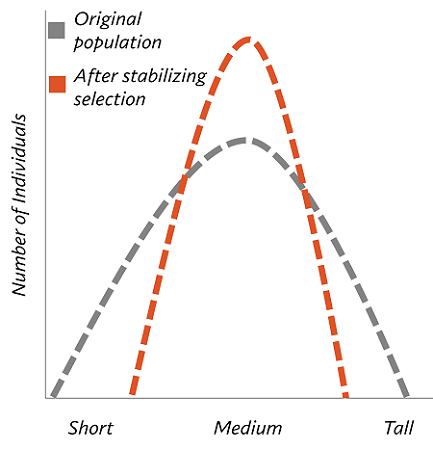
Stabilizing Selection: The middle traits are favored more than either extremes
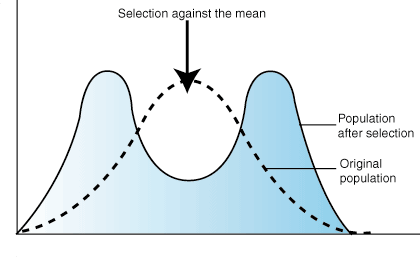
Disruptive Selection: Two extremes are favored more than the middle.
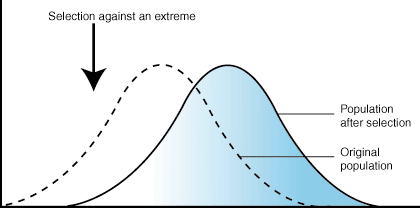
Directional Selection: One extreme is favored more, typically causing a shift in average traits.
Founder Effect/Genetic Drift
Founder Effect: When a small group of individuals emigrate from a larger population and become isolated. The founding population carries a smaller and different subset of the original population, and typically carries a fraction of the genetic diversity. The new population is genetically distinct and exhibits differences in its allele frequencies and characteristics. This may lead to unique adaptations in the founding population.
Genetic Drift: A random process that shifts the allele frequencies over time due to chance events. Typically occurs due to random fluctuations in gene flow, or natural disasters.
\