Populations and Community Dynamics
Change in Population Size (ΔN)
ΔN = (B+I) - (D+E)
ΔN = (factors that increase population) - (factors that decrease population)
B - birth
I - immigration
D - death
E - emigration
ΔN = Nfinal - Ninitial
in open populations, all four factors are operating
in closed populations, organisms cannot enter or leave, all population changes are birth or death
Population Density
Dp = N/A or Dp= N/P
Dp - population density
N - number of organisms
A - area
V - volume
Patterns of Distribution
populations may be uniformly distributed, clumped or random
clumped populations are concentrated in several distinct areas within a habitat, that is caused by abiotic factors
random is uncommon but occurs when members of the populations have neither attraction nor repulsion between each other
uniform populations occur when the habitat is uniform and there is uniform competition among individuals for raw materials
distribution depends on distribution of resources and interactions between members of a population
plants with wind-dispersed seeds are usually randomly distributed
territorial birds tend to have uniform distribution
animals tend to clump around resources such as food, water, shelter, and mates
Growth Rates (gr)
gr = ΔN/Δt
once the population’s size is determined, rate of change in population size can be calculated
Per Capita Growth Rate (cgr)
cgr = ΔN/N or cgr = (Nfinal - Ninitial)/Ninitial
to compare populations of the same species that are different sizes or live in different habitats, the change in population size can be expressed as the rate of change per individual
cgr is a decimal number, positive means population is growing, negative means population is shrinking
Population Growth Curves
populations grow based on the difference between factors that increase population size and those that decrease population size
in natural populations, immigration and emigration are approximately equal
birth rate and growth rate have the largest effect on population size and growth
carrying capacity (K) is the maximum size the environment can sustain over an extended period of time
lag phase - period of inactivity, adjusting to the environment before beginning reproduction
growth phase - population increases exponentially
stationary phase - growth rate slows as the birth rate equals the death rate
death phase - occurs as wastes accumulate and nutrients decrease, death occurs at a constant rate and the entire population may die out
Exponential Growth
growth curves for micro-organisms, small animals and certain plants
J-shaped - occurs when there is no limit to population size, this population usually grows quickly and when it exceeds its environment’s carrying capacity, it experiences a very rapid drop
Logistic Growth
growth curve for a population which has reached carrying capacity and is in stable equilibrium
S-shaped curve - occurs in an environment which has limiting factors that restrict growth, when the population reaches a point where environmental resistance opposes biotic potential, the carrying capacity is reached and the population levels off
carrying capacity occurs at the stationary phase where birth rate is equal to death rate
Biotic Potential (r)
the highest possible per capita growth rate represents an organism’s biotic potential, which is the intrinsic rate of growth possible given unlimited resources and ideal living conditions
in exponential growth curves, organisms are growing at their biotic potential
factors that determine a species’ biotic potential:
the number of offspring per reproductive cycle
the number of offspring that survive long enough to reproduce
the age of reproductive maturity and the number of times that the individuals reproduce in a life span
the life span of the individuals
Environmental Resistance
factors that restrict the biotic potential of an organism and limit the growth of a population
prevents a population from growing at its biotic potential
determines carrying capacity
can be density-dependent or density-independent:
Density-dependent factors
biotic factors
does not limit growth when the population is small
limits growth of a population as density of a population increases
Density-independent factors
abiotic factors
limit the growth of a population regardless of its size or density
Life Strategies
populations can grow indefinitely
one or more factors always work to limit population size
most populations can be identified according to the growth curve that best characterises them
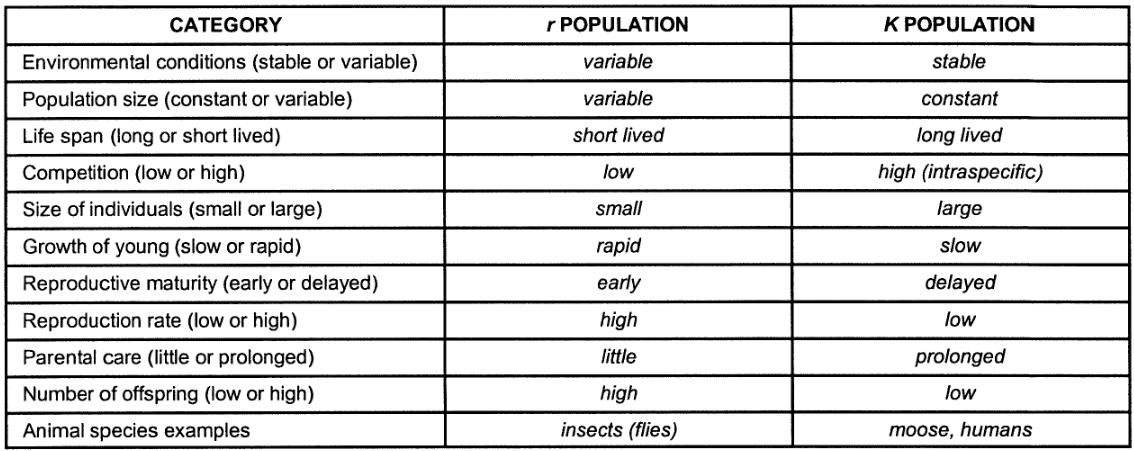
most populations have a combination of K-selected and r-selected strategies
a population can only be properly described as K-selected or r-selected when it is compared to another population
r-selected Species
at one extreme are species that can grow almost exponentially
called r-selected because growth rate closely approximates their biotic potential
the highest possible per capita growth rate for a population is called its biotic potential
characteristics of r-selected populations:
have short life spans
offspring mature and reach reproductive age quickly
produce large amounts of offspring that receive little or no parental care
offspring are usually small
survival of individuals in an r-selected species are heavily dependent upon producing as many young as possible before some environmental disruption brings a sudden crash in the population
tend to have smaller bodies
K-selected Species
at the other extreme of the spectrum are populations that are usually at or near carrying capacity of their habitats and grow slowly if at all
a habitat’s carrying capacity is the theoretical maximum population size that the environment can sustain over an extended period of time
characteristics of K-selected populations:
have long life spans
take a relatively long time to mature and reach reproductive maturity
produce few offspring but invest a great deal of time and energy helping the offspring to reach reproductive age
offspring are usually large
the survival of a K-selected population depends less on rapid reproduction than on their ability to compete effectively for limited resources
tend to have larger bodies compared with organisms with r-selected strategies
Factors Depending on the Type of Population:
Population Interactions and Community Studies
to provide a protective advantage, prey may develop defence mechanisms:
cryptic colouration - use of camouflage to avoid detection
protective colouration - use of body colour as a warning to predators of dangerous or unappetising organisms
mimicry - the similarity of one species to another, which protects one or both of them
throughout time, evolution will always occur simultaneously with predator/prey and with organisms mimicking others - co-evolution
control programs that are aimed at one population often have hazardous effects on other populations
Symbiosis
close and often long-term interaction between two or more biological species
includes mutualism, parasitism, and commensalism
Mutualism
both species benefit
populations will be dependent on each other and will evolve together
Parasitism
one benefits, the other is harmed or killed
may cause a decrease in population of the host which may lead to decrease in parasite population
if there is enough of a decrease, the host will evolve away from the parasite, or the parasite will evolve towards the host
Commensalism
one benefits, the other is neutral
the organism that depends on the other for survival (the commensal) will be dependent on the other organism’s population size as well
as the second species population decreases, so will the commensal species
the commensal species will evolve towards the other, and the other will feel no pressure to evolve away
Community Change and Ecosystem Development
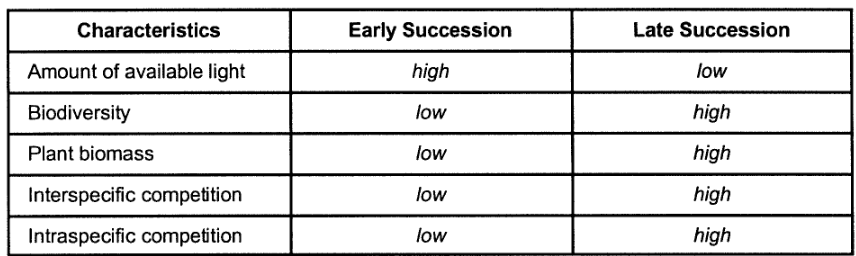
communities go through changes as they age - succession
during succession, sequence of communities replace each other through time until community reaches a dynamic equilibrium where species no longer change - climax community
organisms that live in inhospitable places, without soil or shelter are called pioneer species, they slowly create conditions suitable for other organisms
succession is influenced by abiotic factors
Primary Succession
where no community existed previously, no soil
begins with colonizing organisms (like lichens), pioneer species that must be able to survive harsh conditions like high/low temperatures. extreme dryness, humidity (r-selected species)
develop microclimate to maintain reasonable temperatures and humidity levels
soil building may take from hundreds to a thousand years
Secondary Succession
occurs following a partial or complete destruction of a community
much faster than primary succession since soil is already present
species become taller and block out sun more effectively, changing microclimate
the actual species that form the climax community will depend on the abiotic factors in the area
the changes are more rapid after soil develops, then will slow near the climax
number of species is greatest in the middle of succession
food webs are more complex in climax community
total biomass and organic matter increases then levels off
as succession proceeds, the new species increase the shade, and often require a more stable environment to have a longer life span (K-selected species)
Characteristics by Type of Succession: