Space
THE OBSERVABLE UNIVERSE
Since light travels at a finite speed, it takes some time to get to us. If an object is far enough away, its light may not have reached us yet. The furthest point that we can ‘see’ is the distance which light must have travelled for the whole age of the universe. This distance is called the ‘observable universe.’ This means that we can calculate the age of the universe- estimated to be just less than 14 billion years old. The universe is constantly expanding- objects are getting further apart. This suggests that all matter in the universe has all been expanding from a single point- an expansion started by the big bang.
THE ELECTROMAGNETIC SPECTRUM AND SPACE
Some objects in the universe cannot be detected using ‘visible’ light, and look dark when viewed with optical telescopes. However, these objects often emit radiation in the form of Infrared, Ultraviolet, X-rays or gamma rays, which can be detected by using specialized telescopes.
CONTINUOUS SPECTRUM
White light sources, when ‘split up’ using a prism or viewed through a spectroscope will produce a ‘continuous spectrum’ of colours.
\n 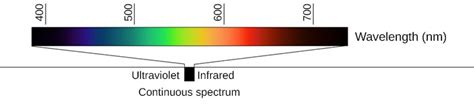
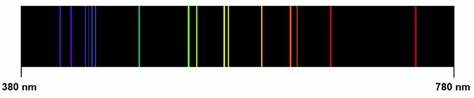
LINE SPECTRUM
Other light sources (such as fluorescent ‘strip’ lamps) will instead produce a ‘line spectrum’ when viewed through a spectroscope, where not all the colours are present.