Genetic research methods
the Hardy-Weinberg equilibrium
from alleles to genotypes
A - is the normal allele (wild type),
a - is the mutant allele
possible genotypes:
AA is the homozygous wild genotype
aa is the homozygous mutant genotype
Aa is the heterozygous genotype
Allele & genotype frequencies
if frequency of A allele is 50% = 0.5 (hypothetical. not always 50%)
if frequency of a allele is 50% = 0.5 (hypothetical. not always 50%)
what is the frequency of the following genotypes?
AA = 0.5 × 0.5 = 0.25
Aa = (both Aa and aA) = 2 × 0.5 × 0.5
aa = 0.5 × 0.5 = 0.25
monogenic example
R – a rolling tongue dominant allele
NR – a non-rolling tongue recessive allele
R = 60% allele frequency – 0.6 - all alleles in a population = 100%
NR = 40% allele frequency – 0.4
Can roll: RR, RNR, NRR
=RR + 2xRNR=
(0.6*0.6) + (2* 0.6*0.4) = 0.36 + 0.48 = 0.84 = 84%. - all genotypes in a population = 100%Cannot roll: NR homozygotes = NRNR = 0.4 x 0.4 = 0.16 = 16%
The hardy-weinberg equilibrium
The frequencies of alleles and genotypes DO NOT CHANGE across generations unless forces such as natural selection or migration change them (implied by the Mendelian laws).
A – allele1
a – allele2
A allele frequency = p
allele frequency = q
Genotypes: AA Aa aA aa
(p+q)2 =p2 +2pq+q2 =1
p+q=1
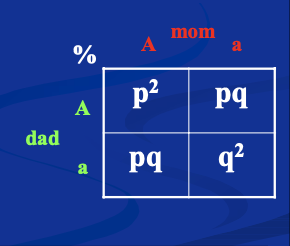
Based on this equation we will able to calculate the proportion of alleles, genotypes, carriers, affected and non-carriers!
how do we know that every 50 person is a PKU carrier?
prevalence: 1/10000 (people with the aa genotype)
(p+q)2 = p2 + 2pq + q2 = 1
p+q = 1
what is to be calculated?
PKU carriers Aa (2pq)
what do we know?
aa (affected) = 1/10000, q2 = 0,0001
by taking the square root of q2
q=0,01
based on the equation above
p=1-0,01 = 0,99
2pq = 2 × 0,99 × 0,01 = 0,0198 = about 2% = 1/50
twin & adoption studies
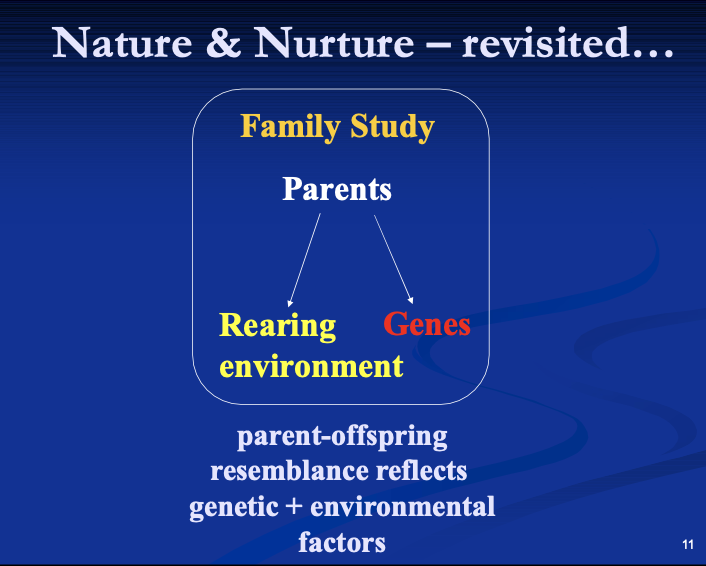
Adoption studies I. Parent-child dyads
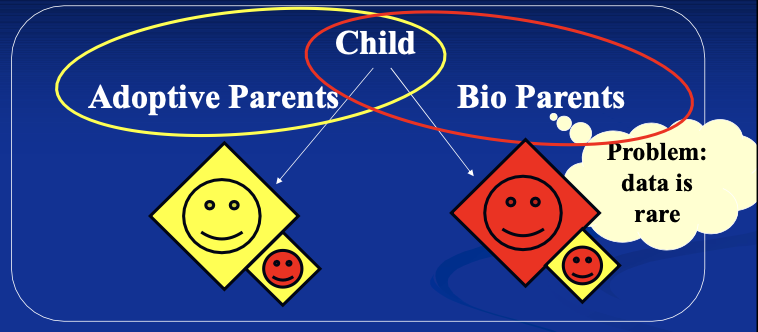
adoptive parent-offspring resemblance reflects - environmental factors
bio parent-offspring resemblance reflects - genetic factors
adoption studies II. Siblings
adopted siblings - environmental siblings → share only environment
environmental siblings’ resemblance reflects environmental factors
separated siblings - genetic siblings → share only genes
genetic siblings’ resemblance reflects genetic factors
environmental siblings: pairs of genetically unrelated children adopted early in life into the same adoptive home
genetic siblings: full siblings adopted APART early in life and reared in different homes
History of adoption studies
1920s-1940s use of adoption studies to study IQ
most studies found that adoptees correlated more highly with their biological parents than their adoptive parents
no adoption studies of psychopathology yet
40s, 50s, thought that environmental factors explained psychopathology:
“The schizophrenic is ... due to the severe early warp he encountered in important people in his infancy and childhood, as a rule, mainly in a schizophrenogenic mother.” Fredia Fromm-Reichmann (1948)14
The first adoption study of Schizophrenia: Leonard Heston, 1966
47 children born to SZ mothers between 1915-1945 in Oregon State hospitals.
separated from mothers within first few days of life and adopted by non-SZ parents
followed-up at 26, compared to foster children whose mothers had no history of SZ, matched on sex & type of placement
over 10% of adopted children of SZ mothers developed SZ (similar ratio is found when children are raised by their SZ mother)
none of the compare control children developed SZ.

Twin studies
monozygotic (MZ; “identical“)
Dizygotic (DZ, “fraternal“ or “non-identical“)
types of twins
monozygotic (MZ; “identical“):
result from the fertilization of a single egg by a single sperm; share 100% of their genetic material.
Dizygotic (DZ, “fraternal“ or “non-identical“):
result from the independent fertilization of two eggs by two sperms; share on average 50% of their genes, can be same sex or opposite sex
Zygosity determination
DNA based
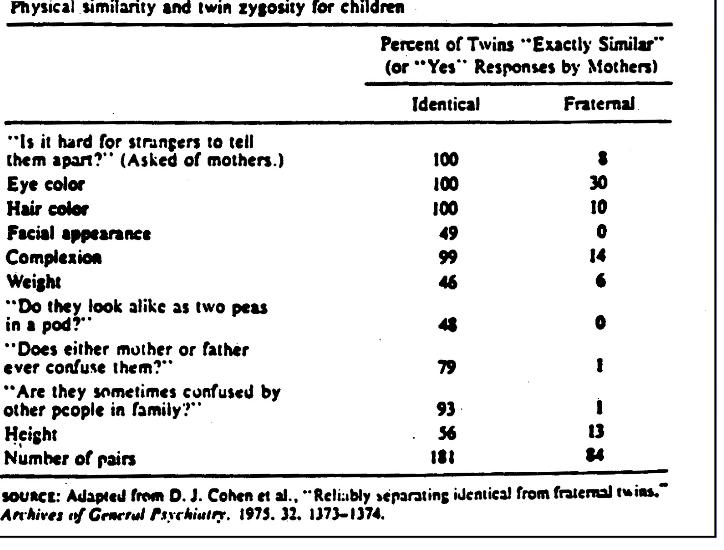
Physical similarity
eye color, hair color and texture (if pairs differ on one of these traits: fraternal pair)
questionnaire methods
e.g. is it hard for others, family members to differentiate them?
equal environment assumption EEA
if the twins are raised in the same family, the env. effects for the MZ and DZ twins are close to identical.
(although MZ twins are sometimes raised more similar, as compared to DZ twins. e.g. dressed similarly)
What is heritability?
Heritability is the proportion of phenotype variance that can be accounted for by genetic effects.
calculated based on twin studies
logic of classical twin studies
MZs share 100% genes, DZs share (on avg) 50%
both twin types share 100% env.
r (the correlation coefficient) represents similarity of pairs
similarity = r correlation coefficient
if rMZ = rDZ, then genetic factors are NOT important.
if rMZ > rDZ, then genetic factors ARE important.
heritability index = twice the difference between rMZ and rDZ
heritability the proportion of phenotypic variance that can be accounted for by genetic factors
if rMZ < 1, (usually this is the case) then non-shared env factors are also important
P = G + E
Total Phenotype Variance = Genetic effects + Environmental effects
G = A + D
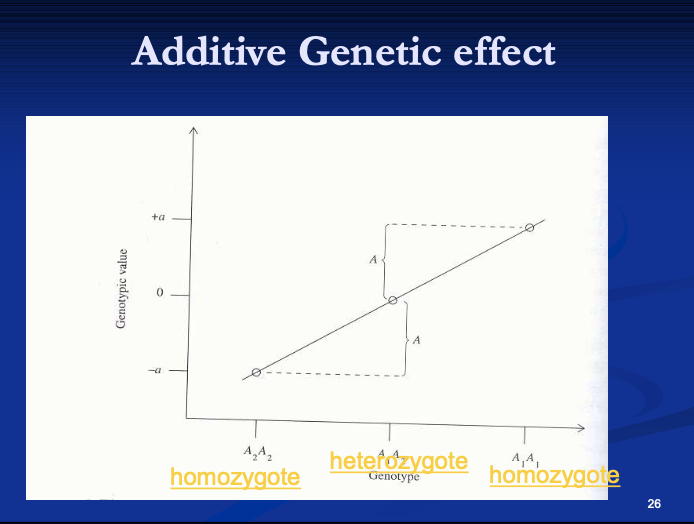
A = Additive genetic effects
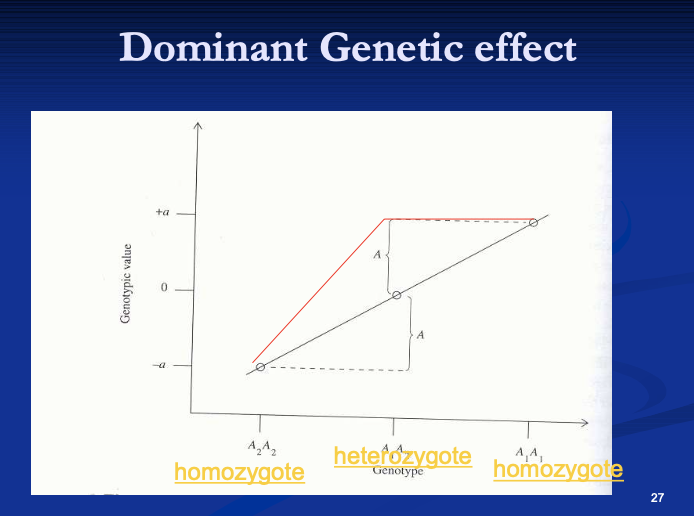
D = Dominance genetic effects
E = C + U
C = Common (shared) env effects make siblings similar e.g. shared parenting
U = Unique (unshared) env effects make sibilings different, e.g. car accidents
P = A + D + C + U
Total Phenotypic Variance = Genetic Effects + Environmental Effects
A = additive genetic effects,
D = dominance genetic effects
C = common (shared) environmental effects (make siblings similar, e.g. shared parenting)
E = unique (unshared) environmental effects (make siblings different, e.g. car accident)
Interpreting Heritability
heritability refers to the genetic contribution to individual differences (variances), not to the phenotype of a single individual, both genotype and env are indispensable — a person would not exist without genes and env.
for example, the heritability of height is about 90%, but this does not mean that you grew to 90% of your height for reasons of heredity and that the other inches were added by the env.
what it means is that most of the height differences among individuals are due to the gentic differences among them.
summary
• The Hardy-Weinberg equilibrium and related calculations
• Adoption Studies
Adoptee & Biological Parent → genetic influence
Adoptee & Adoptive Parent → environmental influence
• Twin Studies
rMZ > rDZ → genetic influence (the difference twice = heritability)
rMZ < 1 → also environmental influence
total Phenotypic Variance (P) = A+D+C+U
• heritability index (h2) and it’s interpretation