Working Memory & Performance Limitations and Decision-Making
Working Memory
- the system responsible for the temporary storage and concurrent processing of information
- plays a central role in cognition because it processes temporarily stored information that is often essential to task performance
- plays an important role in a number of cognitive functions, including comprehension, learning, reasoning, problem solving and reading
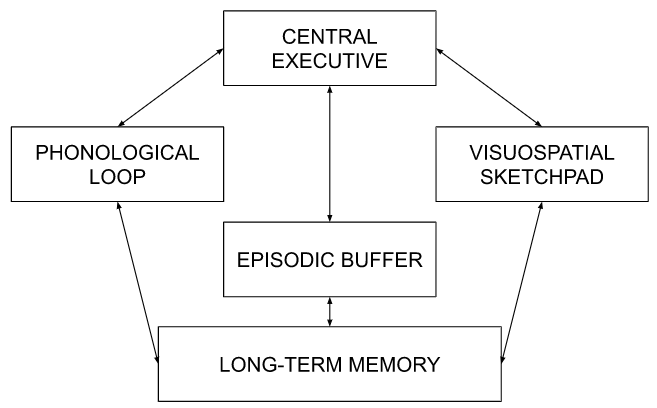
- the most influential model of working memory has been developed by ^^Alan Badeley^^ and his collaborators
- Central Executive: “manages” working memory by executing a number of control processes
- Phonological Loop: responsible for the short-term retention of material coded in a phonological format; speech-based
- Visuospatial Sketchpad (VSSP): retains information coded in a visuospatial form
- Episodic Buffer: provides a means of linking working memory to long-term memory and perception in addition to providing buffer storage for the components of working memory to communicate with each other
Central Executive Processes
- maintaining and updating task goals
- monitoring and correcting errors
- scheduling responses
- initiating rehearsal
- inhibiting irrelevant information
- retrieving information from long-term memory
- switching retrieval plans
- coordinating actively in concurrent tasks
Central Executive
- controls how the slave systems are used
- can put information into any of the slave systems or retrieve information from them
- can translate information from one system to another
Phonological Loop
- consists of multiple components
- Articulatory Loop
- functions as an “inner voice” that rehearses verbal information, as when we’re told a phone number and we rehearse it over and over again while trying to dial it
- Phonological Store
- “inner ear” that hears the inner voice and stores the information in a phonological form
Working Memory and Cognitive Aging
- older participants were less able to inhibit intrusive interference
- one important executive function is to ensure that task-irrelevant information is ignored or suppressed, and evidence indicates that this inhibitory function can deteriorate with age
- aging can also affect executive attentional control in relation to uploading in working memory
- recent evidence indicates that executive functioning and working memory in general can be improved by suitable ^^cognitive training^^ of older persons
- cognitive plasticity is retained in older age and that this plasticity can be exploited by interventions aimed at improving working memory functioning
- ^^bilingualism^^ in older persons is associated with greater executive control in working memory
- ^^playing of musical instruments^^ appears to mitigate the effects of cognitive aging
- ^^regular aerobic exercise^^: MRI scan revealed a significant increase in brain volume in gray- and white-matter regions as a function of aerobic training in the older participants
Working Memory and Air Traffic Control
- our understanding of the mental workload of the air traffic controller will need to improve because this is a highly safety critical risk
- an overarching requirement of the enroute ATC task is to maintain “separation” between aircraft (usually a minute of 5 nautical miles horizontally)
Working Memory and Mental Arithmetic
- working memory is used to monitor the calculation strategy and execute a changing succession of operations that register, retain, and retrieve numerical data
- mental calculation is a task that involves storage and concurrent processing and is, therefore, likely to be dependent on working memory
- while maintaining visuospatial information in the visuospatial sketchpad plays a small role in solving additions problems, the central executive makes the greatest
Working Memory and Math Anxiety
- math anxiety appears to impair the efficiency of the central executive in executing procedural operations such as carrying, sequencing, and keeping track in multi-step problems
- anxiety produces a reduction in executive processing capacity by comprising selection mechanisms, allowing intrusive thoughts and distracting information to compete for limited processing capacity
Working Memory and HCI
- ^^human-computer interaction^^ research encompasses the use of many different forms of IT
- Byrne and Bovair (1997) studies the cognitive errors associated with using ATMs to make cash withdrawals from bank accounts
- ^^post-completion errors^^ occurred when the user completed their task of withdrawing cash but failed to remove their bank card from the ATM
- the occurrence of post-completion errors led to the redesign of ATMs, with the result that they now only dispense cash after first returning the card to the user
Decision-Making
- Decision: commitment to a course of action
Sunk-Cost Effect
- an increased tendency to ^^invest resources^^ in an uncertain project following ^^previous failure with that project^^
- expending additional resources to justify some previous commitment that has not worked well
- most people show this effect even though it would be preferable on average to accept the loss and invest elsewhere
Optimistic Bias
- the judgment that we are more likely than other people to ^^experience positive events but less likely to experience negative events^^
Heuristics
- Donny Kahneman and Amos Tversky have focused on explaining why we seem so prone to error on many judgment problems
- they argued that we typically rely on ^^simple heuristics or rules of thumb^^ when confronted by problems
- we use heuristics even though they can cause us to make errors because they are ^^cognitively undemanding and can be used very rapidly^^
Representativeness Heuristic
- “Events that are representative or typical of a class are assigned a high probability of occurrence. If an event is highly similar to most of the others in a population or class of events, then it is considered representative.”
- Conjunction Fallacy: the mistaken belief that the probability of a conjunction of 2 events (A and B) is greater than the probability of one of them (A or B)
Availability Heuristic
- the assumption that the frequencies of events can be estimated accurately by the accessibility in memory
Support Theory
- A more explicit description of an event is regarded as having greater substance probability than the same event described in less explicit terms. This is because
- an explicit description may draw attention to aspects of the event that are less obvious in the non-explicit description
- memory limitations may mean that people do not remember all the relevant information if it is not supplied
Prospect Theory
- Kahneman and Tversky (1979, 1984) developed prospect theory in an attempt to understand such apparently paradoxical findings
- 2 Main Assumptions
- individuals identify a reference point generally representing their current state
- individuals are much more sensitive to potential losses than to potential gains; this is ^^loss aversion^^. This explains why most people are unwilling to accept a 50-50 bet unless the amount they might win is about twice the amount they might lose
- Loss Aversion
- the tendency to be ^^more sensitive to potential losses than to potential gains^^
- If people are much more sensitive to losses than to gains, they should be ^^unwilling to accept bets involving potential losses^^ even though the potential gains outweigh the potential losses. They would also ^^prefer a sure^^ gain to a risky but potentially greater gain
Prospect Theory and Self-Esteem
- Josephs et al (1992) found that high self-esteem individuals were 10 times more likely to select the riskiest than the least risky gamble, whereas almost twice as many low self-esteem individuals chose the least risky gamble than the riskiest one
- Individuals high in self-esteem have a strong self-protective system that helps to maintain self-esteem when confronted by threat or loss. In contrast, people with low self-esteem are concerned that negative or threatening events will reduce their self-esteem
Framing Effect
- the influence of irrelevant aspects of a situation (e.g., ^^working of the problem^^) on ^^decision-making^^