Introduction to Cognitive Psychology
Definition (#f7aeae)
Important (#edcae9)
Extra (#fffe9d)
Cognitive Psychology:
Cognitive psychology explores mental processes.
Studies how the human brain works- how we think, remember & learn.
They apply psychological science to understand how we perceive events and decisions.
Involves:
Perception
Paying attention
Remembering: Memory.
Distinguishing items in a category
Visualizing
Understanding and production of language
Problem solving
Reasoning and decision-making
Why you need to study cognition:
It’s a major part of the human psychology (4 major branches: Clinical, Cognition, Developmental and Social Psychology).
Influences other areas of psychology.
Personal manual on how the mind works.
Origins:
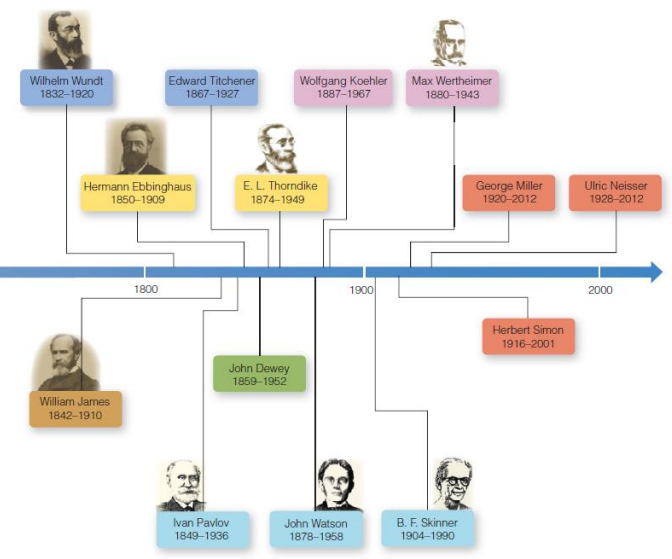
Aristotle, 2,000 years ago, proposed law of learning and memory and discussed the importance of mental imagery.
The 1st cognitive psychologist:
Donders (1868):
Measuring how long it takes a person to make a decision.
Reaction Time (RT) expertiment:
Measures interval between stimulus presentation and person’s response to stimulus.
Simple RT task: Participant pushes a button quickly after a light appears.
Choice RT task: Participant pushes one button if light is on right side, another if light is on left side.
Choice RT – Simple RT = Time to make a decision.
Choice RT = 1/10th sec longer than Simple RT.
1/10th sec to make decision.

Brief history:
Wilhelm Wundt (1879):
Approach Structuralism:
Experience is determined by combining elements of experience called sensations.
Method:
Analytic introspection: Participants trained to describe experiences and thought processes in response to stimuli.
Proposed studying the mind with introspection.
Herman Ebbinghous (1885/1913):
Studied human memory.
Constructed >2,000 nonsense syllables ( DAK, DAX) to test memory.
Studied the amount of time taken to remember.
Read list of nonsense syllables aloud many times to determine number of repetitions necessary to repeat list without errors.
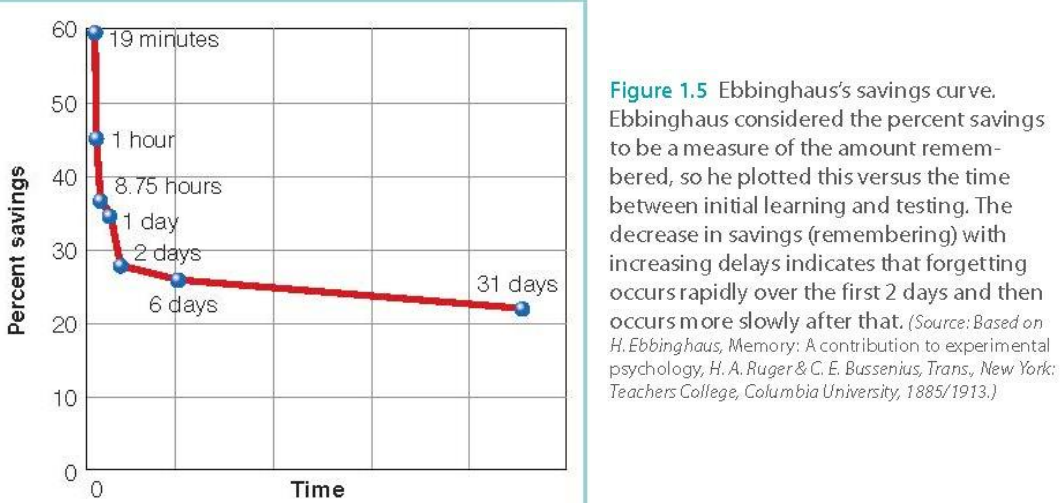
After some time, he relearned the list, learned many different lists at many different retention intervals
Short intervals = fewer repetitions to relearn.
Savings = (Original time to learn the list) – (Time to relearn the list after a delay)
Savings curve shows savings as a function of retention interval.


John watson noted 2 issues:
Extremely variable results from person to person.
Results difficult to verify.
Invisible inner mental processes.
Mary white Walkins:
Recency effect: Our observations are especially accurate for the final item in a series of stimuli.
Gestalt approach (early 1900):
Humans have basic tendency to organize what they see.
The whole is greater than the sum of its parts.
Criticized Wundt’s introspection technique of looking at things individually.
Criticized behaviorist for looking at a phenomenon as stimuli-response units.
William James (1890):
Published: Principles of Psychology (perception, attention, memory, reasoning, tip-of the-tongue phenomenon).
Believed more everyday psychological experiences instead of experimenting on nonsense syllables.
The rise of behaviorism:
John Watson proposed a new approach called behaviorism.
Eliminates the mind as a topic of study and studies directly observable behavior.
Watson and Rayner (1920): Little Albert experiment:
Classical conditioning of fear.
9-month-old became frightened by a rat after a loud noise was paired with every presentation of the rat.
Behavior can be analyzed without any reference to the mind.
Examined how pairing one stimulus with another affected behavior.
Emergence of other behaviorist:
Pavlov: Classical Conditioning.
B.F.Skinner: Operant Conditioning.
Behaviorism: Emphasize only on observable reactions.
Operational definition: Precise definition that specifies how concept are being measured.

The reemergence of the mind in psychology:
Frederick C. Bartlett (early 1900):
Human memory is a constructive process in which we interpret and transform the original material.
Often making material more consistent with our own personal experience.
Tolman (1938):
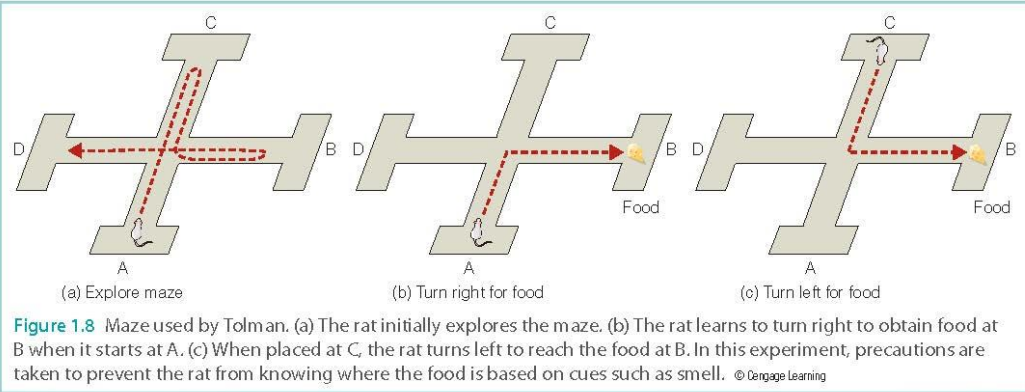
Trained rats to find food in a four-armed maze.
2 competing interpretations:
Behaviorism predicts that the rats learned to “turn right to find food”.
Believed that the rats had created a cognitive map of the maze and were navigating to a specific arm.
The rats navigated to the specific arm where they previously found food, supported Tolman’s interpretation.
The decline of behaviorism:
A controversy over language acquisition.
Skinner (1957): Verbal Behavior
Argued children learn language through operant conditioning.
Children imitate speech they hear.
Correct speech is rewarded.
Chomsky (1959):
Argued children do not only learn language through imitation and reinforcement.
Children say things they have never heard.
Children say things that are incorrect and have not been rewarded for.
Language must be determined by inborn biological program.
The cognitive revolution:
Shift from behaviorist’s stimulus-response relationships to an approach that attempts to explain behavior in terms of the mind.
Information-processing approach: Way to study the mind created from insights associated with the digital computer.
Studying the mind:
To understand complex cognitive behaviors:
Measure observable behavior.
Make inferences about underlying cognitive activity.
Consider what this behavior says about how the mind works.
Modern cognitive psychology:
Emerged in 1956 when many researches was publish in relation to cognition and was presented in conferences.
Attitudes, methodology and approaches to study shifted.
Factors contributing to the rise:
Begun when psychologist developed disenchantment with behaviorism as well as new developments in linguistic, memory and mental psychology.
The Information-processing model (1950s):
Mental process can be best be understood by comparing it with the operations of a computer.
Mental process can be interpreted as information progressing through a system in a series of stages, one step at a time.

Cognitive revolution:
Cherry (1953):
Dichotic listening.
Present message A in left ear.
Present message B in right ear.
To ensure attention, shadow one message.
Participants were able to focus only on the message they were shadowing.
Broadbent (1958):
Flow diagram representing what happens as a person directs attention to one stimulus.
Unattended information does not pass through the filter.


Modern Research in Cognitive Psychology:
How research progresses from question to question:
Start with what is known.
Ask questions.
Design experiments.
Obtain and interpret results.
Use results as the bases for new research questions and experiments.
The Role of Models in Cognitive Psychology:
There are two kinds of models to be aware of:
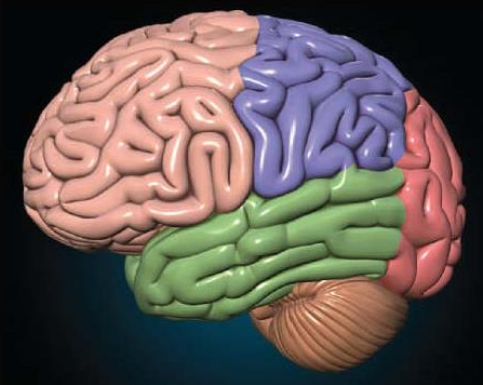
Structural Models:
Representations of a physical structure.
Mimic the form or appearance of a given object
Process Models:
Represent the processes that are involved in cognitive mechanisms, with boxes usually representing specific processes and arrows indicating connections between processes.


Current issues in cognitive psychology:
Artificial Intelligence (AI):
“Making a machine behave in ways that would be called intelligent if a human were so behaving.” (McCarty et al.)
Newell and Simon created the logic theorist program that could apply rudimentary logic to creating mathematical theorems.