exam #6: study guide (unit #7)
==reaction types==:
- synthesis reaction
- two or more substances combine to form something more complex
general form: A + B → AB
==examples:==
2Na + Cl2 → 2NaCl
N2 + 3H2 → 2NH3
Fe + S → FeS
- decomposition reaction
- a reaction in which a single compound breaks down to form two or more simpler substances
general form: AB → A + B
==examples:==
CaCO3 → CaO + CO2
2H2O2 → 2H2O + O2
H2CO3 → H2O + CO2
- combustion reaction
- one substance reacts with oxygen or a similar compound in a usually high-heat, exothermic reaction
general form: A + O2 → AO
==examples:==
2H2 + O2 → 2H2O
CH4 + 2O2 → 2H2O + CO2
2Mg + O2 → 2MgO
- single-displacement reaction
- one atom or group of atoms is replaced by another
general form: AX + B → BX + A
==examples:==
CuCl + Na → NaCl + Cu
Al(OH3) + 3K → 3KOH + Al
ZnCl2 + 2Li → 2LiCl + Zn
- double-displacement reaction
- two atoms or two groups of atoms switch places
general form: AX + BY → AY + BX
==examples:==
2KI + Pb(NO3)2 → 2KNO3 + PbI2
CuCl2 + 2NaOH → Cu(OH)2 + 2NaCl
MgSO4 + Na2CO3 → Na2SO4 + MgCO3
==balanced reaction equations==:
lavoisier: ==the law of conservation of mass==
- matter cannot be created, nor destroyed
- in a closed system for mass and energy (nothing gets in or out), the mass does not change (whatever atoms you start with, you must have at the end)
identifying the numbers in the equation:
==subscripts==: these tell us how many of a specific atom or polyatomic ion we have
ex.: CO2 = 1 C atom, 2 O atoms
==coefficients==: these appear in front of a compound or element and tell us how many copies of it we have
ex.: 2C = 2 units of C
steps for balancing full equations:
- in your unbalanced reactions (assume all coefficients are 1), make lists or tables of the number of each type of atom on both sides of the reaction
- sort out which elements are unbalanced and begin with the ones that have the least difference in number of atoms
- add coefficients to balance elements while disrupting the numbers of balanced elements as little as possible (there may be different ways to do this, think about what makes the most sense)
- do one final count of all atoms in your balanced equation
==molar mass==:
formulas:
==empirical formula==: the simplest ratio of the individual parts that you need (for every one person).
==molecular formula==: the specific ratio of individual parts that you need to make a specific thing (for exactly 40 people)
calculations with moles:
a mole = 6.02 * 10^23
- dimensional analysis: (6.02 * 10^23 particles)/1 mole or 1 mole/(6.02 * 10^23)
molar mass:
what number on your reference tables is the ==atomic mass== again?
this number tells you the mass of the nucleons in the atom (it also doubles as the element’s molar mass)
- this is the mass of 1 mole of the element in gram (gram-formula mass)
calculating masses for different numbers of moles:
==mole calculations==: number of moles = (given mass)/gram-formula mass)
==percent composition==:
calculating molar mass of compounds:
we’ve learned how to identify the molar masses of individual elements and use them to determine the masses for individual elements, but what about for compounds?
the answer is straightforward: add the molar masses for each individual atom
==percent composition== = % composition by mass = (mass of part/mass of whole)(100)
==moles & stoichiometry==:
mole-mole calculations:
in a balanced chemical equation, the coefficients serve to tell you what the ratio of reactants and products will be
- use the number of moles of one substance to determine the number of moles of any other
mole-gram calculations:
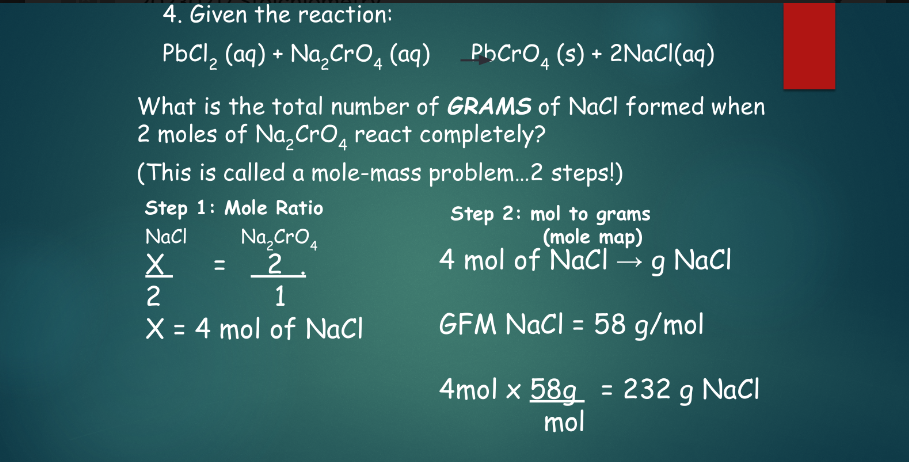 ==empirical formula==:
we focused on learning to scale up balanced equations to determine how many moles of a compound are used or formed, given a specific amount of another
similarly, we can use empirical formula to determine the chemical formula of a specific compound, if we know its molar mass