Unit 2 - Week 6
Key Words:
Mannerism: An artistic style characterized by exaggerated elegance, distortion of proportions, and a sense of artificiality, emerging in the late Renaissance period.
Counter-Reformation: The Catholic Church's response to the Protestant Reformation, involving reforms, reaffirmation of doctrine, and efforts to win back followers.
Council of Trent: A series of meetings (1545-1563) held by the Catholic Church to address and respond to the challenges posed by the Protestant Reformation.
Baroque: A dynamic and ornate artistic style characterized by grandeur, drama, and elaborate details, prevalent in the 17th century.
Pope Urban VIII Barberini: The pope (1623-1644) associated with the patronage of the arts during the Baroque period, known for commissioning various artistic works.
Tenebrism: A painting technique that uses strong contrasts between light and dark to create a dramatic effect, often associated with Baroque art.
Chiaroscuro: The use of strong contrasts between light and dark in visual arts to create a sense of volume and three-dimensionality.
Baldacchino: A canopy-like structure, often ornate, placed over an altar or throne, commonly seen in Baroque architecture.
Solomonic: Referring to a twisted column design, named after the biblical King Solomon, often used in Baroque architecture and decoration.
Key Work:
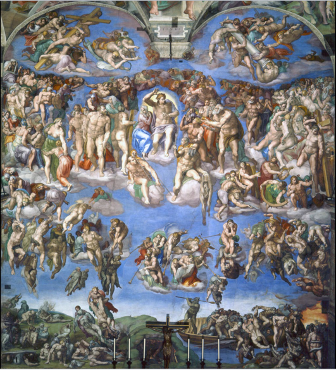 The Last Judgement
Artist: Michelangelo
Medium: Fresco
Date: 1534-1541
Location: The Sistine Chapel, Vatican City, Rome
- The separation of the blessed and the damned, with the righteous ascending to heaven and the damned falling into hell, adds drama to the scene.
- The Last Judgment is considered a masterpiece, showcasing Michelangelo's unparalleled skill in depicting human anatomy and conveying complex narratives through art.
- The fresco underwent significant restoration work in the late 20th century to address damage and discoloration, revealing the vivid colors and details intended by the artist.
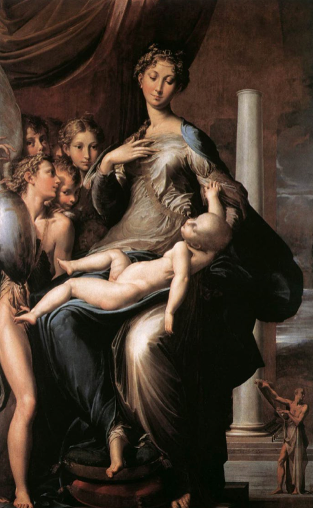 Madonna of the Long Neck
Artist: Parmigianino (Girolamo Francesco Maria Mazzola)
Medium: Oil on wood
Date: 1534-1540
Location: Uffizi Gallery, Florence, Italy
Characteristics of Mannerism:
- Mannerism is described as parasitic, original, derogatory, refined, hyper-decorative, courtly, anti-classical, and classicizing.
- Parmigianino's work embodies mannerist art with its departure from traditional proportions and the exploration of fantastical and otherworldly realms.
- The style rejects the rational classicism of the high Renaissance, introducing new visual language characterized by artificiality and emotional provocation.
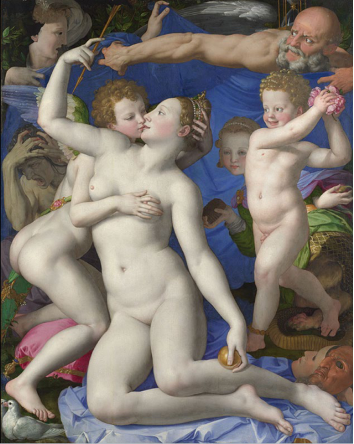 Allegory with Venus and Cupid
Artist: Agnolo Bronzino
Medium: oil on panel
Date: Mid 1540s
Location: National Gallery, London
Characteristics of Mannerism:
- The structure and quality of the artwork resemble a relief sculpture, lacking significant depth or a real background
- The painting's figures, including Venus and Cupid, are highly idealized with exaggerated proportions, emphasizing intellectual sophistication over realism
- Mannerism often employs complex and multilayered themes
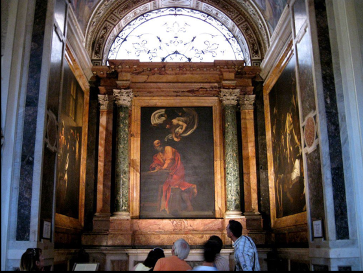 Contarelli Chapel
Artist: Michelangelo Merisi da Caravaggio (The Calling of St. Matthew, The Inspiration of St. Matthew, The Martyrdom of St. Matthew)
Medium: Oil on canvas
Date: 1600
Location: San Luigi dei Francesi, Rome
-
- Caravaggio's innovative use of light and shadow, known as chiaroscuro, is prominently displayed in these works.
- The paintings depict scenes from the life of Saint Matthew, emphasizing the divine calling, inspiration, and martyrdom of the apostle.
- Caravaggio's realistic and emotionally charged portrayals had a significant impact on the development of Baroque art and the representation of religious subjects.
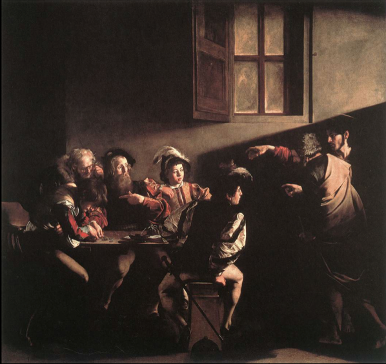 The Calling of St. Matthew
Artist: Michelangelo Merisi da Caravaggio
Medium: Oil on canvas
Date: 1599-1600
Location: Contarelli Chapel, San Luigi dei Francesi, Rome
- Exemplifies Caravaggio's distinctive style, characterized by dramatic use of light and shadow (chiaroscuro) and naturalistic depiction.
- The composition captures the moment when Jesus points towards Matthew, who is seated at a table with money, gesturing him to follow.
- Caravaggio's realistic portrayal diverges from traditional idealized depictions, presenting the characters with human flaws and everyday details.
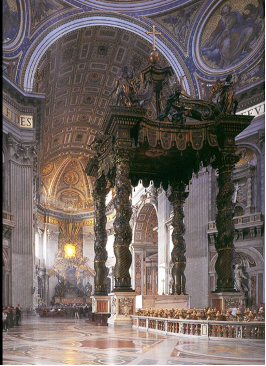 Baldacchino
Artist: Gian Lorenzo Bernini
Medium: Gilded bronze
Date: 1624–1633
Location: St. Peter's Basilica, Vatican City
Size: 95ft. High
- They are striping out art materials to invest on the Catholic Church
- PATRON: Urban VIII Barberini (pope from 1623-1644)
 Ecstasy of St. Teresa
Artist: Gian Lorenzo Bernini
Medium: Marble sculpture
Date: 1647–1652
Location: Cornaro Chapel, Santa Maria della Vittoria, Rome
-
 Raising of the Cross
Artist: Peter Paul Rubens
Medium: Oil on panel
Date: 1609-1610
Location: Cathedral of Our Lady, Antwerp, Belgium
Key Events:
Counter-Reformation
- Catholic Church’s attempt to eliminate
internal corruption as a response to the
Reformation
- Council of Trent, 1545-1563
- Denounced Lutheranism and reaffirmed
Catholic doctrine
- Council of Trent on Art
o New artistic guidelines
o Art should be didactic (educational)
o Art should be clear (no confusing compositions or complicated symbolism)
o Art should be ethically correct and decent (restrictions against nudity)
o Art should depict religious events accurately and conform to Church doctrine
o Art should appeal to emotion rather than reason (resulted in an increase of paintings of miraculous themes)
o Roman Inquisition was given the power to censor works of art deemed inappropriate
Introduction to the 17th-Century
- Europe is split between Catholic and Protestant countries, leading to religious wars, such as the Thirty Years War (1618-1648)
- Age of Absolutism (Examples - Louis XIV (France, 1643-1715), Philip IV (Spain, 1605- 1665), and Charles I (England, 1600-1649))
- New commercial powers - The Dutch and the English
- Scientific progress - Galileo (1564-1642), Isaac Newton (1642-1727)