Competitive Strategy
Market signaling
Porter’s Five forces - Industry structure, embodied in the five competitive forces, provides a way to think about how value is created and divided among existing and potential industry participants.
The addition of a sixth force, most often government or technology.
Factor market (input) conditions take primacy over industry competition in determining company performance.
Staying flexible, incorporating new ideas, or building up critical resources or core competencies that are portrayed as independent of competitive position.
Framework - The underpinning of this framework is the analysis of the five competitive forces acting on an industry and their strategic implications. Part I builds on this framework to present techniques for the analysis of competitors, buyers, and suppliers; techniques for reading market signals; game theoretic concepts for making and responding to competitive moves; an approach to mapping strategic groups in an industry and explaining differences in their performance; and a framework for predicting industry evolution.
Part II shows how the analytical framework described in Part I can be used to develop competitive strategy in particular important types of industry environments. These differing environments reflect fundamental differences in industry concentration, state of maturity, and exposure to
international competition. These differing environments are crucial in determining the strategic context in which a business competes, the strategic alternatives available, and the common strategic errors. Part II examines fragmented industries, emerging industries, the transition to industry maturity, declining industries, and global industries.
Part III of the book completes the analytical framework by systematically examining the important types of strategic decisions that confront firms in competing in a single industry: vertical integration, major capacity expansion, and entry into new businesses. (Divestment
Wheel of competitive strategy-
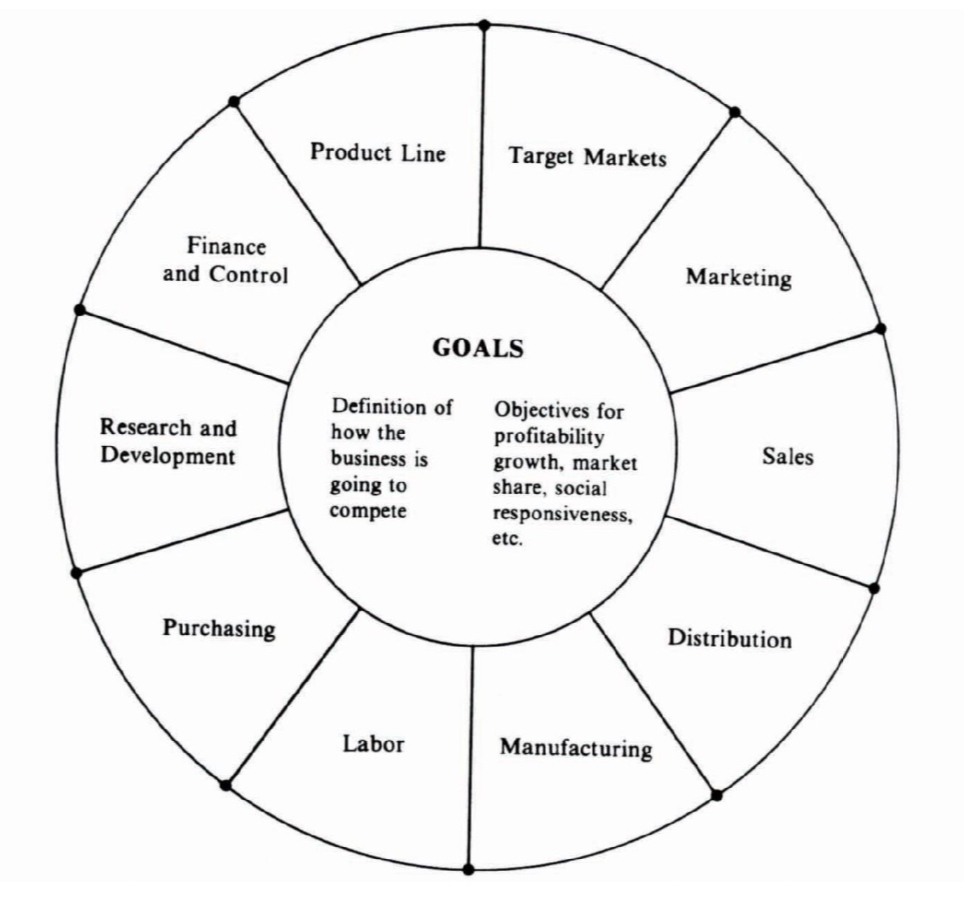
Key points for formulation- competitive strategy

Societal expectations reflect the impact on the company of such things as government policy, social concerns, evolving mores, and many others.These four factors must be considered before a business can develop a realistic and implementable set of goals and policies.
The company's strengths and weaknesses are its profile of assets and skills relative to competitors, including financial resources, technological posture, brand identification, and so on. The personal values of an organization are the motivations and needs of the key executives and other personnel who must implement the chosen strategy.
The appropriateness / suitability/ fitness of a competitive strategy can be determined by testing the proposed goals and policies for consistency.
a) Tests of Consistency
• Internal Consistency
- Are the goals mutually achievable?
- Do the key operating policies address the goals?
- Do the key operating policies reinforce each other?
- Environmental Fit
- Do the goals and policies exploit industry opportunities?
- Do the goals and policies deal with industry threats (including the risk of competitive response) to the degree possible with available resources?
- Does the timing of the goals and policies reflect the ability of the environment to absorb the actions?
- Are the goals and policies responsive to broader societal concerns?
- Resource Fit
- Do the goals and policies match the resources available to the company relative to competitors?
- Does the timing of the goals and policies reflect the organization’s ability to change?
- Communication and Implementation
- Are the goals well understood by the key implementers?
- Is there enough congruence between the goals and policies and the values of the key implementers to insure commitment?
- Is there sufficient managerial capability to allow for effective implementation?
Process for Formulating a Competitive Strategy
a)A. What is the Business Doing Now?
1. Identification
What is the implicit or explicit current strategy?
2. Implied Assumptions II
What assumptions about the company’s relative position, strengths and
weaknesses, competitors, and industry trends must be made for the
current strategy to make sense?
B. What is Happening in the Environment?
1. Industry Analysis
What are the key factors for competitive success and the important
industry opportunities and threats?
2. Competitor Analysis
What are the capabilities and limitations of existing and potential
competitors, and their probable future moves?
3. Societal Analysis
What important governmental, social, and political factors will present
opportunities or threats?
4. Strengths and WeaknessesGiven an analysis of industry and competitors, what are the company’s
strengths and weaknesses relative to present and future competitors?
C. What Should the Business be Doing?
1. Tests of Assumptions and Strategy
How do the assumptions embodied in the current strategy compare with
the analysis in B above? How does the strategy meet the tests in Figure
I-3?
2. Strategic Alternatives
What are the feasible strategic alternatives given the analysis above? (Is
the current strategy one of these?)
3. Strategic Choice
Which alternative best relates the company’s situation to external
opportunities and threats?
The focus of the analysis of industry structure, or “structural analysis,” is on identifying the basic, underlying characteristics of an industry rooted in its economics and technology that shape the arena in which competitive strategy must be set.