The Constitution POLS 2300
The Constitution POLS 2300
Types of Institutions
- State institutions- institutions that are related to the constitution
- They get their authority from constitutional documents
- Political Institutions- structure democratic expression within states; closely related to citizen behavior
- Structure democratic expression within the state. Example... political parties, media
The Constitution
Objectives
What is a constitution?
What are the components of the Canadian constitution?
How can we change the Constitution? How has the Canadian Constitution changed over time?
WHAT IS A CONSTITUTION?
CONSTITUTION - DEFINED
constitution - the fundamental rules by which a country is governed
- written and unwritten tells us how a GOV operates, the supreme law (takes precedent over other laws) that outlines state power
- Tells us about what we value
Three key relationships
1. branches of government- what the basic institutions are, how elections work, define the branches of GOV
2. levels of government (division of power)- tell what things our GOV AND other GOV can do
3. state and the people- delineates the limits of governmental power between citizens and state, what is it are governments not allowed to do to citizens, also states what GOV MUST do required in the consitution
- written (fundamental laws are written down in one of more constitutional documents) or unwritten (principles of the constitution that consist of customs, conventions, statutes, not in one document)
- United Kingdom= Unwritten
- American Constitution= Written
- CAN= mix of both, complicated
- Reminds us of supreme law
WHAT ARE THE COMPONENTS OF THE CANADIAN CONSTITUTIONS?
CANADIAN CONSTITUTION
Entrenched – means that the things that are written down can only be changed by the use of the amending formula- 13 legislatures have to agree to make that change
- Constitution Act, 1867 (formerly the BNA Act)
- Used to be called the British North American act
- Constitution Act, 1982 including the Charter
- includes the charter of rights and freedoms
Nonentrenched
- can be changed 50% +1, laws similar to other laws (precedent)
- acts of a constitutional nature- written but not entreched
- judicial decisions- changed our understanding of the consitution
- conventions- not written, not entrenched
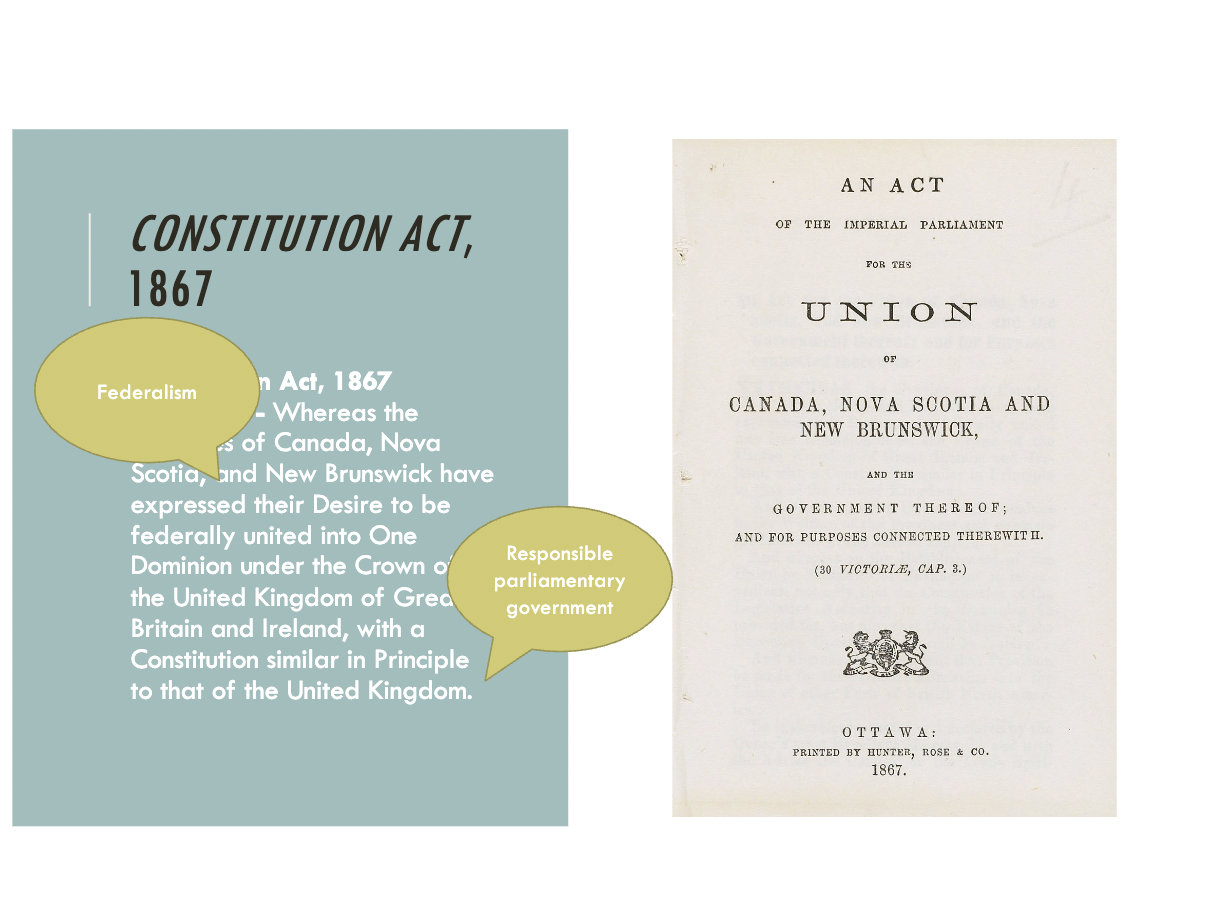
- A constitution to that of the United Kingdom... the British constitution is not written
- All the convention that exists in British politics WE INHERIT
- Responsible parliamentary GOV
CONSTITUTION ACT, 1867
- Constitution Act, 1867
- The Union and the Crown- king and his powers
- Executive Powers- cabniet
- Legislative Powers- HOC SENATE
- Provincial Constitutions-
- Federalism- one of the most important things in CAN GOV
- The Judiciary - CONSTITUTION ACT, 1982
Constitution Act, 1982
- equalization
- provincial control over natural resources
- Official Languages Act
- Aboriginal rights (Section 35) - The existing aboriginal and treaty rights of the aboriginal peoples of Canada are hereby recognized and affirmed- those rights we say they have been upheld, if GOV action goes against this, they can sue
- Charter of Rights & Freedoms
- amending formula
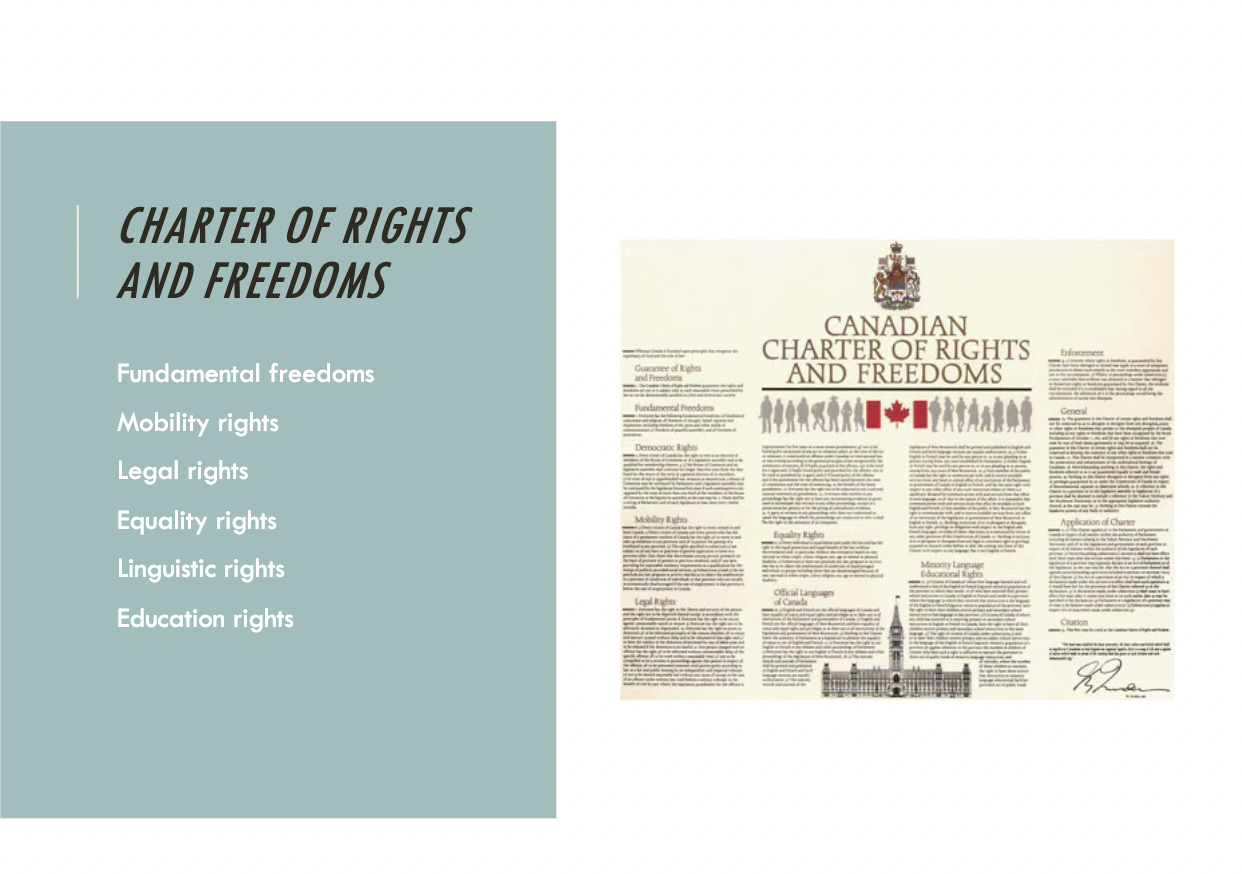
- 3. Citizens of the state relationship
ACTS OF A CONSTITUTIONAL NATURE
- an ordinary statute that supplements the entrenched constitution by applying a
general principle to specific circumstances
- Laws or acts of the cabinet, we think of them as constitutional weight but are not subject to the amending formula
- British Statutes and Orders in Council – amendments to the BNA Act
e.g. terms of union for BC and PEI
- 1. there would always be a ferry to go to the main island of PIE to NS, said they should build a bridge... has to get the consent of the policy makers to be ok with giving up the ferry and having the confederation bridge
- organic Canadian statutes
- the acts that created MN, AB, SK
- Indian Act, Supreme Court Act, Canada Elections Act, Bill of Rights, Constitutional Veto Act, Clarity Act
- even though problematic, has import weight with the Crown and indigenous people
- can and has been changed by the lib GOV just need 50+1
- We had a bill or Rights in the 60’s
- clarity act: can be changed
- Canadaian elections act: have major changes in 2018
JUDICIAL DECISIONS
judicial review - the authority of the courts to invalidate laws passed by Parliament
or provincial legislatures that they deem to be in violation of the Constitution.
- Courts don’t do this proactively; people have to ask them
- Important part of the legal system
- Judges are there to interpret the constitution and tells us what it means
- Judicial Committee of the Privy Council (1949) JCPC – last place for judical review
- Supreme Court of Canada AFTER 1949- Final court of appeal
CONVENTIONS
DEFINITION: unwritten rules based on custom that binds political actors to adhere to the tradition
of the constitutional order
- Not adjudicated by courts
widely accepted informal constitutional rules
- not legally enforceable by the courts
- the reason we would know a convention would be violated is because everyone would be really mad about it
- the principle is so important, PUBLIC OPINION ADJUTICATES IT
- No mention of the prime minister in both versions of the constitution 1867 1982
-
- examples?
- The senate of CAN is a legislative body that has almost identical powers to HOC, we now think its illegitimate so it can never say no to anything, convention of non-use
HOW CAN WE CHANGE THE CONSTITUTION? HOW HAS THE CANADIAN CONSTITUTION CHANGED OVER TIME?
CONSTITUTIONAL CHANGE
Missing from the BNA, 1867 (Roger Gibbins)
1. Québec - Québec's place in the federation
2. Indigenous people – awareness about indigenous people
3. popular sovereignty – idea that the people as Canadians are aware of how the power resides, power of the people
4. Rights – some from British conventions but no charter yet
5. Independence – did not mention Canada as ani independent country
- We were a dominion of THE uk
CONSTITUTIONAL CHANGE – 1867 – 1930s
BNA Act,1867 – unpatriated – means" to bring home”
- If we wanted to make changes, we needed the British GOV’s approval
- Problematic: 1. for independence reasons 2. ability to change constitutions that involves both levels of GOV
1931 - Statute of Westminster British law that declared that Britain and its Dominions
were constitutionally “equal in status.” – making them fully independent
- Established all of the dominions that existed (new Zealand, Australia...) making them fully independent
- Balford declaration document in 1926 was recommending this policy- CAN realized they need an amending formula so when this happens we can change it
BUT
statute of Westminster contained a clause allowing the British Parliament to amend the BNA Act, 1867
changes to the BNA Act would occur through:
1. Amendments by the British Parliament - unanimous provincial consent
- Everyone would agree... federal GOV and all the provinces
2. Statues/orders in council
- changes to the Indian act example
3. Judicial decisions
- The constitution remained UNPATRIOATED
CONSTITUTIONAL CHANGE - 1940s – 1950s
Attempts for a domestic amending formula were made in 1935–36 and 1949
Mega-constitutional politics (Peter Russell)
- idea that there are different types of changes to a constitution: some are low level changes (like from newfoundland to newfoundland and Labrador)
- BIG changes that will change the federation in a dramatic way
Patriation failures
- 1964 - Fulton-Favreau Formula
- One amending formula, nothing else in it
- Quebec decided to change their mind and not support this change, withdraw as they see this as an opportunity to discuss other issues {place of Quebec in the federation}
- 1971 - Victoria Charter
- tried again here
- inclusion of political and language rights
- involvement in the nomination of supreme court judges
- Quebec with draws again... CONVENTION SAYS... ALL PROVINCES NEED TO BE UNANOMIOUS.... PACKAGE IS DEAD... this happened 2 times
- both failed because Québec withdrew support
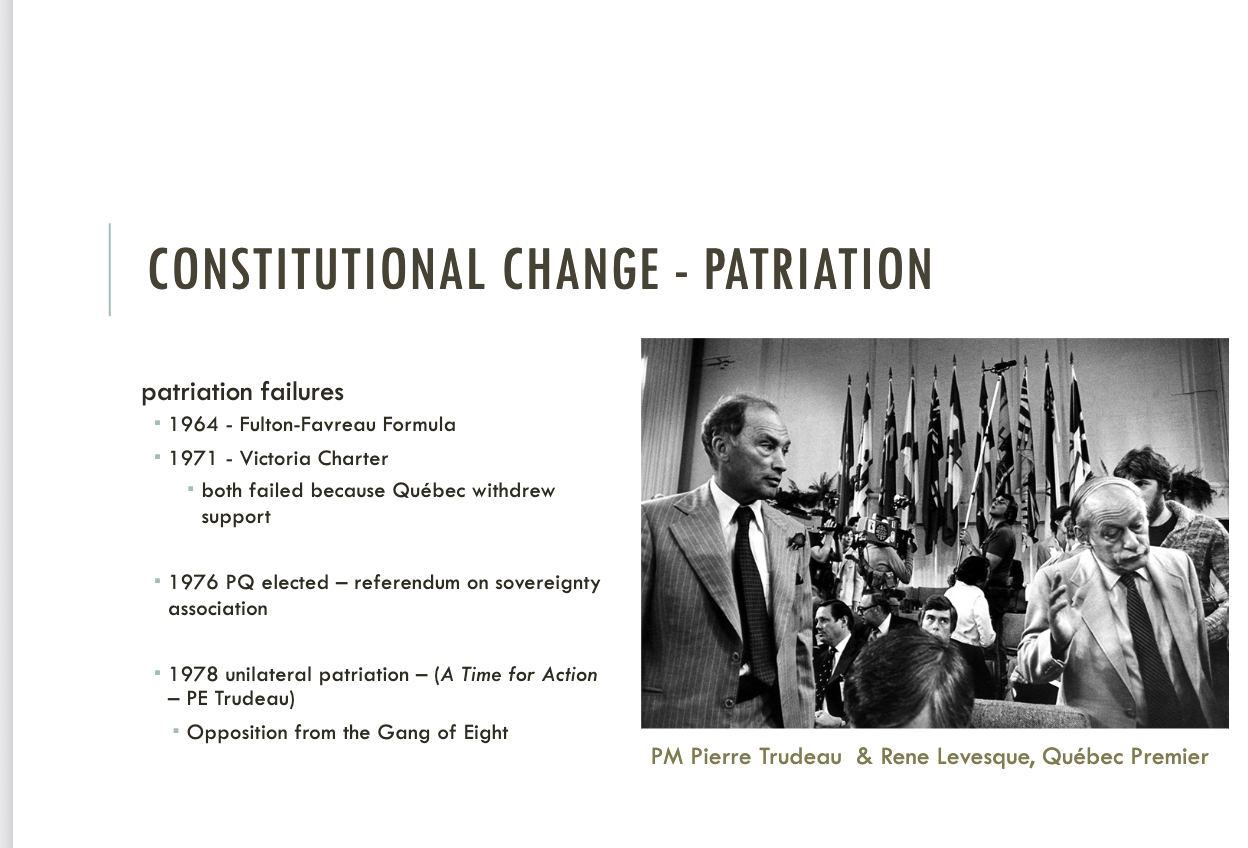
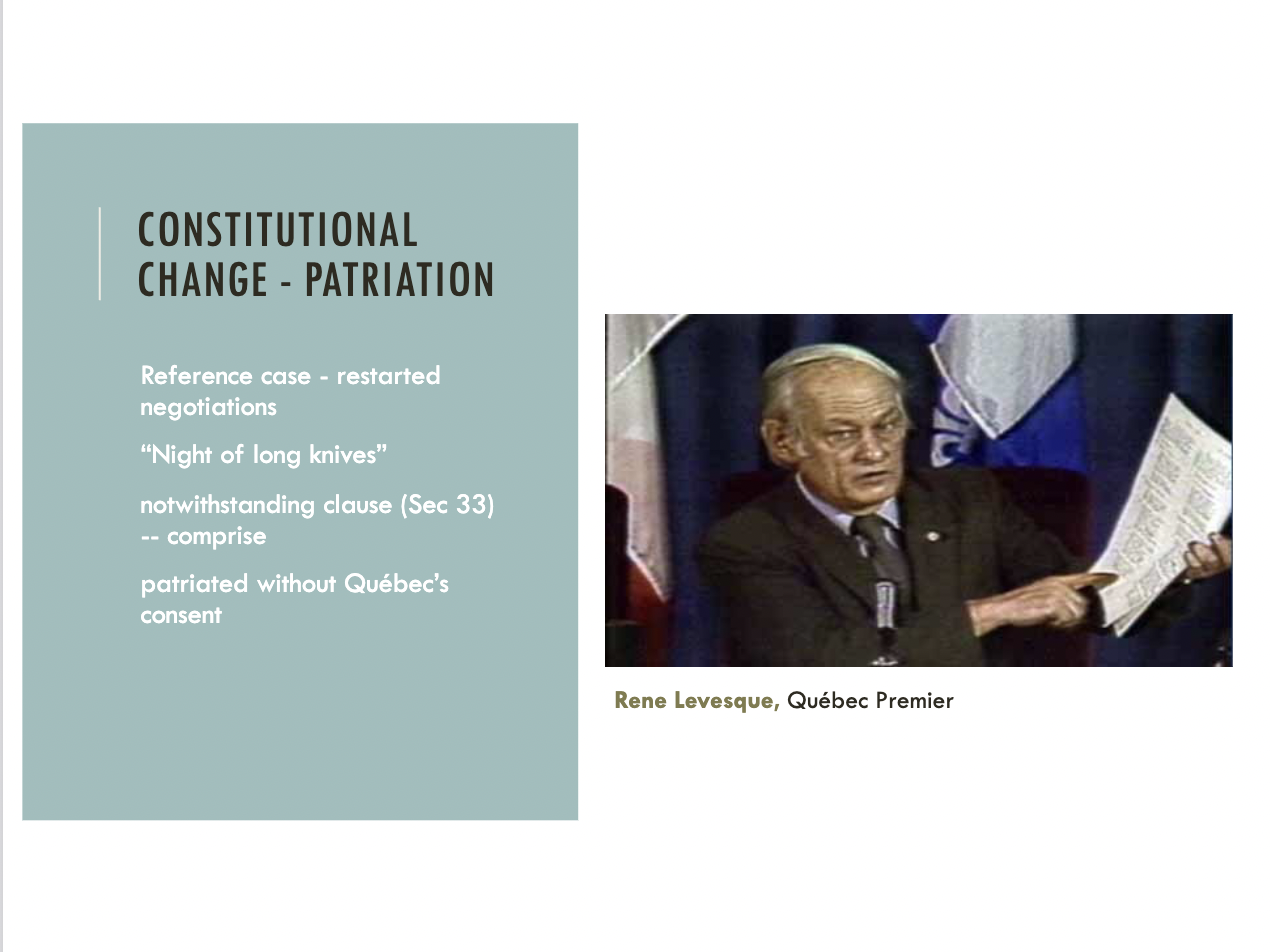
PM Pierre Trudeau and Rene Levesque Image
- Rene says the federation has been terrible to us (Quebec)
- Says they want a sovereignty association
- Trudeau does not like this idea
- During the campaign when Rene is asking everyone to vote for separatists
- T says... he will immediately take action to renew the constitution and won't stop until its done”
- Rene likes this, Quebec is happy
- BUT only 40 percent of Quebec vote of separatism and they lose
- In 1980... Trudeau says he's had enough and are going to send an amendment package to Britian on their own, WEIRD because it BREAKS CONVENTION, bold move, assumed you needed to have all the provinces on board to change the constitution … seen in the Victoria and Fulton formulas
- People are angry
- REFERENCE POWER- THE ability of the gov (federal) and PROV to ask a question to the highest court (supreme) to get feedback
CONSTITUTIONAL CHANGE - PATRIATION
Patriation Reference, 1981- most CONSITUTIONAL LAW COURT CASES IN THE COUNTRY
The federal government ASKED the SCC
1. Was unilateral patriation legal? unilateral patriation would be legal BUT unconstitutional in a conventional sense. CAN THE GOV CHNAGE THE CONSITUTION ON ITS OWN
2. Did a convention of provincial consent exist? substantial degree of provincial consent, SHOULD THEY ASK FOR CONSENT
SCC: yes & yes
BUT... they shouldn’t... they would be operating outside of the norms
The convention they say exist is a substantiable degree of PROVINCIAL CONSENT
- Different from unanimous
Story of Patriation 1982 constitution
- Held at the national convention Centre
- Invites all of the premiers
- 8 of them have rooms at the chateau of Laurier
- Rene stays in a hotel on the other side of the river
- One night, the attorney general of Saskatchewan and 2 other have a conversation on how they can have a constitution everyone can agree on
- They knock on everyone's doors and wait for agreement
- Rene is across the river... he drives the next day back there... there is a paper that says CAN and the provinces have come to a deal on the CAN constitution
- Rene was upset
- THEY CAME TO AN AGREEMENT WITHOUT QUEBEC
- They can do this because the SCC said you need a “substantial degree of consent”- he cant do anything about it
Picture of Trudeau and the Queen
- Signs the document that makes Canada independent
- Constitution becomes patriated in 1982
CONSTITUTION ACT, 1982
Constitution Act, 1982
equalization
provincial control over natural resources
Official Languages Act
Aboriginal rights
Charter of Rights & Freedoms
amending formula
CONSTITUTIONAL CHANGE – AMENDING FORMULAS
amending formula - formal process for changing a written constitution
domestic amending formula = patriation
- Included in the 1982 formula
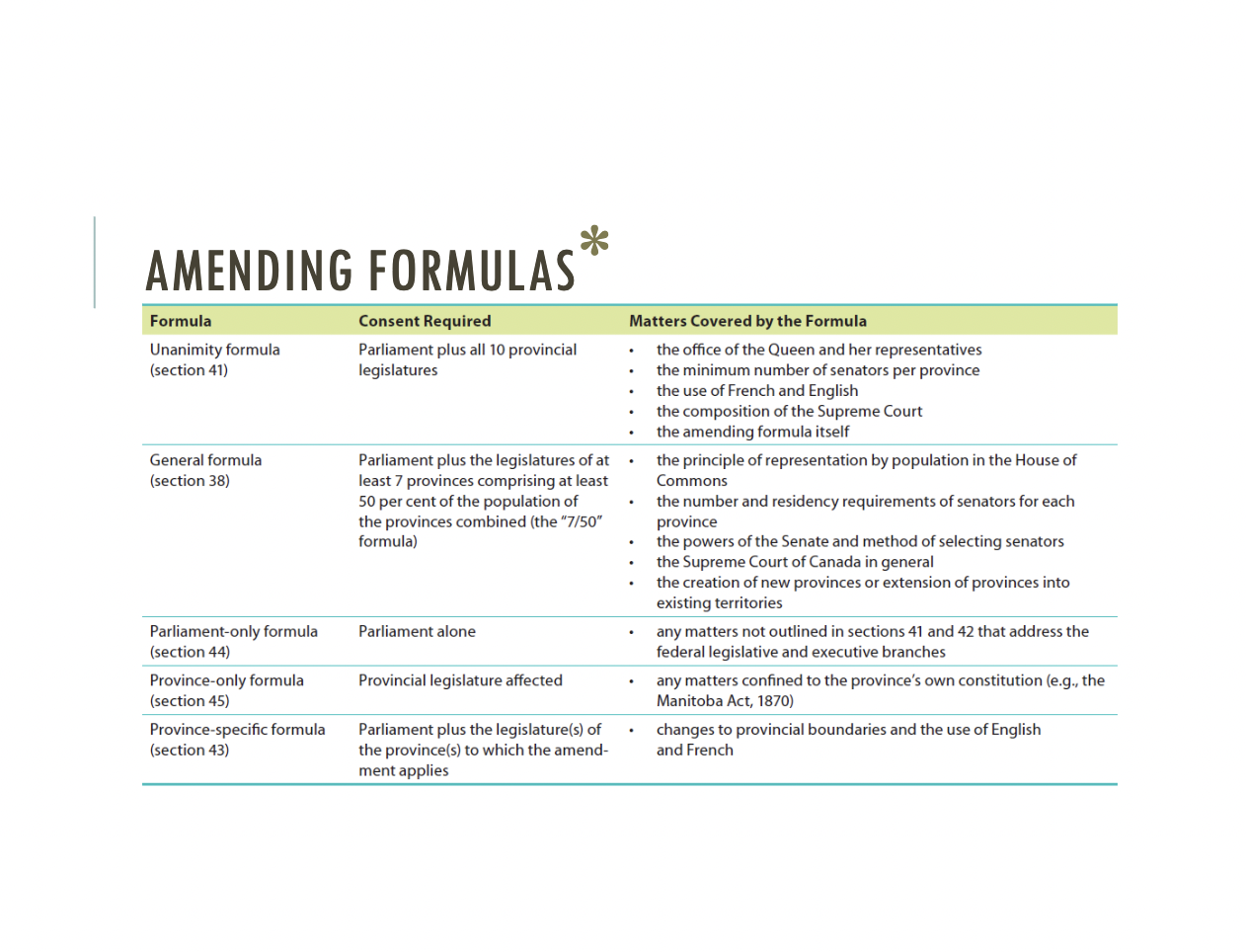
- 44 – things parliament can do but do not need consent
- Some things require 2 provinces (43)
- Bunch that requires unanimous agreement
- 750 does something that makes Quebec hates the constitution even more
Friday September 22nd, 2023 CONT
CONSTITUTIONAL CHANGE - PATRIATION
“And no one cheered . . . - The struggle over the constitution was shaped by
dreams and compromises. The participants brought to the negotiations a
complex mix of goals and dreams, only some of which are visible in the final
outcome. For some dreams, especially those of Québec nationalists, the
constitutional settlement represents an historic defeat. For others, the
settlement represents a sweeping compromise” (Banting & Simeon, 1983: 3).
CONSTITUTIONAL CHANGE
Meech Lake Accord- brough to the floor by 2 factors (Trudeau leaves office replaced by brain Mulrooney, and Robert Bourassa)
1986: “five conditions” for Quebec to engage in constitutional negotiations
- sends those five demands to Brian Mulroney, he brings the other 9 premiers to discuss
- Provincializes the 5 demands
1987: Meech Lake Accord – provincialized all but distinct society
PM Brian Mulroney & Robert Bourassa, Quebec Premier
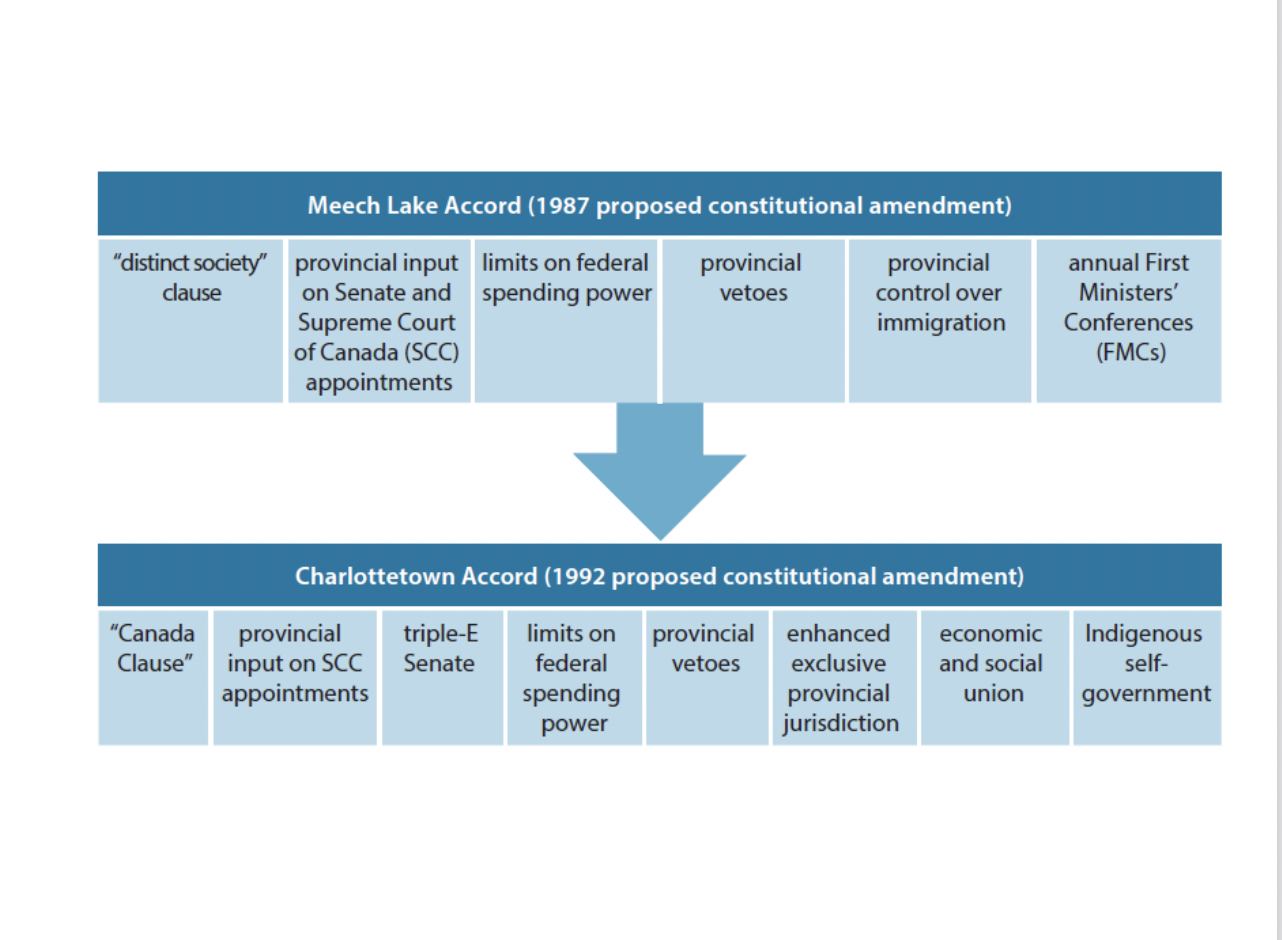
- idea of distinct society, this would be written into the preamble of the constitution (master document)
- Wanted to use immigration so that French language would still be passed on
- The deal is made: premiers get together make it and then present it to Canadians
CONSTITUTIONAL CHANGE
Meech Lake Accord- the Quebec round- was focused around Quebec to sign the constitution
1986: “five conditions” for Quebec to engage in constitutional negotiations
1987: Meech Lake Accord – provincialized all but distinct society
1990: Meech Lake Accord fails – MN & NL
- FAILS
- 2 components of the 5 require unamioty, other 3 require 750... Changed to that ALL need it to be unanimous
- N and L does not approve
- Manitoba said they needed to have everyone agree to get rid of these public hearings
- Elijah Harper, Manitoba MLA Indigenous induvial said no
- Brian Mulroney is a quebeer and wanted to bring them into the constitution
CONSTITUTIONAL CHANGE
Charlottetown Accord
1992: (28 August) First ministers and Indigenous leaders sign the Charlottetown Accord
- created by brain Mulroney
- Canada round
- Charlottetown Accord
- 1992: (26 October) Charlottetown Accord is defeated in nationwide referendum
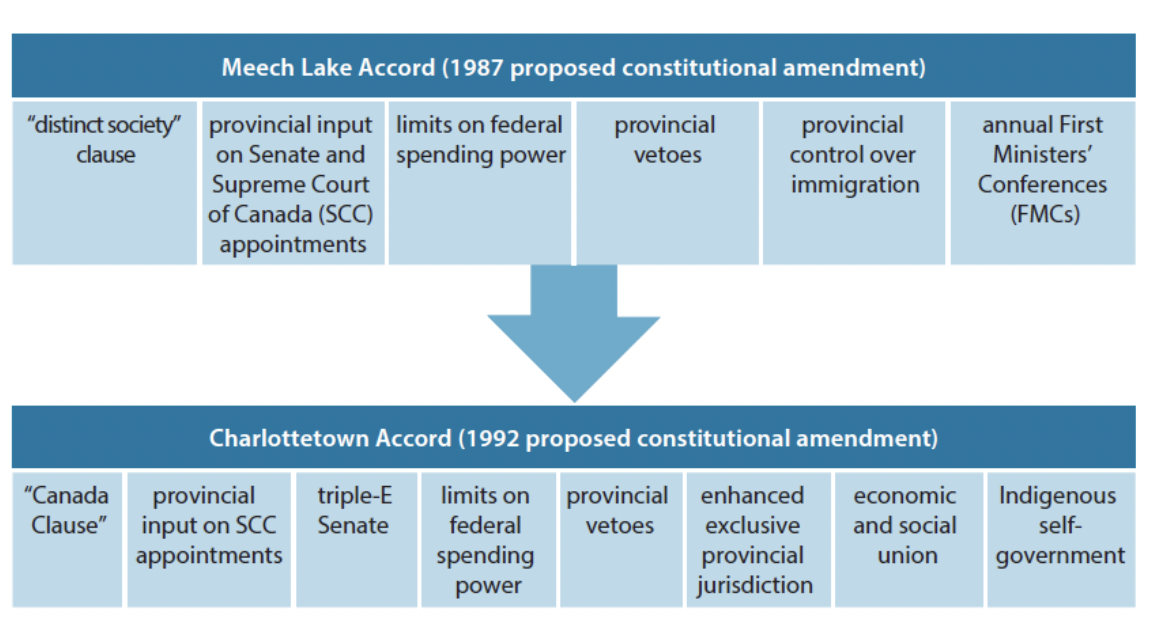
- - Says there is an inherit right for indigenous people to self-govern
- - triple e senate (equal, elected, and effective)
- - Wanted to create a senate that is equal (everyone has the same number of seats, they would be elected, and they would be able to exert their power)
- - Canada clause: had random phrases?
- Different in creation: ML: 10 white men came together to be made
- CA: Asked for a lot of Canadian feedback before they met and came up with these ideas
- Difference in being ratified
- ML: Ratified through each of the provincial governments going to the highest level (supreme court)
- CA: There was a referendum (asked Canadians what they thought)
Globe and mail article
- CAN did not want Charolette accord
- Rejected in all western provinces and in Quebec
- PIE, NL, NB loved it
Why it may have failed...
- Size of the package... they may like one part but hate another part so much they can't support it
- 2nd big attempts to give a branch to Quebec fails
CONSTITUTIONAL CHANGE
Differences Between Accords
1. focus
- Québec round vs. Canada Round (bringing in more actors=West, Indigenous people)
2. negotiations
- executive federalism vs. multilateral negotiations (idea that indigenous leaders were able to participate in this conversation)
3. public involvement
- none vs. substantial (before – Spicer Commission and after referendum)
CONSTITUTIONAL CHANGE
“Canadians . . . would much prefer to make do with political institutions poorly designed for the nineteenth century than engage in constitutional reform” (Gibbins, 2009).
non-constitutional change
- Québec is a distinct society (1995) and a nation (2006)
- Constitutional Amendments Act
- Senate reform
- Too much work... would need to talk about Quebec and indigenous peoples so they just dance around the mention of the constitution
CANADIAN CONSTITUTION – AMENDING FORMULAS
Constitutional Amendments Act, 1996
- act of Parliament
- sets out the combination of provinces and regions whose support is needed before the Canadian Cabinet presents proposed constitutional changes to Parliament
- changes to 7-50 rule, replaces it
- We cant use the amending formula to change the mending formula
- Acts of a constitutional nature
- The constitution amendment act- attempts to fix 750 (the one where Quebec loses its veto)
- Attempt to fix 750- says Ontario, Quebec, BC have a veto
Formula
1. ON, QC, BC
2. 2 Atlantic provinces with more than 50 % of the region's population
3. 2 Prairie provinces with more than 50 %of the region's population (Defacto AB veto )
- says Ontario, Quebec, BC have a vet
- Atlantic prov with mor than 50 per cent of the regions pop
- Prairie provinces with more than 50 percent of the pop
- Gives a Defacto veto back to Quebec (even though not explicitly said)
- We don’t use it because we don’t talk about the constitution
- Never used this formula
- CAN has a rigid constitution- we cannot really fix it
- Several section 43 changes
KEY POINTS
- A constitution is the fundamental rules by which a country is governed
- Canada’s constitution is made up of written, unwritten, entrenched and unentrenched, formal and informal components
- Very complex set of documents
- Canada could not, on its own, change its Constitution until 1982; it now has 5 entrenched amending formulas
- The constitutional veto act NOT entrenched (68,72) because he can still change it, it is normal law,
- The Canadian constitution is rigid and quite difficult to change
- Because we as Canadians are difficult
****5 Amending formulas involved*** In 1982
*** make chart of the constitution****