APUSH Period 1
1.1 Contextualization
Different native societies adapted to and transformed their environments through innovations in agriculture (slash and burn), resource use, and social structure (permanent vs nomadic)
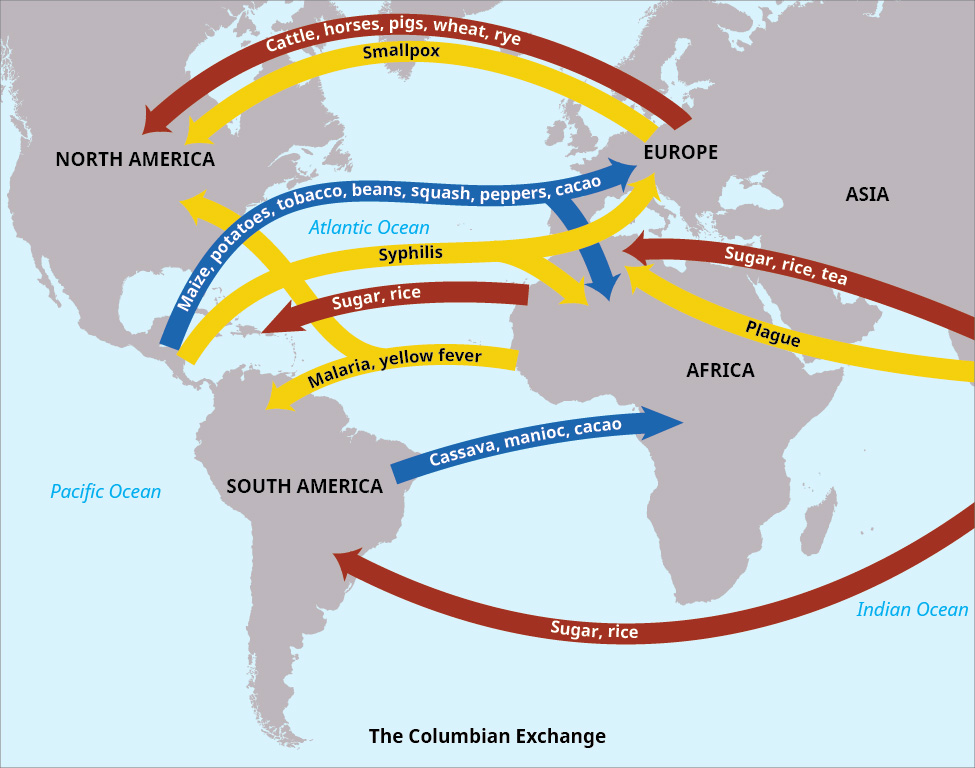
Columbian Exchange: Interactions between the Americas, Europe, and Africa. They exchanged ideas, resources, and people.
1.2 Native American Societies before European Contact
Southwest: Dry (desert), Hot, Arid, little water, mostly flat, agriculture, hunting, gathering, soil is clay-like.
Great Basin and Great Plains: Flat, Mountains, dry, grassy, open space, little vegetation, hunting, gathering, fishing, rivers, rice, little wood, and nomadic
Northeast/ Mississippi River Valley/ The Atlantic Seaboard: Agriculture, fishing, consistent weather, wet, cold, mountains, amazing vegetation, and created permanent settlements.
Northwest and California: Warm, hunting, gathering, agriculture, and created settled communities.
1.3 European Exploration in the Americas
The Europeans’ main arguments for exploring the Americas were: Christianity, wealth, and military
Christianity: they wanted to send missionaries out to spread the word of god
Wealth: they saw the Americas as an economic gain to their market with diverse resources and lots of land
Militarily: Europeans sought to explore and claim the Americas before other nations, aiming to establish a military presence that would secure their control over the newly acquired territory.
1.4 Columbian Exchange, Spanish Exploration, and Conquest
The Columbian Exchange brought new crops to Europe from the Americas.
Spanish exploration and conquest of the Americas furthered widespread epidemics that killed millions of Natives.
1.5 Slavery, Labor, and Caste system
Encomienda System: Spanish government’s policy to “command” (or give) Indians to certain colonists in return for the promise to Christianize them. This was part of a larger idea to subdue the indian tribes in the West Indies and North America
Caste System: The idea of ranking people at the top was that Europeans born in Europe. The middle was mixed race Europeans. The bottom was black and indian people.
Bartolome de Las Casas: He wanted to halt Indian forced labor. He also wanted to end the caste system. Bartolome was an activist of the time fighting for equal rights in Spain.
1.6 Cultural Interactions Between Europeans, Native Americans, and Africans
Cultural Exchange: Interactions between Europeans, Native Americans, and Africans led to significant exchanges of languages, customs, agriculture, and religions. Indigenous and African cultures enriched Europe with crops like maize, potatoes, and tomatoes.
Religious Influence: Christianity spread through missionary efforts aimed at converting Native Americans and Africans, often conflicting with existing spiritual beliefs.
Social Structures: These interactions created complex hierarchies, notably the caste system in Spanish colonies that ranked Europeans, mixed-race individuals, and Native Americans/Africans according to colonial racial hierarchies.
Economic Impact: Exchanges transformed economies, increasing demand for labor in agriculture and mining, leading to the forced labor of Native Americans and the introduction of the African slave trade, resulting in demographic changes.
Resistance and Adaptation: Indigenous peoples resisted European encroachment through conflict and alliances while adapting by blending traditional practices with new influences. This resistance led the Europeans to stop seeking Indians for labor, but for Africans instead, as they couldn’t escape as easily because they didn’t know the land.
Epidemiological Consequences: The Columbian Exchange also introduced new diseases to the Americas, decimating Native populations without immunity and weakening resistance to European expansion.