Free-Fall & 1-D Kinematics
Free-Fall & Acceleration Due to Gravity
Free-fall definition: Any object that is no longer in physical contact with Earth (or an object attached to Earth) and is acted on only by gravity is in free fall – this is true whether the object is moving upward or downward.
Gravitational acceleration at Earth’s surface: (magnitude).
Direction is always toward Earth’s center → in the conventional coordinate system (up = +), .
On other celestial bodies (e.g.
Moon) the same free-fall principles apply but use the local (Moon: ).Unless a problem explicitly introduces drag/air-resistance, treat motion as occurring in a breathable vacuum (ignore non-gravitational forces).
1-D Kinematic Equations (Constant Acceleration)
For vertical motion swap and :
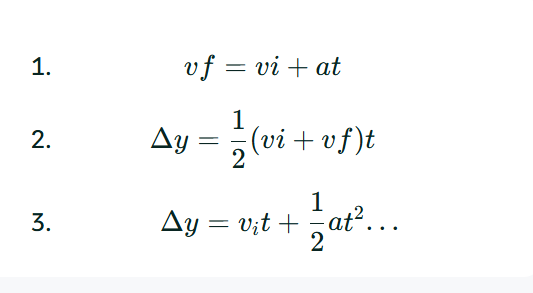
Sign Conventions & Units
Upward = positive, Downward = negative.
Always state vector answers with magnitude + direction (e.g. means 25.5 m/s down).
Time (s) and mass (kg) are inherently non-negative; a negative value indicates an algebra/sign mistake.
Convert all givens to SI before substituting; convert final answers to requested units (e.g. multiply by to go from m/s → km/h).
Standard Problem-Solving Strategy
Sketch & annotate the motion diagram (choose origin, indicate positive direction).
List knowns & unknowns (identify givens such as “from rest”, “to rest”, “dropped”, “peak”, etc.).
Pick the kinematic equation containing the desired unknown and only known variables (avoid simultaneous equations unless necessary).
Check units & signs before inserting numbers.
Solve algebraically first; substitute numerics second.
Assess reasonableness (e.g. time can’t be negative, speeds within plausible range, etc.).
Worked Examples & Key Results
Example 1 – Thrown Downward From Building
Data: , , , .
Height: use Eq-4 → .
Flight time: Eq-2 → .
Example 2 – “Giant Drop” Ride (2.60 s Free Fall)
From rest: , .
Final speed: Eq-1 → .
Distance fallen: Eq-3 → .
Example 3 – Feather on the Moon
, .
Drop time: Eq-3 → (slower than on Earth).
Example 4 – Kangaroo Vertical Jump ()
At peak .
Takeoff speed: Eq-4 → upward.
Example 5 – LeBron James’s 1.12 m Vertical
Takeoff speed: .
Time to peak: (Eq-1).
Hang time: .
Example 6 – Baseball Pop-Up (Hang-Time 6.25 s)
.
Initial speed: .
Maximum height: Eq-4 → .
Example 7 – Penny Dropped From 370 m Skyscraper
Drop time: Eq-3 → .
Impact speed just before ground: Eq-4 → .
Example 8 – Required Speed for 91.5 m Throw
Using Eq-4 with → .
Convert to km/h: (≈152.5 km/h).
Practical Notes & Pitfalls
Hang-time questions: split motion into upward phase (peak) and double the time for total flight if the start & end heights are the same.
Dropped vs. Thrown Up/Down:
• “Dropped” ⇒ . • “Thrown up” ⇒ .
• “Thrown down” ⇒ .At peak: ; use this statement to simplify equations.
Quadratics occasionally occur (Eq-3 with unknown & non-zero ), but course problems are typically structured to avoid messy algebra.
Keep all intermediate calculator digits; round only final answers.
Connections & Forthcoming Topics
The same kinematic framework underpins 2-D projectile motion (next unit) – the y-motion is still governed by the free-fall equations outlined here.
Week 3 introduces forces (Newton’s laws, friction, drag) → we will revisit terminal velocity and modify constant-acceleration models to include air resistance.
Ethical / Real-World Implications Mentioned
Mythbusters experiment: a penny dropped from a skyscraper cannot kill due to air drag (real-world terminal velocity ≈ 18 m/s).
→ Highlights importance of including resistive forces when accuracy matters.Safety note: theme-park “drop” rides use controlled braking; theoretical free-fall speeds illustrate why engineering safeguards are critical.
Quick Reference Conversions & Constants
(use 9.81 if more precision required).
.
(and divide by 3.6 for inverse).