Chem 120
isotopes: atoms that have the same number of protons but a different number of neutrons
allotropes: different molecular forms of the same element
atomic mass interval: (lower bound mass, upper bound mass) range od values expected for the atomic mass of given atom, due to variation in isotopic abundances
calculating atomic mass interval:
ionic compounds:
molecular compounds:
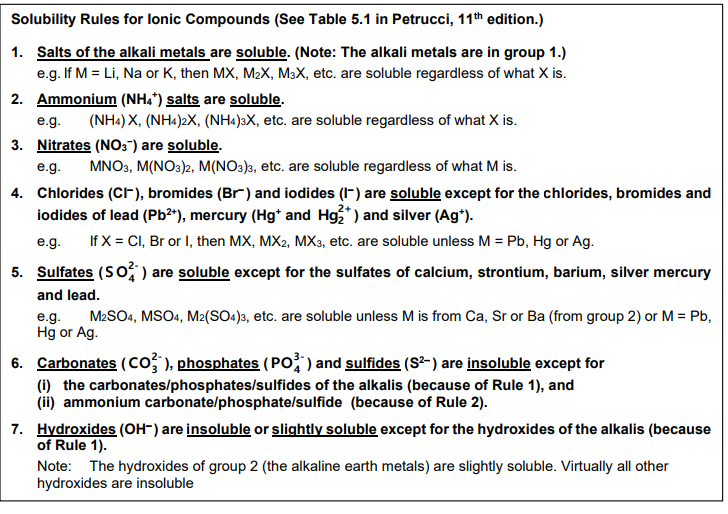
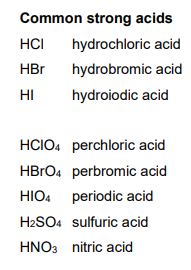
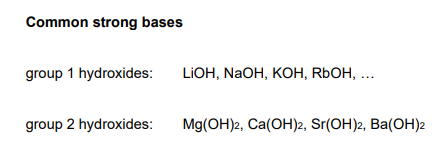
acid: proton H(+) donor
base: proton (h+) acceptor
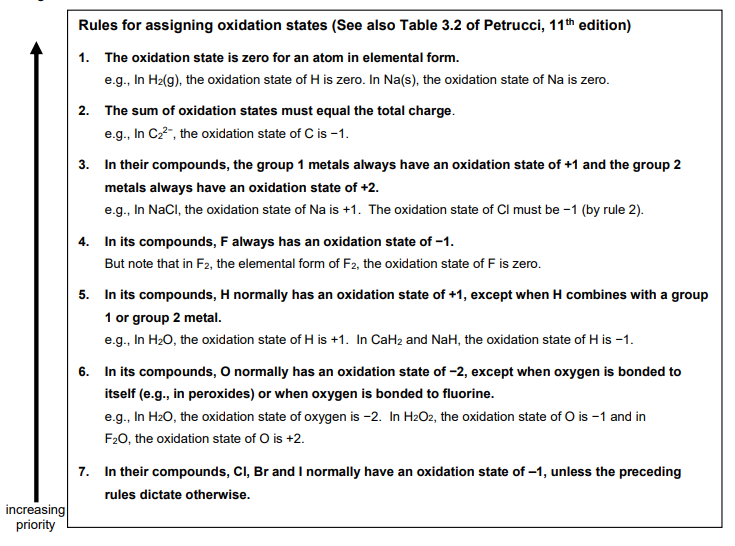
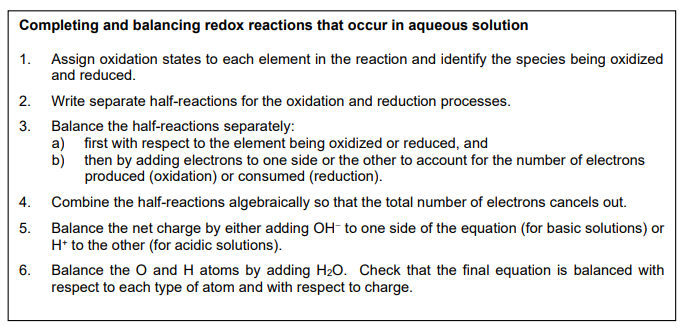
OILRIG: Oxidation Is the Loss of electrons Reduction is the Gain of electrons
consecutive reactions: a series of reactions that occur one after another (can be added together)
simultaneous reaction: reactions that are independent and occur at the same time
% atom economy: stoich mass of product/ mass of a stoich mixture of reactands
e-factor: (mass of waste produced/mass of product obtained
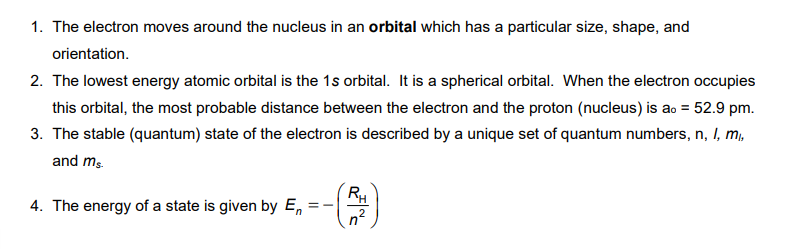
quantization: when an electron is confined to a finite region of space by the forces exerted on it, its total energy is restricted to certain special values.
wavelength, λ (in meters) = distance between successive maxima
period, T (in seconds) = time it takes for the electric field to return to its maximum strength
frequency, v=(1/T) /s = #of times/sec the electric field reaches its maximum value.
wavelength frequency relationship: λv=c
1 Hertz (Hz) = v of 1
visible light spectrum: 400-750nm
nm → m: 1nm= 10e-9m
energy photon = hv = w + KE
work function : min energy required to dislodge an electron from the metal’s surface, w = (hc)/λ
line spectra of atoms: proved that the energy of an atom is quantized
energy of the electron: En = (-Rh/n^2)
ΔE=hv=-Rh(1/nf^2 - 1/ni^2)
change in energy level: high → low (emit photon)
de Broglie wavelength (λdB) = h/p=h/mv
angular momentum of electron (mvr) = n(h/2ℼ)
Heisenberg Uncertainty Principle: we can not know the exact position and momentum of a electron at the same time. (equations)
principal quatum number (n): determines the size of an orbital (any #)
Orbital momentum quantum number (l): determins the shape of an orbital (n-1)
magnetic quantum number (ml): number of orientations allowed for a particular orbit
electron spin quantum number: no two electrons can have the exact same quantum number.
Probability Density Plots (“scatter point plots”)
Boundary Surface Plots (“balloon pictures”)
Radial Factors
Radial Electron Densities
Radial Distribution Plots
# of radial nodes = n-l-1
# of angular nodes = l
total # of nodes = n-1
# of maxima (radial electron) = n - l
the difference between orbital energy diagrams for the H atom vs multi electron atoms: H atom s,p&d are of the same energy level.
the pauli exclusion principle: no two electrons can have the same set of quantum numbers (n,l,ml,ms)
the aufbau procedure: for neutral atoms orbitals are filled according to the n+l rule
Hunds Rule: if a subshell is not completly full it will assume the lowest energy arrangement.
exceptions to the aufbau procedure: Cr(z=24) & Cu (z=29)
Cr Electron Configuration: [Ar] 4s1 3d5
Cu Electron Configuration: [Ar] 4s1 3d10
electron configuration of negative monatomic ions(anions): write electron configuration for the neutral atom then use the n+l rule to ass electrons to the appropriate orbitals.
Electron configurations for positive monatomic ions (cations): write the eleectron configuration for the neutral atom first, then remove electrons from the orbitals with the highest n orbital first, if same n remove from orbrit with highest l value.
paramagnetic: one or more unparied electrons, atom has a magnetic moment and will inreact strongly with an external magnetic field
Diamagnetic: all electrons are paried, atom does not have a magnetic moment
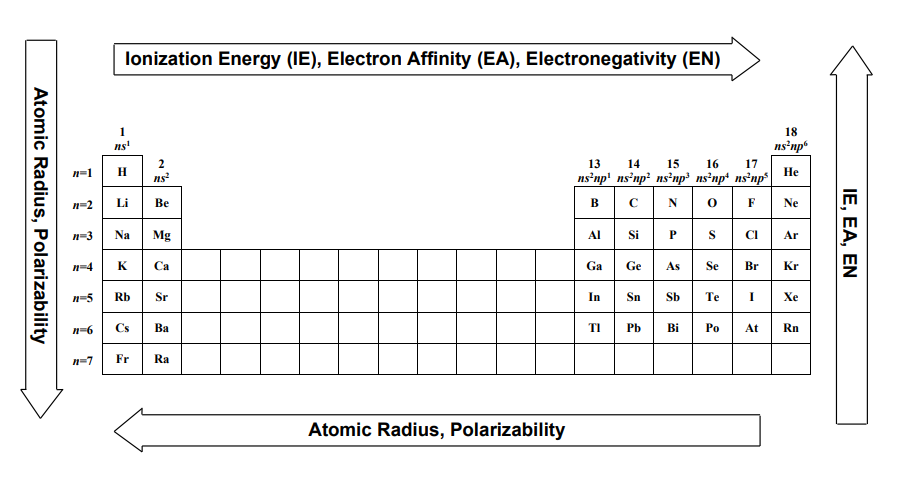
Atomic Radii: the size of an atom mesured by the distance between nuclei in a certain enviroment.
covalent radius = 1/2 of the diatomic bond length for the X2 molecule
metallic radius = 1/2 of the distance bettwen “nearest neighbours” on a metallic solid.
general rules for atomic radius: decreases across a period & increase down groups
ionization energy: energy required to remove an electron from a gas-phase atom (enthalpy change)
general rules for ionization energy: it becomes harder and harder to remove electrons if electrons have already been removed, IE decrease down groups and increase across a period but drops down at group 13&16.
electron affinty: energy change that accompanies the addition of an electron to a gas-phase atom.
general rules for electron affinities: most atoms other than group 2 & 18 and N release energy, EA is small on the left side of the table and large on the right side.
ionic bonds: transfer of electrons (s block element combining with p block element)
covalent bonds: sharing of electron pairs (p block element with p block element)
octet rule: an atoms tendancy to obtain noble gas config
rules of molecular compounds: 1. H atom never has more then 2 valence electron 2. 2nd rown atoms never have an expanded octet
formal charge formula = # valence brought - # electrons owned (1/2 bonding electrons)
sum of formal charges must always equal the total charge on the molecule or ion.
resonance structures: have the same spatial arrangment of atoms but a diffrent distrubution of electrons around the atoms.
guidelines for placing formal charges: 1. structures with negative formal charges on EN elements 2.minimize the number of formal charges (or lower charges bettera) 3. avoid placing like formal charges on adjacent atoms. oxidation state: the charge an atom would have if the bonding electrons in each bond were owned by the more EN atom.
formal charge: the charge an atom would have if the electrons that form the bond are shared equally
When more than one equivalent resonance structure can be drawn, the actual structure is the average of the equivalent resonance structures
the strength of a covalent bond depends on, the size of the atoms, the bond order, whether the bond is polar or non-polar
Bond dissociation energy: energy required to break a particular covalent bond
general key to strength of covalent bonds: 1. small atoms tend to form strong, compact bonds 2. bond length decreases and bond strength increases as the bond order increases
a covalent bond is typically 100-200pm in length
bond dissociation energy for a covalent bond is typically a few hundred kJ/mol
Δr H = Σ BDE (reactants) - Σ BDO (products)
Electronegativity: mesure of the pull an atom has on the electrons in its bonds
general rule for electronegativity: increase across periods and decreases down groups
When electron pairs are not shared equally, the bond will have a dipole moment
VSEPR Theory: Valence Shell Electron Pair Repulsion Theory how groups arrange themselves around an atom to minimize electron pair repulsions
VSEPR group # = # bonded atoms + # lone paris
because there is better orbital overlap in a σ bond than in a ℼ bond a σ bond is stronger.
Orbital Hybridization: combining atomic orbitals to create new hybrid orbitals
sp → 2 groups (linear)
sp2 → 3 groups (trigonal planar)
sp3 → 4 groups (tetrahedral)
sp3d → 5 groups (trigonal bioyrimidal)
sp3d2 → 6 groups (octahedral)
σ bond: - orbital overlap occurs along the internuclear axis - often involves overlap of hybrid orbitals
ℼ bond: - orbital overlap does not occur along internuclear axis -can be formed via the overlap of unhybridized p orbitals
molecular orbital: tells us how a single electron interacts with all of the nuclei
molecular orbitals types: bonding and antibonding
molecular orbital diagram
pressure (P): force per unit area
volume (V): provides a mesure of the space occupied
Kelvin Temperature (T): ℃ + 273.15 = temp in kelvin
ideal gas equation predictions
relationship between gas density and molar mass
partial pressure equation
real gases: when gases deviate from ideal
behaviours (very high or low pressures and temperatures)
compressibility factor: Z= PV/nRT
real vs idea gases: for real gases it is expectied that… volume will be equal or greater & pressure to be lower
molecular dependent constants: a(measure of intermolecular forces) & b (measure of the size of molecules)
increase of energy within the system: solid → liquid → gas
phase changes require energy input or output
vapour pressure: pressure of vapour that forms above a liquid in a closed container
Boiling point: temp that vapour pressure equals 1atm
surface tension: energy required to increase the surface area of a liquid
viscosity: mesure of a fluids resistance to flow
general rules of IMFs: stronger → higher boil point, the greater the surface tension, the higher the viscosity and the lower the vapour pressure.
dipole moments: when bond dipoles do not full cancel out within a molecule
polarizability: mesure of how easily an molecules charge cloud can be distored by another molecule (larger molecules have larger polarisability)
dipole-dipole forces: polar molecules (positive & negative end of molecule)
london dispersion forces: temp dipole moment due to uneven distrubtioin of electrons
Hydrogen Bonds: when H is bonded to O,N or F (creates a very large dipole)