Carl Rogers
Definition (#f7aeae)
Important (#edcae9)
Extra (#fffe9d)
The self and tendency towards actualization:
Significance of self-insight in the formation of personality.
Actualization tendency:
Basic human motivation to actualize, maintain and enhance self.
Process involves struggle and pain
Organismic valuing:
Process of judging experiences in terms of hindering in fostering actualization and growth.
Perception of experiences influences behavior.
Experiential world:
Reliable reality depends on one’s perception of experience.
Perception changes with time and circumstance.
Experiences become the basis for judgments and behaviors.
Development of the self in childhood:
Infants develop a need for positive regard that guides behavior.
Positive regard: Acceptance, love, and approval from others.
Unconditional positive regard: Approval granted regardless of behavior.
Positive self-regard: Condition under which an individual grants himself/herself acceptance and approval.
Condition of worth: Belief that a person is worthy of approval when.
They express desirable behaviors.
Refrains from disapproving behavior.
Conditional positive regard: Approval, love and acceptance for desirable behaviour and attitudes.
Incongruence: Discrepancy between one’s self-concept and aspects of experience. Experiences incongruent to one’s self concept becomes threatening.
Level of psychological adjustment is a degree of compatibility between one’s self-concept and experiences
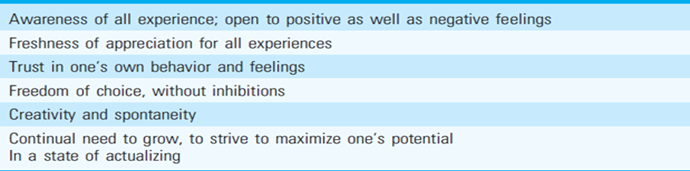
Fully functioning person:
Self-actualization
Developing all facets of the self
Desired result of psychological development.
Questions on Human Nature:
Emphasis on free will
More focus on nurture influence
More inclined to the present
Recognized uniqueness and universality
Growth process
Optimistic
Assessment:
Person-centred therapy:
Client is assumed to be responsible for changing their personality.
Focus is on subjective conscious experiences.
Client is given unconditional positive regard.
Encounter groups:
Group therapy techniques.
People learn about their feelings and how they relate to one another.
Facilitators help members to gain insight.
Psychological tests:
The experience inventory.
The experience scale
Research:
Focus: Client self-report.
Introduced recording and filming of therapy sessions
Person-centered therapy:
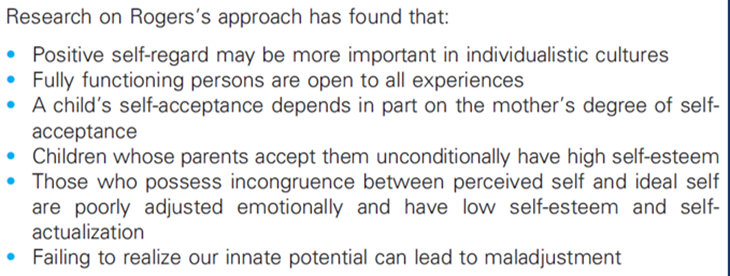
Q-sort technique: Self-report technique used to assess self-concept
Openness to experience
Acceptance of self
Emotional adjustment
Reflection:
Criticism:
Disregard of unconscious factors that could influence behavior.
Subjective reports may be distorted
Contributions:
Widely used to help veteran adjust to civilian life, post WW 2
PCT became popular and highly accessible.