2.3 - Determination of the internal resistance of a cell
Definition of internal resistance of a cell:
The internal resistance of a cell is the resistance to the flow of current within the cell or battery.
Theory:
The equation used for determining the internal resistance is 𝑉 = 𝐸 − 𝐼r where V is the terminal p.d. of a cell; E is the emf of the cell; I the current flowing in the circuit and r is the internal resistance. V = IR and the equation can be re-written as 𝑅 = 𝐸/𝐼 − 𝑟. Therefore a graph of R against 1/𝐼 should be linear.
Apparatus:
Cells – e.g. 3 or 4 × 1.5 V “D” type batteries connected in series
Switch
Ammeter or multimeter set to A range - ±0.01
A Various resistor values 0 - 60 Ω
Diagram:
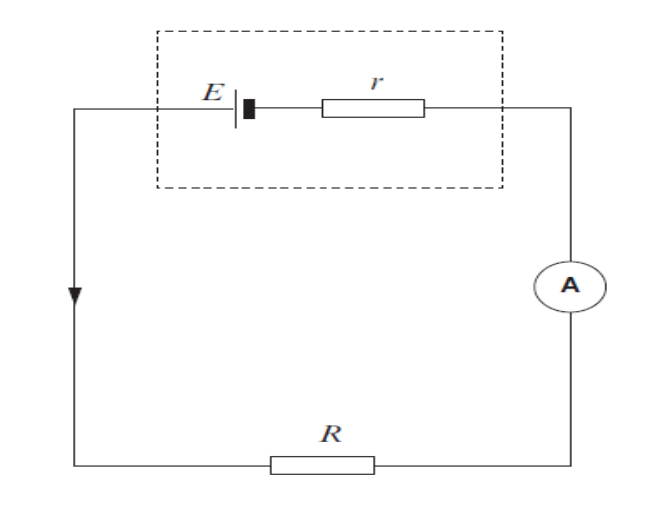
Experimental Method:
The resistor values should be varied and the current values recorded. Plot a graph of R (y-axis) against 1/𝐼 (x-axis). The graph should be a straight line with the intercept on the y-axis which is equal to the value of the internal resistance