Gene Expression
Definitions
Ribozymes - Catalytic RNAs, they cut or bind sequences, replicate RNA molecules and facilitate bond formation in proteins
Intergenic - non-coding
Regulatory Regions - Influence gene expression. Can be distant from the gene.
Promoter: DNA sequence where proteins bind to initiate transcription (near the transcription start site). - RNA polymerise will bind to initiate transcription.
Termination Region - Indicates end of transcription.
Exons - Candidate parts of RNA that remain after splicing and encode functional products.
Introns - Noncoding sections spliced out before RNA is translated into protein.
Ribozymes
Ribozymes - RNA molecules that can catalyse chemical reactions
1981: Thomas Cech discovers catalytic function of RNA.
Catalytic RNAs are called ribozymes. They:
Cut or bind sequences
Replicate RNA molecules
Facilitate bond formation in proteins.
Structure
Single stranded
RNA chain can fold back on its self, forming weak bonds between base pairs
Creates a specific 3 dimensional shape specific to its nucleotide sequence
This creates active sites
Examples
Ribosomes - Made of proteins and rRNA, with its catalytic activity driven by this RNA, it is responsible for making new polypeptide chains.
Viral RNA - some viruses contain self cleaving ribozymes, that cut the RNA at precise locations during replication ( Hepatitis delta virus )
Origins of Life:
ribozymes are key in the RNA world hypothesis, as it states that in early evolution of life, RNA molecules performed both the storage of genetic information and the catalysis of chemical reactions.
Genes
Eukaryotic genomes are organized into genes and intergenic regions.
Functions
Control hereditary traits (physical and biological).
Transcribed into RNA and/or translated into proteins.
In eukaryotes, genes represent only 1-1.5% of the genome; the remainder consists of intergenic regions.
Thousands of genes expressed at specific times determine cell function.
Transcription (simple)
Transcription - The conversion of a gene into mRNA.
Gene Expression - The process of producing RNA and proteins from genes.
History
Initial Model - 1 gene = 1 enzyme
Modified Model - 1 gene = 1 polypeptide
Some genes encode structural RNAs like tRNA, miRNA, rRNA
Process
DNA splits via DNA Helicase
free RNA nucleotides line up against there complementary bases on the template strand
RNA polymerase joins up free nucleotides
via phosphodiester bonds to form pre-mRNA
DNA polymerase rejoins up DNA
pre-mRNA is spliced and introns are removed
leaving mRNA
Transcription stages
3 Key Stages
Initiation: Transcription machinery recognizes and binds to the promoter without needing a primer.
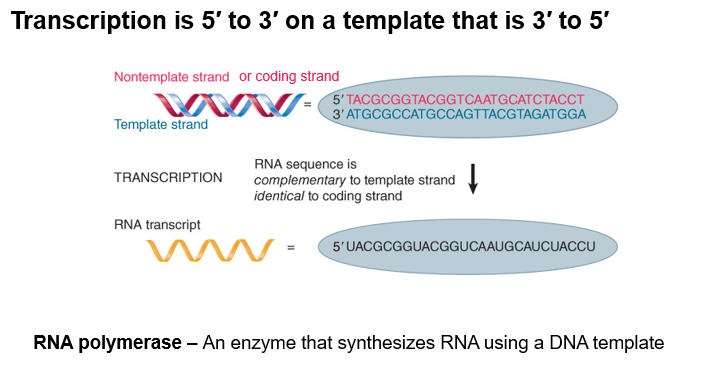
Elongation: RNA polymerase synthesizes RNA by adding nucleotides in the 5’ → 3’ direction.
Genes are transcribed from one specific strand (template strand).
Termination: Enzyme dissociates at the end of the transcription unit, releasing RNA.
Initiation
Promotor Recognition
Signals encoded in the DNA (punctuation) tell the RNA polymerase exactly where to start and stop transcription, the start signals are diverse in their nucleotide sequences.
Regulatory DNA and Proteins
Stretches of regulatory DNA (noncoding regions) bind to specific transcription regulatory proteins. These proteins control the local rate of transcription by either promoting or inhibiting the assembly of the transcription machinery.
Products needed
RNA Polymerase II: This is the primary enzyme for transcribing protein-coding genes in eukaryotes.
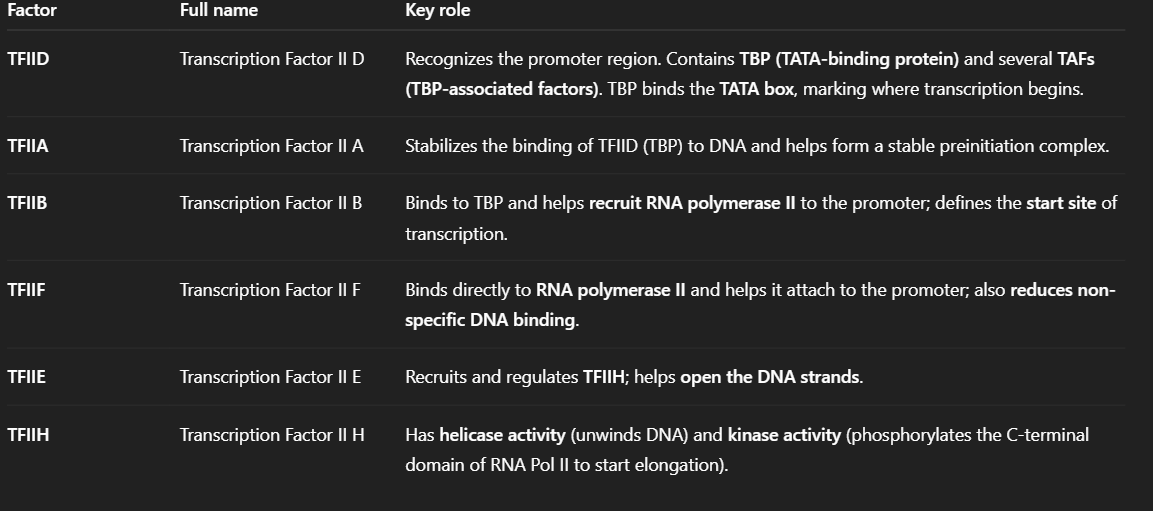
General Transcription Factors: Initiation requires a specific set of these factors to help the polymerase position itself correctly at the promoter.
Activator Proteins: These proteins specifically promote the assembly of RNA polymerase at the start point of transcription.
Mediator and Chromatin-Modifying Proteins: In eukaryotes, additional proteins like the Mediator complex and those that modify chromatin structure are required to facilitate initiation.
RNA polymerase
RNA Polymerase: Enzyme synthesizing RNA using a DNA template.
Different types of RNA polymerases in eukaryotes:
RNA polymerase I, II, and III.
Each binds to specific promoters and transcribes respective genes.
RNA polymerase II
Transcribes protein-coding genes.
Requires accessory proteins (TFs) for promoter binding.
RNA Polymerase II promotors
RNA polymerase II promoters include:
Core Promoter: Contains TATA box recognized by TFIID transcription factor.
Regulatory Promoter: Binds transcription factors that regulate transcription speed.
Enhancers/Silencers: May be located far from the regulated DNA sequence.
Facilitate or inhibit transcription.
Elongation
Mechanism of Growth
During transcription, RNA polymerase moves along the DNA template.
RNA monomers are selected and lined up for polymerization based on their ability to pair with the DNA template
(for example, A in DNA pairs with U in RNA).
Requirement for Accessory Proteins
In eukaryotic cells, the process of elongation is not carried out by the RNA polymerase alone; it requires a set of accessory proteins to help the enzyme move efficiently along the DNA. these include transcription factors
Super helical Tension
As the RNA polymerase moves, it unwinds the DNA, which creates super helical tension (physical twisting stress) in the DNA molecule that must be managed.
Coupling with RNA Processing
In eukaryotes, elongation is tightly coupled to RNA processing. As the new RNA strand is being elongated, it simultaneously undergoes modifications such as capping and splicing.
Polypeptide Growth
During this phase, amino acids are added one by one to the C-terminal end of the growing polypeptide chain according to the sequence of codons in the mRNA.
Termination
Stop Signals in DNA
Just as there are signals to start, specific nucleotide sequences encoded in the DNA act as punctuation to tell the RNA polymerase exactly where to stop transcribing.
Sequence Diversity
These stop signals are heterogeneous, meaning they vary in their specific nucleotide sequences rather than being a single universal sequence.
Eukaryotic 3' End Processing
In eukaryotic cells, the termination of transcription is closely linked with RNA-processing enzymes. These enzymes recognize specific sequences to clip the RNA and generate the final 3' end of the mRNA molecule.
Stop Codons: The end of the protein-building process is marked by specific triplets in the mRNA sequence known as stop codons.
Release of the Protein: When the ribosome encounters a stop codon, it signals the end of translation, leading to the release of the completed polypeptide chain (protein).
Precision: These stop codons ensure that the protein is exactly the length specified by the gene, preventing the addition of extra, unnecessary amino acids
Transcription Factors
Splicing and mRNA Processing
Co linearity - Proposed by Francis Crick in 1958
Suggests a direct correlation between nucleotides in genes and amino acids in proteins.
Introns -Present in eukaryotic genes, crucial for splicing,
The number and size of introns correlate with organism complexity.
mRNA undergoes capping at the 5’ end and polyadenylation at the 3’ end post-transcription:
5’ Cap: Addition of a modified guanine nucleotide, which increases stability and aids translation.
Poly(A) Tail: Addition of 50-250 adenine nucleotides that also enhances mRNA stability and regulates gene expression.
Alternative Splicing - Different mRNA products can arise from the same gene.
RNA transport involves:
Export from nucleus to cytoplasm as ribonucleoprotein complexes.
Export receptors guide mRNA through nuclear pore complexes with energy from Ran-GTP.
RNA is released in the cytoplasm, making it ready for translation.