The Psychology of Decision Making
Definition (#f7aeae)
Important (#edcae9)
Extra (#fffe9d)
Rationality:
Your preferences are consistent and your choices follow clear principles.
John von Neumann and Oskar Morgenstern formalized how a rational person should choose under risk.
Their work became the foundation of expected utility theory in economics and decisions.
Expected Utility Theory:
By Neumann & Morgenstern.
Expected utility theory is presented as a normative theory.
A classical theory that does not intend to explain how people actually behave, but how people should behave if they follow the will to make certain rational decisions.
It's not mainly describing real behavior, but setting a standard for how people should decide if they want to be rational.
More like rules of ideal decision-making.
Goal: The goal of the theory is to establish a set of assumptions that underlie rational decision making.
These assumptions are the logic behind rational choice.
Order of alternatives:
A rational decision maker should be able to compare any 2 options.
You either prefer A to B, prefer B to A.
You're indifferent, no confusion
"I can't choose” if the options are clear.
Preferred ranking: Decision makers should be able to compare any 2 alternatives.
They should either prefer 1 alternative to the other, or they should be indifferent to them.
Dominance:
Do not choose a strategy that will give better results to the opponent.
Rational actors should never adopt strategies that are “dominated” by other strategies (adopting a strategy is equivalent to making a decision).
Cancellation:
A choice between 2 alternatives should depend only on those outcomes that differ, not on outcomes that are the same for both alternatives.
If 2 options share the same outcomes in some parts, those shared parts shouldn't affect the choice.
The decision should depend only on what differs, because the common factors " cancel out.”
Transivity:
If a rational decision maker prefers Outcome A to Outcome B, and Outcome B to Outcome C, than that person should prefer Outcome A to Outcome C.
a>b and b>c → a>c
This keeps preferences logically consistent and prevents circular choices.
Continuity:
For any set of outcomes, a decision maker should always prefer a gamble between the best and worst outcome to a sure intermediate outcome if the odds of the best outcome are good enough.
Peferences shift smoothly with probabilities, not abruptly.
Invariance:
A decision maker should not be affected by the way the alternatives are presented.
Framing shouldnt matter.
Framing: "90% success” and “10% complication” can describe the same situation, but people often react differently.
It hints that real decisions are sensitive to wording and emotion.
Expected utility theory:
Kahneman and Tversky (1979) argue that utility theory is not an adequate descriptive model and propose an alternative account of choice under risk.
Prospect Theory
Prospect theory:
Different from utility theory.
Replacing 'utility' (net income) with 'value' (profit and loss, ie deviations from a reference point).
Prospect theory predicts that selection depends on how the problem is perceived.
If a 'reference point' is defined where the result is seen as profit, then the function value is concave and the decision maker is 'risk averse'.
If the 'reference point' is termed where the result is seen as a loss, then the function value is convex and the decision maker is 'risk seeking'.
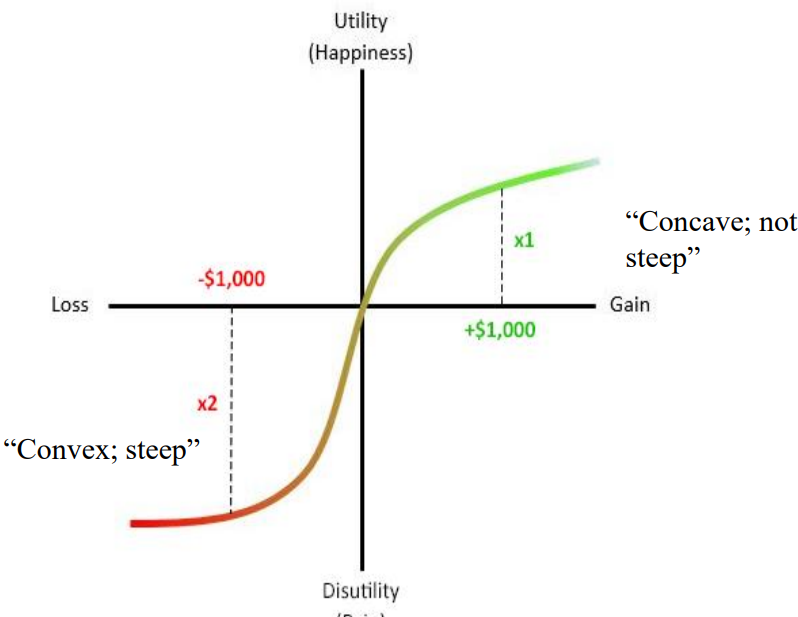
The shape explains why we avoid risk when winning, but may chase risk when trying to avoid losses.
The graph shows that losses are steeper than gains.
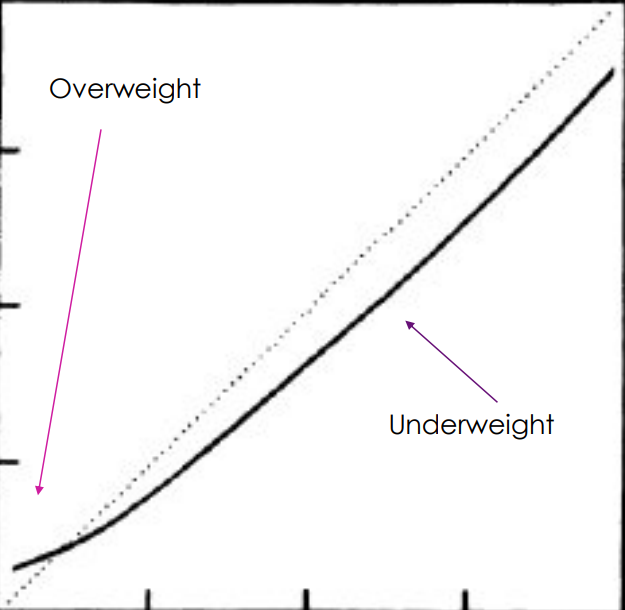
Hypothetical Decision Weights according to Prospect Theory.
Decision weights tend to overweigh small probabilities and underweight moderate and high probabilities.
Prospect theory argues people don't treat probabilities objectively.
This helps explain lottery play and avoidance in low-probability risks.
Thinking fast and slow:
This introduces the idea that we have fast, intuitive thinking and slower, analytical thinking.
It sets up why biases happen:
Often fast thinking drives the first response.
Slow thinking may or may not correct it.
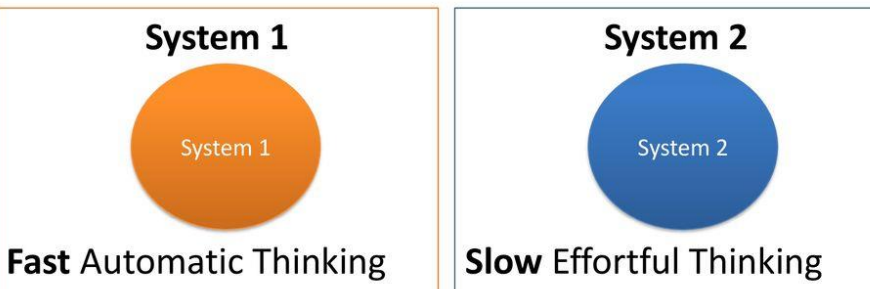
The 2 systems work together.
We need them both but kahneman suggests that we need to be careful.