Week 3 & 4 (Phenotype-Genotype) (Inheritance)
A zygote is an egg that has been fertilized by sperm, and which could develop into an embryo.
a diploid cell resulting from the fusion of two haploid gametes; a fertilized ovum.
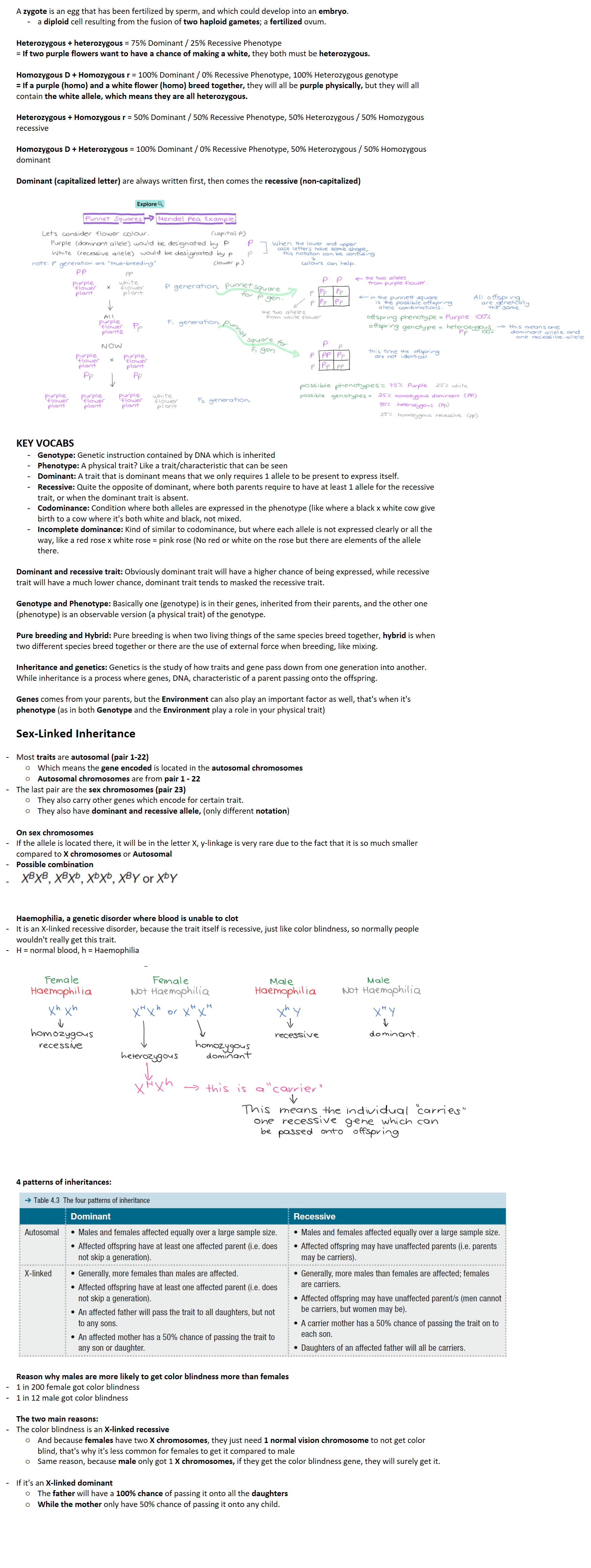
Heterozygous + heterozygous = 75% Dominant / 25% Recessive Phenotype
= If two purple flowers want to have a chance of making a white, they both must be heterozygous.
Homozygous D + Homozygous r = 100% Dominant / 0% Recessive Phenotype, 100% Heterozygous genotype
= If a purple (homo) and a white flower (homo) breed together, they will all be purple physically, but they will all contain the white allele, which means they are all heterozygous.
Heterozygous + Homozygous r = 50% Dominant / 50% Recessive Phenotype, 50% Heterozygous / 50% Homozygous recessive
Homozygous D + Heterozygous = 100% Dominant / 0% Recessive Phenotype, 50% Heterozygous / 50% Homozygous dominant
Dominant (capitalized letter) are always written first, then comes the recessive (non-capitalized)
KEY VOCABS
Genotype: Genetic instruction contained by DNA which is inherited
Phenotype: A physical trait? Like a trait/characteristic that can be seen
Dominant: A trait that is dominant means that we only requires 1 allele to be present to express itself.
Recessive: Quite the opposite of dominant, where both parents require to have at least 1 allele for the recessive trait, or when the dominant trait is absent.
Codominance: Condition where both alleles are expressed in the phenotype (like where a black x white cow give birth to a cow where it's both white and black, not mixed.
Incomplete dominance: Kind of similar to codominance, but where each allele is not expressed clearly or all the way, like a red rose x white rose = pink rose (No red or white on the rose but there are elements of the allele there.
Dominant and recessive trait: Obviously dominant trait will have a higher chance of being expressed, while recessive trait will have a much lower chance, dominant trait tends to masked the recessive trait.
Genotype and Phenotype: Basically one (genotype) is in their genes, inherited from their parents, and the other one (phenotype) is an observable version (a physical trait) of the genotype.
Pure breeding and Hybrid: Pure breeding is when two living things of the same species breed together, hybrid is when two different species breed together or there are the use of external force when breeding, like mixing.
Inheritance and genetics: Genetics is the study of how traits and gene pass down from one generation into another. While inheritance is a process where genes, DNA, characteristic of a parent passing onto the offspring.
Genes comes from your parents, but the Environment can also play an important factor as well, that's when it's phenotype (as in both Genotype and the Environment play a role in your physical trait)
Sex-Linked Inheritance
Most traits are autosomal (pair 1-22)
Which means the gene encoded is located in the autosomal chromosomes
Autosomal chromosomes are from pair 1 - 22
The last pair are the sex chromosomes (pair 23)
They also carry other genes which encode for certain trait.
They also have dominant and recessive allele, (only different notation)
On sex chromosomes
If the allele is located there, it will be in the letter X, y-linkage is very rare due to the fact that it is so much smaller compared to X chromosomes or Autosomal
Possible combination
Haemophilia, a genetic disorder where blood is unable to clot
It is an X-linked recessive disorder, because the trait itself is recessive, just like color blindness, so normally people wouldn't really get this trait.
H = normal blood, h = Haemophilia
4 patterns of inheritances:
Reason why males are more likely to get color blindness more than females
1 in 200 female got color blindness
1 in 12 male got color blindness
The two main reasons:
The color blindness is an X-linked recessive
And because females have two X chromosomes, they just need 1 normal vision chromosome to not get color blind, that's why it's less common for females to get it compared to male
Same reason, because male only got 1 X chromosomes, if they get the color blindness gene, they will surely get it.
If it's an X-linked dominant
The father will have a 100% chance of passing it onto all the daughters
While the mother only have 50% chance of passing it onto any child.