MIS Notes.docx
Chapter 1 1/15/2025
In Class:
- Information systems- There is an input and output
- Data- Raw fact, she has black hair; output
- Ex: what got sold and to who
- Data point- The temp outside, there are 15 girls in the class,
- Information- process data, 80% of the class are female, can’t pull raw, average
- 4 ways to process data- Descriptive, diagnostic, predictive, and prescriptive
- Information systems- HW, SW, Data, Process (People), Networking, Telecommunication
- Cloud= HW and SW
- Input- software, hardware processes
- Output- telecommunication
- The main functional areas of business- accounting, marketing, human resources, finance, operations management, sales
- ex: a house needs plumbing and electricity
- Big data is the new oil, but not all data is good data; ex: climate data
- Volumous- scale of data
- Variety-different forms of un/structured data
- Velocity- the speed at which it changes
- Veracity-uncertainty of data
- BI- trends; information collected from multiple sources
- Be specific and explain why
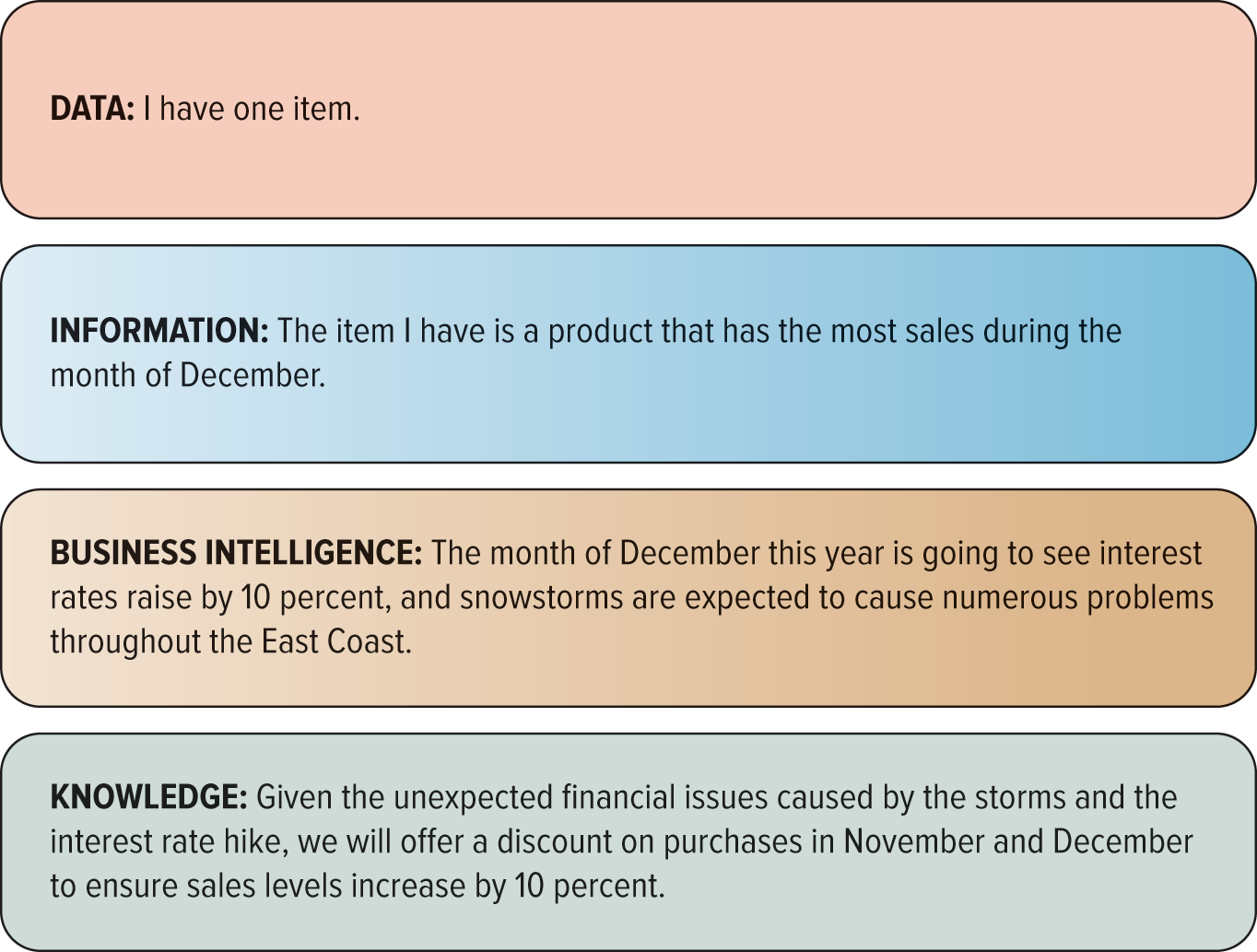
- Data—--> Knowledge
- Efficient- the speed, the money
- Effective- can they do the job
- Competition, substitution, supply, buyer power, new entrance
Book:
- Data analytics brings theory and practice together to communicate data insights
- Internet of Things- The interconnected internet enables things to collect and share data without humans
- Machine to machine- devices that connect directly to other devices
- Data-driven decisions: data, info, business intell., and knowledge
- Data- raw facts that describe the characteristics of an event/object
- Big data- a collector of large datasets with un/structured data that can’t be analyzed using traditional database methods
- Data is too large to fit on a single computer
- Big data= data volumes, high velocity, wide variety, and veracity
- Structured data- defined length, type, and format. Typically stored in a traditional system
- Machine-generated data: made by machines and not human intervention
- Human-generated data: humans+computers
- Unstructured data- opposite: like tweets and texts
- MG un. Data- radar and satellite data
- HB un. Data- texts, social media data
- Snapshot- a view of data at a particular moment in time
- Information- computers need data and humans need information
- Data converted into meaningful context
- Variable- a data characteristic that stands for a value that changes or varies over time
- Changing the variable helps predict the future
- Report- a document with organized data that helps others understand information
- Dynamic report- changed auto, during creation, like stock market prices and inventory
- Static report- created once from data and never changed like a salary report from the past
- Business intelligence- manipulated multiple variables
- Info collected from many sources that analyze patterns and trends for decision-making, like company sales and competitors
- Internal variable: we can control
- External: opp.
- Data analyst- collects, queries, and consumes data to uncover patterns and provide insights for decision-making
- Data analyst=
- Understands math and stats
- Coding skills
- Business subject matter
- Analytics: the science of fact-based decision-making
- Business ana.- scientific process of transforming data into insight for decision-making
- Data scientist- takes knowledge from data by doing statistical analysis on big data to identify trends
- 4 categories of ana.:
- Descriptive-describes past performance and trends
- Diagnostic- examines data
- Predictive- extracts info from data to predict future trends and patterns
- Prescriptive- creates models indicating the best decision to make
- Knowledge- use BI and personal experience to make decisions
- Includes skills, experience, and expertise along with info and intelligence
- “” Assets- the human, structural, and record resources available to orgs
- A school is an org, the people teachers, and books make it successful
- “” Facilitators: help harness the wealth of knowledge in the orgs
- “” worker- individ. Valued for their ability to interpret and analyze info
Systems Thinking and Management Information Systems
- Business unit- a segment of a company representing a specific business function and accounting
- Acct.- records, measures, and reports monetary transactions
- Finance- deals with strategic financial issues, including money, banking, credit, investments, and assets
- HR- maintains policies and procedures for effective management of the employees
- Marketing- supports sales by planning, pricing, and promoting goods and services
- Sales- performs the funct. Of selling goods and services
- Data silo- occurs when one business unit is unable to freely communicate with other business units making it difficult for orgs to work cross-functionally
- Data democratization- the ability to collect and analyze data and make it accessible to all users
- System- a collection of parts that link to achieve a common purpose
- Goods- material items or products
- Services- tasks performed by people that customers will buy
- Production- the process where a business takes raw materials and processes them or converts them into a finished product for goods and services
- Productivity- the rate at which goods and services are produced
- Systems thinking- a way of monitoring the entire system by viewing multiple inputs while continuously gathering feedback
- Feedback- info that returns to its origin. that modified the transmitter's actions
- MIS- a business funt. Such as HR which moves info about ppl, products, and processes across the company to facilitate decision-making and problem-solving
- Value-added- the term used to describe the diff. Between the cost of inputs and the value of the price of outputs
Chapter 2
Identifying Competitive Advantages
- Business strategy- a leadership plan that achieves goals or objectives for specific things like increasing sales or developing new products or services
- Stakeholder- a person or group that has an interest in an org, they drive business strategies
- Competitive advantage- a feature of a product/service on which customers place a greater value than they do on similar offerings from competitor
- The same product has either a lower price or additional value
- CA doesn't last long since other companies duplicate
- First-mover advantage- occurs when a company can significantly increase its market share by being first with a CA
- Competitive intelligence- the process of gathering info about the competitive environment to improve a company's success
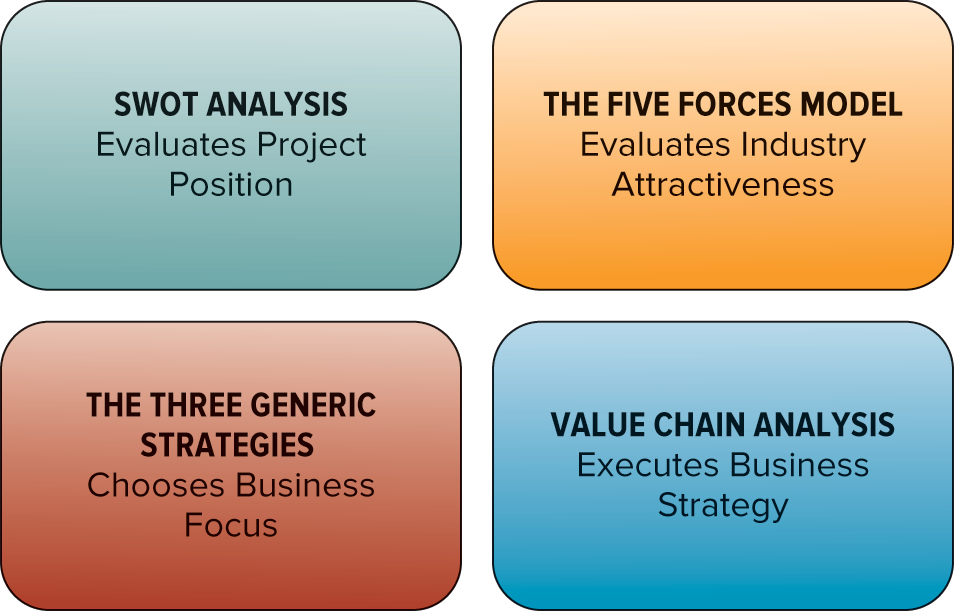
- SWOT analysis- used to identify significant influences that work for or against business strategies
- Buyer power- the ability of buyers to affect the price they must pay for an item
- Number of customers, sensitivity to price, size of orders, etc
- If buyer power is high customers can force competitors to compete on price and price goes down
- Switching costs- Cost that makes customers reluctant to switch to another product or service
- Drives down buyer power
- Loyalty programs- reward customers based on their spending
- Example of using MIS to reduce buyer power
- Supply chain- consists of all parties involved directly or indirectly in obtaining raw material or a product
- Supplier power- The suppliers' ability to influence the prices they charge for supplies (materials, labor, services)
- If the supplier power is high charge higher prices, limit quality or services, shift costs to industry participants
- Buyers often lose money when it's high
- Porters 5 Forces- Subsutition, New entrants, Rivarly, Buyer Power, Suppiler Power
- Threat of substitution product or services- High when there are many alternatives to a product or service and low when there are few alternatives from which to choose
- Threat of new entrants- High when it is easy for new competitors to enter a market and low when there are significant entry barriers to joining a market
- Entry barrier- a feature of a product/service that customers have come to expect and entering competitors must offer the same for survival
- Rivalry among existing competitors- High when competition is fierce in a market and low when competitors are more complacent
- Product differentiation- occurs when a company develops unique differences in its products or services with the intent to influence demand
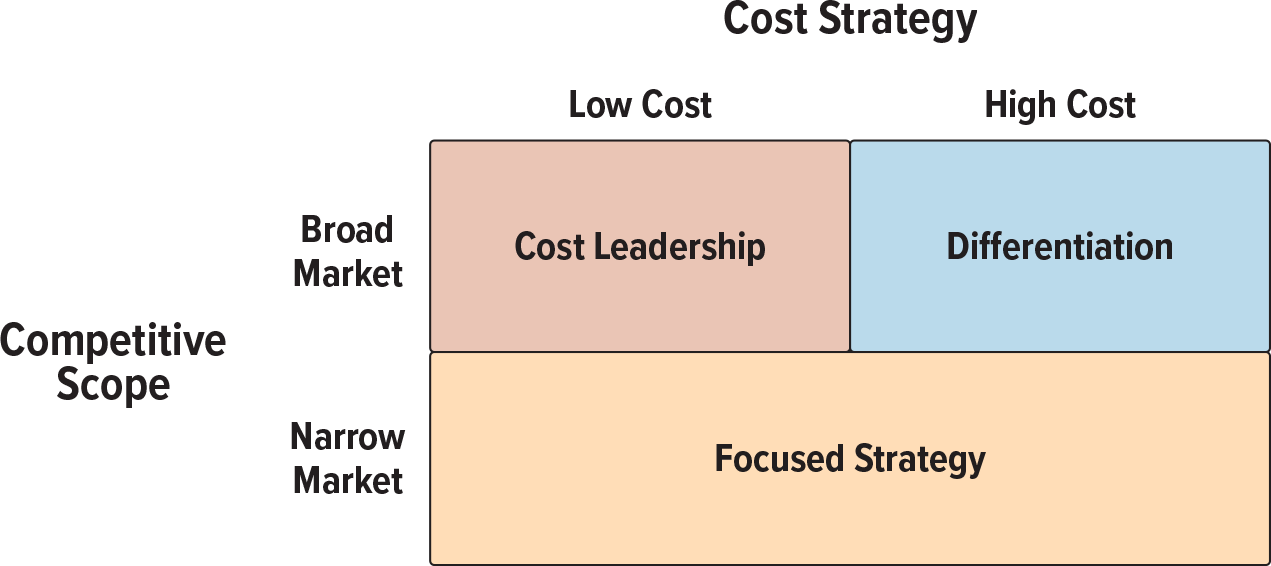
- Porter's three generic strategies- generic biz strategies that are neither org nor industry-specific and can be applied to any business, product, or service
- Broad cost leadership
- Broad differentiation
- Focus strategy (unique and niche)
- Business process- a standardized set of activities that accomplish a specific task, processing an order
- Value chain analysis- views a form as a series of business processes that each add value to the product/service
- Determines how to create the greatest possible value for customers
- The goal is to identify processes in which the firm can add value for the customer and create a competitive advantage for itself, with a cost advantage or product differentiation
- Primary value activities- acquire raw materials and manufacture, deliver, market, sell, and provide after-sales services
- Inbound logistics- acquires raw materials and resources and distributes to manufacturing as required
- Operations- transforms raw materials or inputs into g/s
- Outbound logistics- distributes g/s to customers
- Marketing and sales- promotes, prices, and sells products to customers
- Service- provides customer support after the sale of g/s
- Support value activities- include firm infrastructure, HRM, tech development, and procurement
- Support PVA
- Firm infrastructure- includes the company format or departmental structures, environment, and systems
- HRM- provides employee training, hiring, and compensation
- Tech development- applies MIS to processes to add value
- Procurement- purchases inputs such as raw materials, resources, equipment, and supplies
- Digital value chain- digitizes work across primary and supporting activities
- Allows primary activities to connect digitally to help speed up the transition from sales to manufacturing
Class 01/22/2025
- SMAC IT
- Social, mobile, analytics, IT
- Any Industry (analysis)
- Porters 5-Forces- Substitution, buyer power, supplier power, rivalry, new entry
- SWOT
- Comp. Rival- The threat of new entrants, substitution, buyer power (choices), supplier power (you want to reduce all)
- Switching cost- like when you sign a contract and when you want out there are SC
- (Generic Competitive) Strategy
Broad | Differentiation | Low Cost |
|---|---|---|
Focused |
- Broad differentiation
- Like tesla
- Broad Low Cost
- Hyundai
- Going to Walmart
- Focused differentiation
- Like a hummer
- Focused Low Cost
- Red Box
- Value Chain- the company looks through and looks at the primary things, make and deliver, you look at primary and supporting things and see if they add value
B3- Hardware and Software Basics
- Hardware (physical devices), Software (set of instructions),
- Hardware- input, store, process, output
- Dewey decimal system (10 digits)
- Computers only read 0 and 1’s
- 8 bits make 1 byte
- Binary code for 7= 111, why?
- There is one 4 in 7, one 2 in 7, one 1 in 7. 4+2+1=7
1 | 1 | 1 | |
|---|---|---|---|
2^3 (8) | 2^2 (4) | 2^1 (2) | 2^0 (1) |
- Operating systems- apple= IOS
B3
- IT- can be composed of the internet, some type of computer, and presentation software
- Hardware- consists of the physical devices associated with a computer
- keyboard
- Software- the set of instructions the hardware executes to carry out specific tasks
- Microsoft Excel
- Computer- An electronic device operating under the control of instructions stored in its memory that can accept, manipulate, and store data
- Comp. sys. Has 6 hardware components
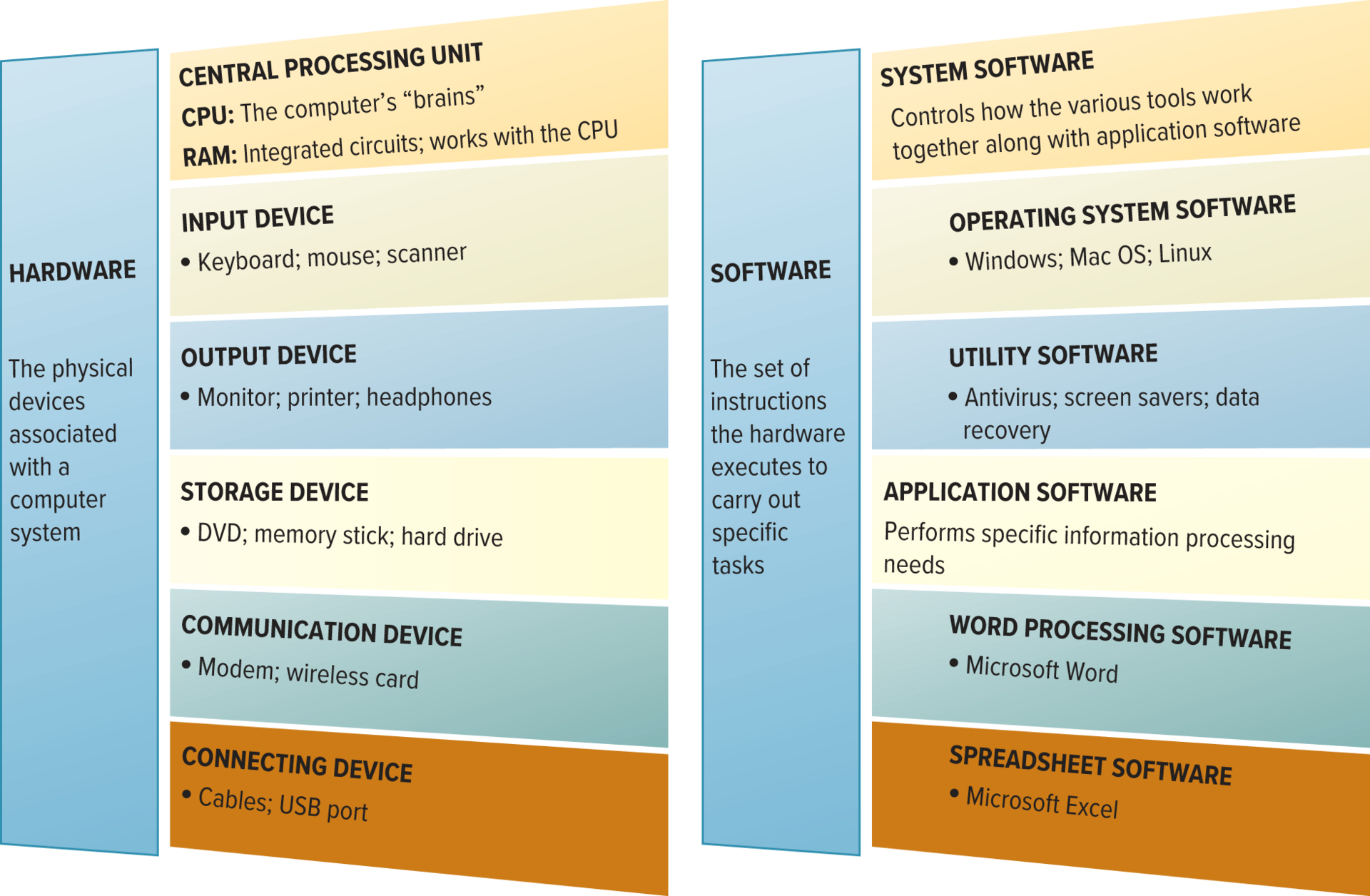
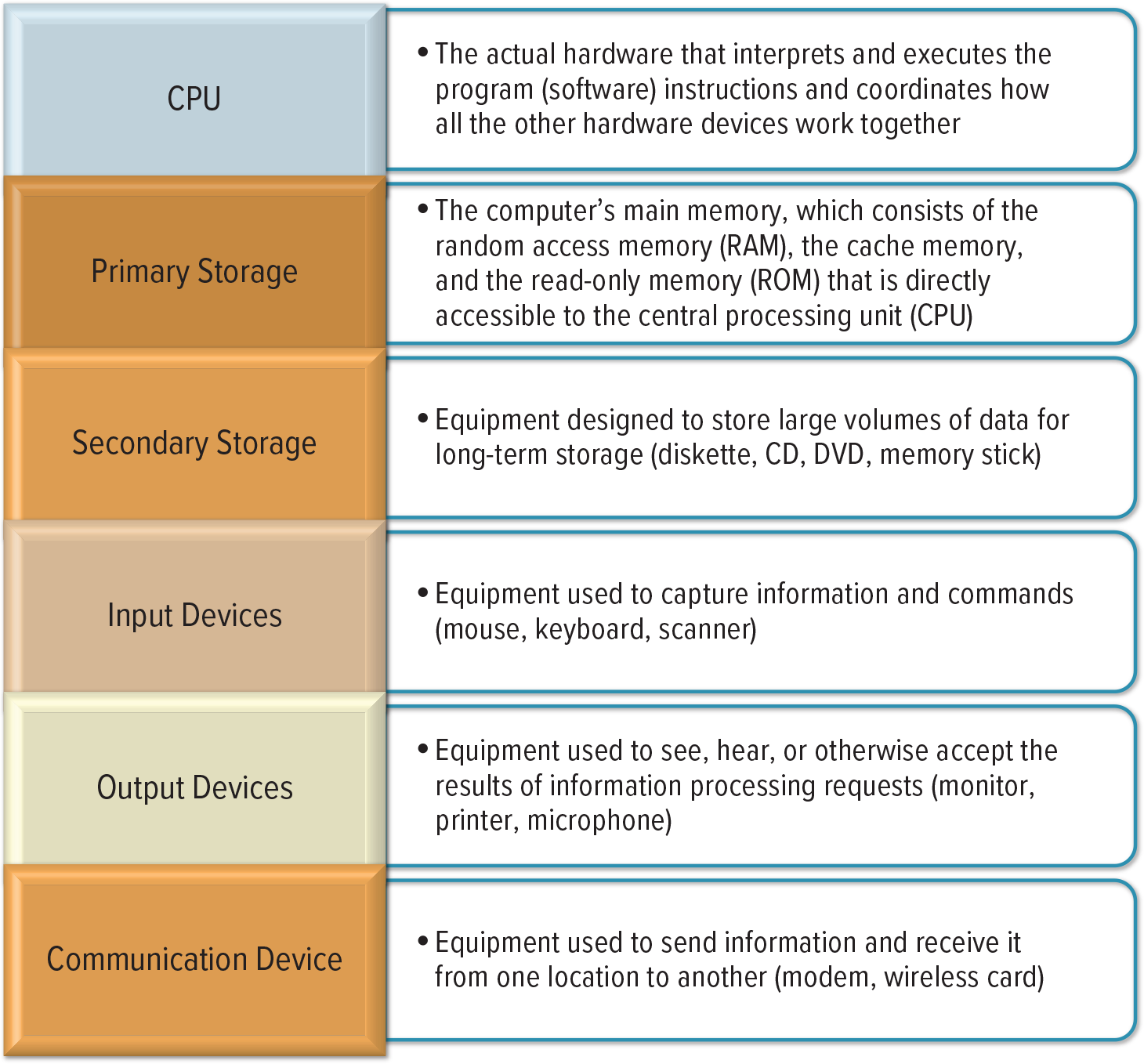
- Central Processing Unit (microprocessor)- the actual hardware that interprets and executes the program (software) instructions and coordinates how all the other hardware works together
- Built on a small flake of silicon it can contain the equivalent of several mill. Transistors
- Two primary parts are the control unit and the arithmetic/ logic unit
- Control unit- interprets software instructions and tells the other hardware devices what to do based on software instructions
- Arithmetic/logic unit (ALU): Performs all arithmetic and logic operations
- Responds to the control unit, interprets, tells each device to perform the task
- Megahertz- the number of millions of CPU cycles per second
- Gigahertz- the number of billions of CPU cycles per second
- Complex instruction set computer (CISC) chips- a type of CPU that can recognize as many as 100 or more instructions, enough to carry out most computations directly
- Reduced instruction set computer (RISC) chips- Limit the number of instructions that the CPU can execute to increase processing speed
- Reduce the instruction set to the bare minimum emphasizing the instructions used most of the time and optimizing them for the fastest possible execution
- Runs faster than a CISC
- Primary storage- the computer's main memory, which consists of the random access memory (RAM), cache memory, and read-only memory (ROM) that is directly accessible to the CPU
- RAM- the computer's primary working memory, in which program instructions and data are stored so that can be accessed directly by the CPU via the processor's high-speed external data bus
- read/write memory
- The CPU can write and read data
- Temp. workspace
- Storage
- Does not retain its contents when the power to the computer is off, so save frequently, when off its wiped clean
- Volatile
- Volatility- refers to the ability of a device to function with or without power
- Cache memory- a small unit of ultra-fast memory that is used to store recently accessed or frequently accessed data so that the CPU does not have to retrieve this data from slower memory circuits such as RAM.
- CM that is built directly into the CPUs circuits is called primary cache and CM contained on an external circuit is called secondary
- ROM- is the portion of a computers primary storage that does not lose its content when the power is off
- Nonvolatile
- Can't erase the program
- Can not perform functions without instructions
- Flash memory- a special type of rewritable ROM that is compact and portable
- Memory cards- Contain high-capacity storage that holds data such as captured images, music, or text files
- Removable
- Can have more than one card
- Data can be downloaded, or erased and used again
- Used in digital devices
- Memory sticks- provide nonvolatile memory for a range of portable devices
- Secondary storage- consists of equipment designed to store large volumes of data for long-term storage
- Nonvolatile
- Megabyte- roughly 1 million bytes
- Gigabyte- 1 billion bytes
- Terabyte- 1 trillion bytes
- Magnetic medium- a secondary storage medium that uses magnetic techniques to store and retrieve data on disks or tapes coated with magnetically sensitive materials
- Magnetic tape- an older secondary storage medium that uses a strip of thin plastic coated with magnetically sensitive material and housed together with the recording heads in a hermetically sealed mechanism
- Solid state drive- an all-electronic storage device that is an alternative to a hard disk and is faster than hard disks because there is zero latency
- Stores data using flash memory
- No moving parts
- Access data faster with greater protection
- Optical medium- a secondary storage medium for computers on which info is stored at extremely high density in the form of tiny pits
- Compact disk ROM drive- an optical drive designed to read the data encoded on CD-ROMS and to transfer this data to a computer
- CD RW drive- an optical drive that allows users to erase existing data and to write new data repeatedly to a CD-RW
- Digital video disk- a CD-ROM format capable of storing up to a max of 17 GB of data, enough for a full-length feature movie
- DVD-ROM drive- a read0only drive designed to read the data encoded on a DVD and transfer the data to a computer
- DVD-RW- a standard for DVD risks and player recorded mechanism that enables users to record in the DVD format
- Input devices- equipment used to capture info and commands
- Adaptive computer devices- input devices designed for special applications for use by people with diff. Types of special needs
- Stylus- used as a pen-like device that taps the screen to enter commands
- Output device- equipment used to see, hear or otherwise accept the results of ino processing requests
- Communication devices- is the equipment used to send info and receive it from one location to another
- Computer categories- smartphone, personal digital assistant, pocket computer, laptop, tablet, desktop, workstation, mainframe, supercomputer
- Clustering- allows companies to chain together thousands of PCs to build mass-market systems
- Parallel processing, which provides the ability to run two or more tasks simultaneously and is viewed as the chip industries future
- Mosaic browser- morphed into Netspcape and made the web a household name
- Appliance- a computer dedicated to a single function, such as a calculator or computer game
- System software- controls how the various technology tools work together alon with the application software. System software includes both operating system software and utility software
- Operating system software- controls the application software and manages how the hardware devices work together
- Some computers have two OS so they can dual-boot
- Dual boot- provides the user with the option of choosing the operating system when the computer is turned on
- Some computers have two OS so they can dual-boot
- Embedded OS- used in computer appliances and special purpose applications like an ATM, used for a single purpose
- Utility software- provides add. Functionality to the OS
- Antivirus software, screen savers, and antispam soft.
- Control panel- windows feature that provides options that set default values for the Windows OS
- Safe mode- occurs if the sys. Is failing and will load only the most essential parts of the OS and will not run many of the background O utilities
- App. software- used for specific info processing needs, used to solve specific problems or perform spec. Taks (payroll)
- Personal info management (PIM) software- handles contact info, appointments, tasks list, and email
- Course management soft.- contains course info such as a syllabus and assignments and offers drop boxes for quizzes and HW along with a grade book
- Single-user license- restricts the use of the software to one user at a time
- Network “”- enables anyone on the network to install and use the software
- Site license- enables any qualified users within the org to install the software, regardless of whether the computer is on a network
- App. service provider license- Specialty software paid for on a license basis or per-use basis or usage-based licensing
Chapter 3
- Business process- a standardized set of activities that accomplish a specific task, such as processing orders
- Business-facing processes- invisible to the external, and customer but essential to the effective management of the business; include goal setting, day-to-day planning, giving performance feedback and rewards
- Customer-facing processes- result in a product or service received by an orgs external customer; includes fulfilling orders, communicating with customers, and sending out bills
- Business process patent- a patent that protects a specific set of procedures for conducting a particular business activity
- Core process- business processes, such as manufacturing goods, selling products, and providing service, that make up the primary activities in a value chain
- Dynamic process- continuously changing and provides business solutions to ever-changing business operations, as the business strategies change, so do the dynamic processes
- Static process- uses a systematic approach in an attempt to improve business effectiveness and efficiency continuously
- Enterprise resource planning (ERP)- integrates all departments and functions throughout an org into a single system so that employees can make decisions by viewing enterprise-wide information on all business operations
- Common data repository- allows the everyday department of a company to store and retrieve info in real-time, making info more reliable and accessible
- Module software design- divides the sys into a set of functional units that can be used independently or combined with other modules to increase business flexibility
- Customer relationship management (CRM)- involves managing all aspects of a customer relationship with an org to increase customer loyalty and retention and an orgs profitability
- Allows an org to gain insights into customers' shopping and buying behaviors in order to develop and implement enterprisewide strategies
- Supply chain- consists of all parties involved, directly or indirectly, in obtaining raw material or a product
- Supply chain management (SCM)- the management of info flows between and among activities in a supply chain to maximize total supply chain effectiveness and corporate profitability
In class 1/27/2025
- Two types of ware-
- Hardware and Software
- Software- application software, systems software (OS)
- Lennx is OS
- Hardware- CPU
- Software- application software, systems software (OS)
- Hardware and Software
- Difference between RAM and ROM
- RAM is volatile memory that temporarily stores the files you are working on. ROM is a non-volatile memory that permanently stores instructions for your computer
- RAM- cache memory
- How to reduce buyer power- loyalty programs (Increase switching costs)
- CRM- Customer
- SCM-
- ERP-
Chapter 4 In class
MIS Chapter 4: Business Strategy and Performance Measurement
Porters Five Forces Framework
- Competitive Rivalry (High): Intense competition between existing companies.
- Supplier Power (Low): Suppliers have limited bargaining power.
- Buyer Power High): Customers have many choices, giving them strong bargaining power.
- ]Threat of Substitution (Low): Few alternative products/services exist.
- Threat of New Entry Medium/Low): Some barriers prevent new competitors from entering.
Applying Strategy and Technology
- Strategy comes first, then technology supports it.
- Common strategies:
- Low cost (e.g., Walmart)
- Differentiation (e.g., Apple)
- Focus (targeting niche markets)
- Broad (offering unique products across multiple markets)
- Competitive advantage is not sustainable—companies must continuously innovate.
Supply Chain Management (SCM)
Key Supply Chain Stages:
- Plan- Forecast demand and create supply chain strategies.
- Source- Acquire raw materials and suppliers.
- Make- Manufacture or produce goods.
- Deliver- Distribute and sell products to customers.
- Return- Handle customer returns and defective products.
- Differentiation- occurs at different points in the supply chain, but companies must have the technology to support their strategy
Customer Relationship Management (CRM)
Key Players in CRM:
- Lead- A potential customer who is unknown to the business.
- Contact- An individual representing an account.
- Account- A business relationship or company associated with contacts.
Enterprise Systems:
- BPA Business Process Analysis) Examines how businesses operate.
- SCM Supply Chain Management) Manages supplier and logistics efficiency.
- CRM Customer Relationship Management) Enhances customer interactions.
- ERM Enterprise Resource Management) Manages internal business processes.
Technology Trends (SCAM IT)
Key technological innovations shaping business:
- Social Media
- Cloud Computing
- Artificial Intelligence
- Mobile Technologies
- Internet of Things IoT- appliances, sensors
Measuring Business Performance (Chapter 4)
Efficiency vs. Effectiveness
- Efficiency Measures how well resources are used (cost savings, process speed).
- Effectiveness Measures customer satisfaction and success in achieving business goals.
Project Management & Metrics
- Project: A temporary initiative to create a unique product, service, or result.
- Metrics: Used to measure progress and success of business strategies.
- Critical Success Factors CSFs): Essential goals for achieving business objectives.
- Key Performance Indicators KPIs): Quantifiable measurements of success (e.g., turnover rates, product returns).
Big Data: The 4 V’s
- Volume- The amount of data (terabytes, petabytes, etc.).
- Variety- Different data types (structured, unstructured, multimedia, etc.).
- Velocity- The speed at which data is generated and processed.
- Veracity- The accuracy and reliability of data.