Trauma and PTSD
History of PTSD diagnosis
- railway spine - 19th century
- shell shock - WWI
- concentration camp syndrome – WWII
- Vietnam War
- PTSD diagnosis first defined in DSM III in 1980
What do we mean by trauma?
- Dictionary → “a deeply distressing or disturbing experience.”
- DSM 5 (Criterion A): exposure to death (of others), threatened death (self/others), actual or threatened injury or sexual violence
- Includes:
- direct exposure, witnessing, or learning of a close other being harmed/exposed to trauma
- repeated exposure in course of professional duties (e.g. first responders, medics, journalists)
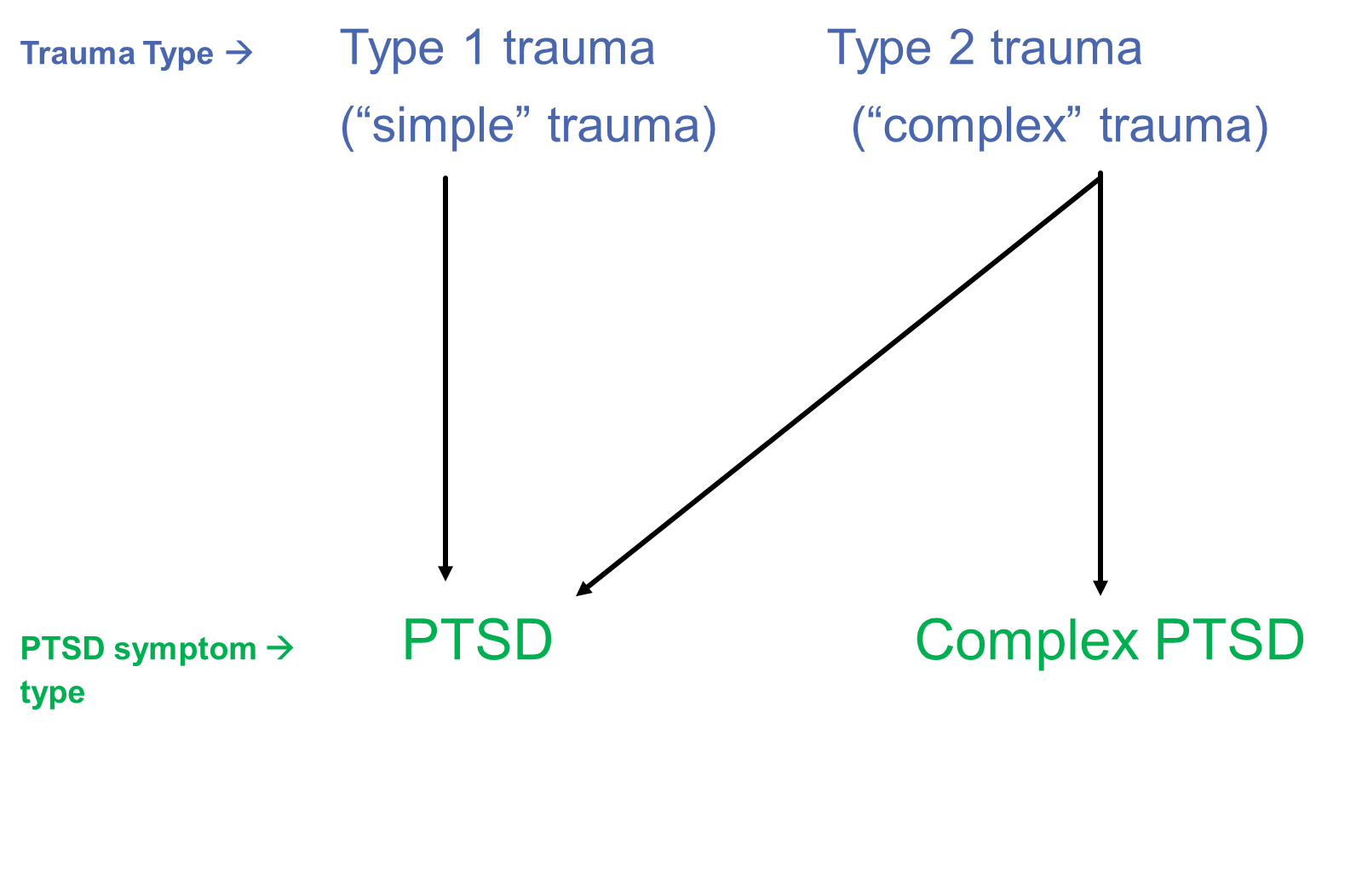
- ‘==Type I’ (‘simple’)== vs ^^‘Type II’^^ (‘complex’ trauma → the distinction between ==a discrete/isolated traumatic event== vs ^^chronic/repeated/prolonged traumatic events^^ (e.g. domestic violence, childhood sexual abuse, trafficking, torture)
- Different psychological impact of chronic trauma exposure?
Types of traumatic experiences
- Natural disasters (i.e. earthquakes, tornados, volcanos)
- Fire/explosion
- Combat /War (as a soldier or civilian)
- Transport accident (e.g. boats, trains, cars, planes)
- Serious/life-threatening accident or illness
- Physical assault/abuse (with or without weapon)
- Sexual assault/abuse (including in childhood)
- Torture
- Witnessing death of others/learning of death of a loved one
- Severe human suffering
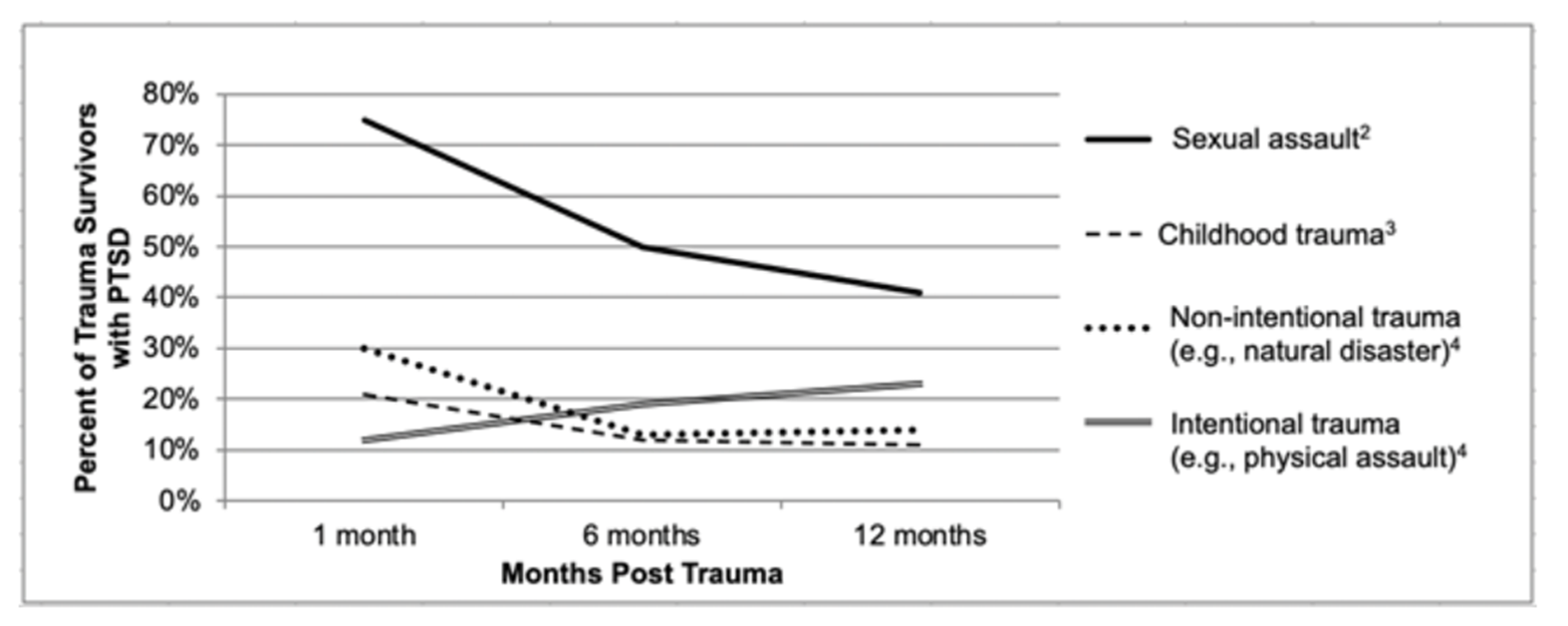
PTSD is only one possible outcome
 Responses to trauma
- Nature of the traumatic event/sequalae (both emotional (e.g. shame, guilt) but also physical (e.g. physical injuries/permanent change)
- Person’s environment/safety after the trauma
- Past experiences
- Existing coping strategies
- Personality factors
- Attributional style
- Cultural experiences/beliefs
Can we prevent PTSD?
- still an ongoing investigation…
- Hard to find factors that consistently predict who will be at risk of developing long-term PTSD symptoms.
- Some research suggests important factors may be:
- Mental defeat (i.e. mentally giving up during the trauma- perceived loss of dignity, autonomy, sense of being human (Dunmore, Clark, & Ehlers, 1999, 2001)).
- Rumination about the trauma
- Pre-existing/family history of mental health difficulties
- Symptom severity/Acute Stress Disorder
- Peritraumatic dissociation (?risk to life/trauma severity)
- Post-trauma social support
- Tetris Experiment
- Risks of ‘psychological debriefing’ – not recommended in NICE guidance
- ‘Watchful waiting’ is important
Other possible reactions after trauma
- Acute stress disorder
- Adjustment disorder
- Grief/persistent complex bereavement disorder
- Depression, anxiety, OCD…. Many different mental health problems
- No mental health problems
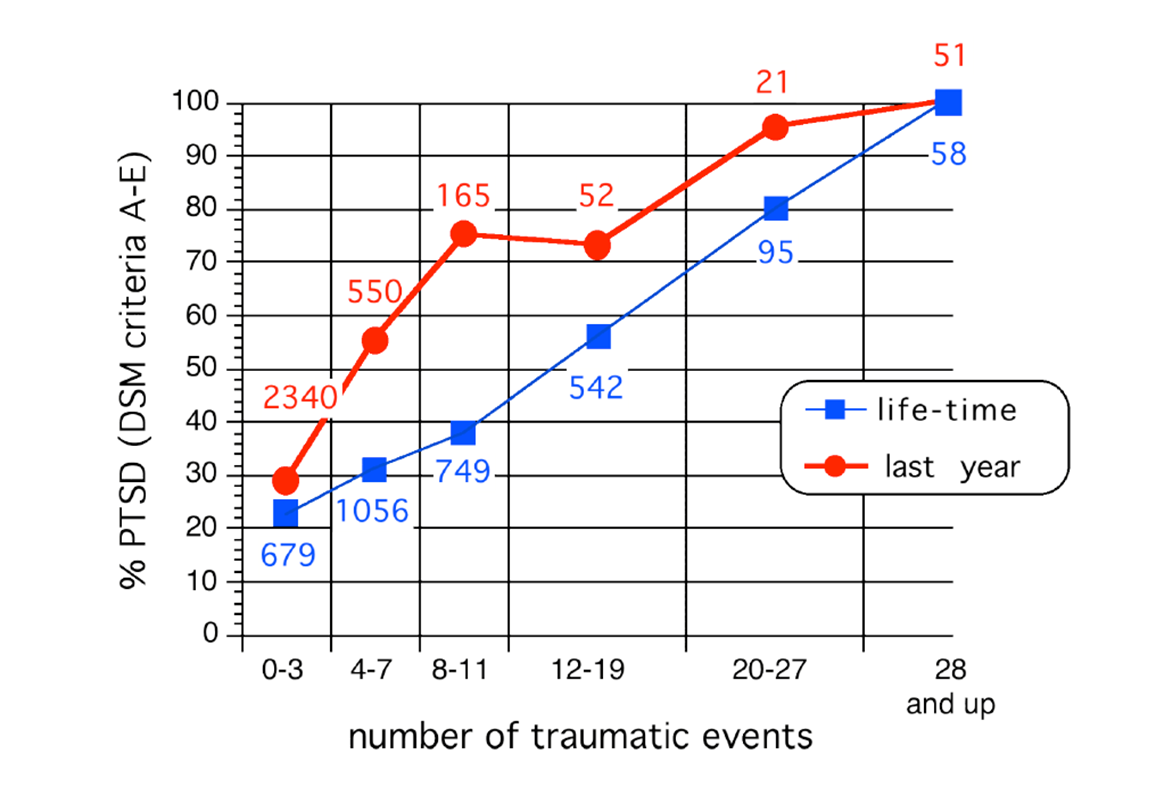
‘Building block effect’ → Schauer et al. (2003)
- With repeated exposure to trauma, the likelihood of a person having PTSD increases
- After 28+ traumatic events, almost everyone will have symptoms consistent with a diagnosis of PTSD
Post-traumatic Stress Disorder (DSM-5)
- Must have been exposed to a trauma
- e.g. death (of others, threatened death (self/others), actual or threatened injury or sexual violence
- Includes direct exposure, witnessing, or learning of a close other being harmed/exposed to trauma, repeated exposure in course of professional duties (e.g. first responders, medics, journalists)
- Symptoms (a month post trauma):
- Re-experiencing
- Avoidance
- Negative alterations in cognition and mood
- Alterations in arousal and reactivity
- Impairment in functioning
Common reactions to trauma in children
- not wanting to sleep alone
- being afraid of things that are reminders of the trauma
- crying and clinging (worried)
- unusual aches and pains
- regressive behaviours
- aggressive play (may re-enact the event)
- being confused about the trauma and its meaning
- being worried and/or confused about death
- trouble concentrating and doing school work
- worries about safety of others
- shame or guilt about what they did or didn’t do
- worry about the future “If I grow up”
- worry about how parents react to the trauma
Complex PTSD
- More likely after extreme, prolonged traumatic events where escape is impossible
- For example, imprisonment, torture, trafficking, domestic violence, childhood abuse
- Symptomatology and impact is often different
- Not officially recognised as a diagnosis until now – ‘clinical consensus’
- Recently added to ICD-11 (2022)
Diagnostic Criteria
- Core symptoms of PTSD plus disturbances in self-organisation:
- affect dysregulation:
- heightened emotional reactivity
- anger
- recklessness
- numbing
- dissociation.
- negative self-concept:
- feeling diminished
- defeated and worthless
- feelings of shame
- guilt or despair.
- disturbances in relationships
- difficulties engaging and maintaining/sustaining relationships
- difficulty feeling close to others
- little interest in engagement in relationships.
Cross-cultural validity of PTSD diagnosis
- Debate about the relevance of PTSD diagnosis to non-Western populations
- (e.g. for refugees) (e.g. Summerfield, 2001; Patel et al., 2016)
- Good evidence cross cultural validity PTSD diagnosis
- (e.g. Hinton and Lewis-Fernandez, 2011, systematic review to advise DSM-5)
- But there are some cross cultural variations in expression/presence of some symptoms, and different ideas about how to treat/recover from trauma
Emotional Processing Theory - Foa & Kozak (1985, 1986)
- Fear networks in memory to facilitate our escape from danger or threat
- Network contains information about:
- the feared stimuli
- our fear responses (e.g. physical/emotional reactions)
- thoughts/meaning associated with feared stimuli
- thoughts/meaning associated with our own responses
- Realistic threat > ‘normal fear’
- Fear network becomes problematic (‘abnormal fear’) when:
- the information does not accurately represent the world
- physical and escape/avoidance responses are triggered by harmless stimuli
- harmless stimuli/responses are perceived as dangerous
- fear responses interfere with daily functioning
- To reduce ‘abnormal’ fear, we need to activate the network and then provide ‘realistic’ information to replace the faulty information in the structure > Prolonged exposure therapy
Dual Representation Theory - Brewin, Dalgleish & Joseph (1996)
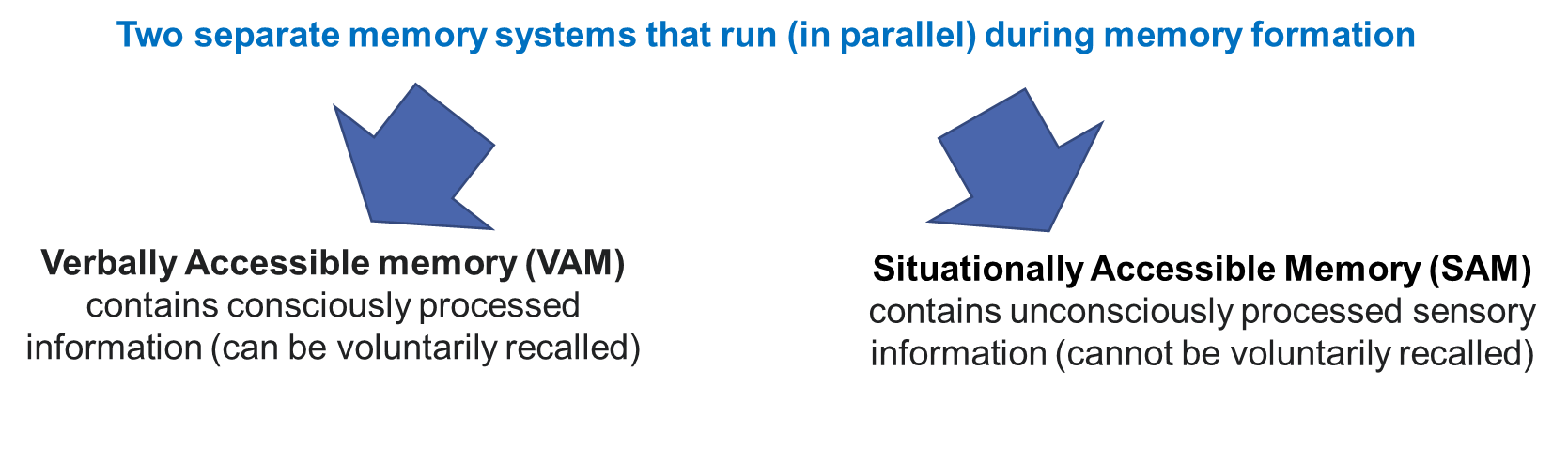
- During a trauma:
- VAM system is impaired (conscious attention is focused on the threat).
- SAM system captures vivid sensory information during the traumatic event
> later automatically recalled through exposure to trauma-related triggers (i.e. re-experiencing symptoms).
What types of treatments have good evidence for PTSD?
- Trauma-focused treatments
- Trauma-focused cognitive/cognitive-behavioural therapy
- EMDR (Eye movement reprocessing and desensitisation)
- Narrative Exposure Therapy (NET)
- Prolonged exposure
- drug treatments are NOT ‘first line’ treatments and are usually prescribed to manage symptoms (i.e. they do not necessarily tackle ‘underlying cause’ of symptoms).
Cognitive Model of PTSD - Ehlers and Clark (2000)
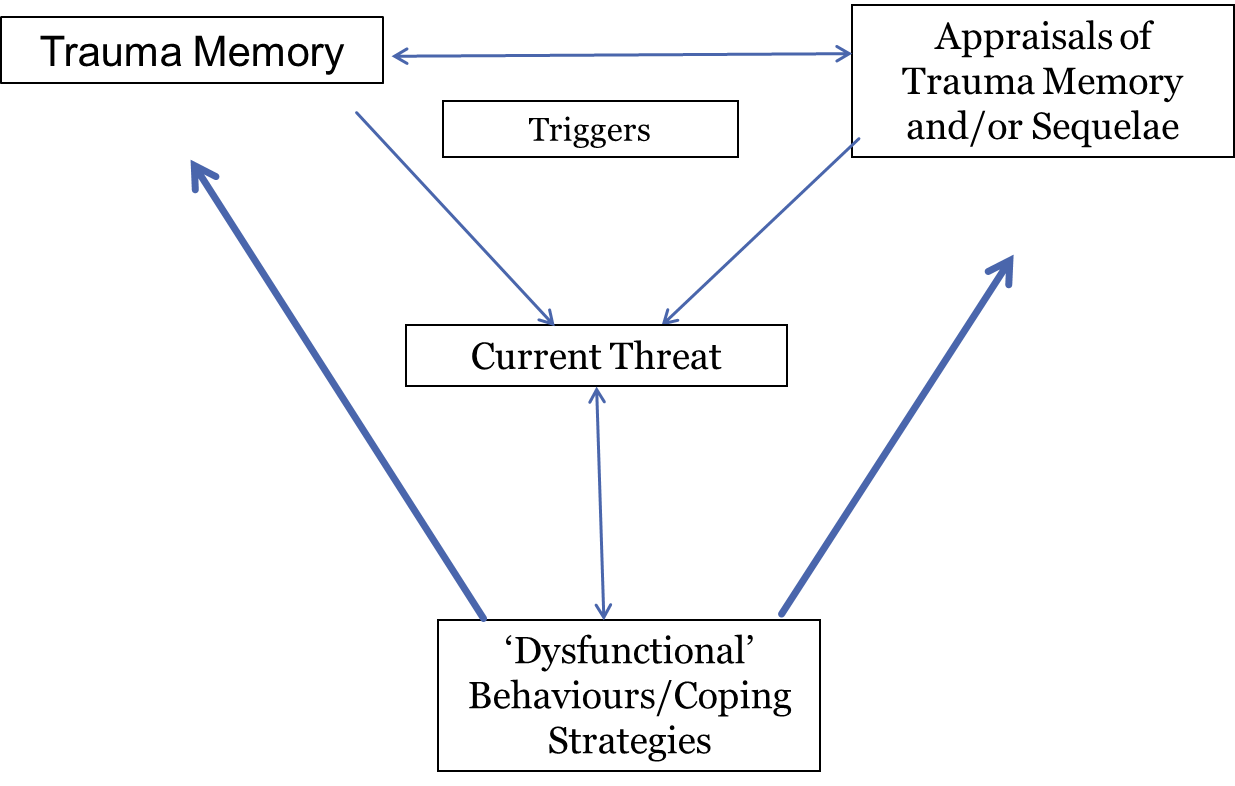 TfCT overview
- Formulation/psychoeducation and introducing ‘Reclaiming Life’
- ‘Reliving’
- Identification of ‘hot spots’
- Cognitive restructuring of hotspots
- modifying negative appraisals (developing ‘updates’ for hotspots)
- Site visit
- Behavioural experiments (to drop safety-seeking behaviours/cognitive strategies)
- Stimulus discrimination
Other types of tf-CBT
- Cognitive Processing Therapy (CPT)
- group or individual intervention, often used for survivors of sexual assault/domestic abuse.
- Involves a detailed written narrative of traumatic event
- Resick & Schnicke (1992)
Prolonged Exposure (PE)
- therapist supporting the client to:
- engage with in vivo and imaginal exposure to trauma reminders with the goal of reducing their avoidance in relation to trauma-related stimuli
- to promote ‘extinction’ of the conditioned fear response.
- McLean & Foa (2011)
EMDR
- Client asked to recall traumatic event whilst implementing ‘bilateral stimulation’
- e.g. eye-movements; tapping, audio stimulation/tones
- Hypothesis that EMDR therapy facilitates retrieval of the traumatic memory network and enhances information processing.
- Aim: new associations are made between the trauma memory and more adaptive memories or (new) information
- complete information processing
- new learning
- reduction of emotional distress
- new cognitive insights
Overview
- Assessment/history taking
- Identifying trauma(s) to work on)
- Resource building/skill development (e.g. for self-soothing and emotional regulation)
- Target memory identified and processed using EMDR therapy procedures.
- client engages in ‘sets’ of bilateral stimulation whilst simultaneously holding the trauma in mind:
- After repeated sets, when the client reports no distress related to the targeted memory, the client is asked to focus on a preferred positive belief
- This process (of processing target memory) is repeated for all traumatic memories identified by as problematic by the client.
Narrative Exposure Therapy (NET)
Overview
Summary
- PTSD is one potential consequence after a person experiences a traumatic event
- PTSD-type symptoms are normal in the immediate aftermath of a trauma, only if symptoms persist should a diagnosis of PTSD be made
- PTSD is much more likely to develop after certain types of trauma (e.g. interpersonal violence)
- Understanding trauma in its context is important
- Trauma-focused therapies are the main evidence-based treatments for PTSD at present
- Treatments should be adapted to incorporate the cultural and personal beliefs and values of the client
Criterion B: Re-experiencing Symptoms
The traumatic event is persistently re-experienced
- Need 1 or more symptom:
- Recurrent, involuntary and intrusive memories of the trauma
- Nightmares of the trauma
- Flashbacks of the trauma (and other dissociative reactions to the trauma including complete loss of consciousness)
- Intense or prolonged distress after exposure to traumatic reminders.
- Marked physiologic reactivity after exposure to trauma-related stimuli
- For children:
- Intrusive memories: children older than 6 may express this symptom in repetitive play.
- Nightmares: Children may have frightening dreams without content related to the trauma(s).
- Flashbacks: Children may re-enact the event in play
Criterion C: Avoidance Symptoms
Persistent effortful avoidance of distressing trauma-related stimuli after the event
- Need 1 or more symptom:
- Avoid thoughts, feelings, conversations about the trauma
- Avoid external reminders (e.g. people, places, activities, objects, situations) associated with trauma
Criterion D: Negative alterations
Negative alterations in cognitions and mood that began or worsened after the traumatic event.
- Need two or more symptoms:
- Inability to recall key features of the trauma
- Persistent (and distorted) negative beliefs and expectations about oneself or the world (e.g. “I am bad”; “the world is completely dangerous”)
- Exaggerated blame of self or others for causing the trauma
- Persistent negative trauma-related emotions (e.g. fear, horror, anger, guilt, shame)
- Difficulty experiencing positive emotions (constricted affect)
- Decreased interest in (pre-traumatic) significant activities
- Feeling isolated/cut off/disconnected from others
Criterion E: Alterations in arousal and reactivity
Trauma-related alterations in arousal and reactivity that began or worsened after the traumatic event
- Need two or more symptoms:
- Irritability or aggression
- Risky or self-destructive behaviour
- Hypervigilance
- Exaggerated startle reaction
- Difficulty concentrating
- Difficulty sleeping
Criteria F + G + H
- Criterion F:
- Duration of symptoms must be more than one month. (If less than diagnosis of acute stress disorder may be more appropriate)
- Criterion G:
- symptom-related impairment in social, educational or occupational functioning
- Criterion H:
- Disturbance is not due to medication, substance use, or other illness.