Lecture Notes
1/8:
Types of Drug info requests:
Verbal consults (phone, voicemail)
Written (email, mail, fax, text, electronic)
Personal interactions
Importance of written DI responses:
mech for communicating info
written back up to verbal response
documentation (prof responsibility, position justification, legal issues)
Evidence-based practice:
best available evidence
clinical expertise
patient pref
Five A’s of EBP
Ask an answerable question
Obtain request info
obtain requestor demographics
obtain background
determine EBP question
Acquire the best evidence
define search criteria
define search strat
Appraise the evidence
evaluate the studies found
evaluate the info
Apply the evidence
synthesize the info
apply results to patients
Assess the results
determine the final rec
document final answer
Documenting DI Request
EBP allows organized, structured process for providing responses the DI inquiries
intake or documentation form often used to facilitate
benefits:
ensures sufficient background info and patient data obtained
helps to guide pharmacist in providing complete response
avoids oversimplification of DI question
disadvantages:
may not apply in all situations
could disrupt the natural flow of info
Question and background
write down what requestor is asking
obtain background info (if applicable)
patient-specific, academic, personal?
what resources has requestor already consulted?
why is question being asked?
how will the info provided by used?
treating patient? deposition for lawsuit?
how has the problem/situation been managed to date?
are there alternative options that should be explored?
Importance of Background
arrive at real question
understand needs
provide responses that addresses needs
avoid vague/general response
anticipate additional questions/concerns
Tips:
good communication skills: respect, correct grammar, appropriate terms
always restate questions
ensure enough info gathered so question “why is requestor asking for this info” can be answered
call requestor back if additional info is necessary after the initial encounter with the requestor
Requestor Info
name/contact
appropriate mode of communication for response
when response needed
assess requestor’s background knowledge and familiarity with the topic
Patient Info
gender
age
height/weight
race
allergies
PMH
SH
meds (prescriptions, OTC, Herbal)
Relevant physical findings (symptoms, vitals)
relevant lab and procedure data
Requestor presented problem
write down what requestor ask
write down other info gained when inquired further
Treatment
what is the standard treatment for the problem?
how is the patient treating the issue?
PICO
Patient/Population/Problem
Intervention
Comparison
Outcomes
Initial EBP question
requestor may miss or omit details in original request or requestor may phrase question in indirect or disorganized manner
pharmacist needs to identify true need
Structuring EBP question options:
In POPULATION, what is the effect of INTERVENTION on OUTCOME compared with COMPARISON?
In POPULATION, does the use of INTERVENTION reduce the future risk of OUTCOME compared with COMPARISON?
Categorizing question
what is underlying topic of question?
adverse event, product info, pharmacokinetics, etc
often multiple categories
helps with search strategies
Evidence Evaluation: (2/11)
Evidence based practice:
best available evidence
clinical expertise
patient preference: take best guidelines and clinical expertise that your patient will comply with
Literature Types:
Primary: direct access to data
Secondary: abstracting of indexing search engines, facilitate location of primary and tertiary literature
Tertiary lit: indirect access to data, author interpretation of the literature
When answering a DI question, what literature do we search?
tertiary
practice guidelines
systematic reviews/meta-analyses
bigger sample size
primary literature
back up information that you have
may be part of systematic review
What questions can be answered with tertiary sources?
what is apixban’s place in the management of atrial fibrillation?
what is the dosing of xarelto for atrial fibrillation
how should the dose of eliquis be adjusted for decreased renal function?
how long should treatment be continued with xarelto for atrial fibrillation?
what is the level of evidence for the use of eliquis in atrial fibrillation?
Use of AI
where is AI getting the information?
ask it to provide sources
double check information: make sure references are not hallucinated (make something up)
report use of AI
debate about it, but bc not provided by human, it is not cited
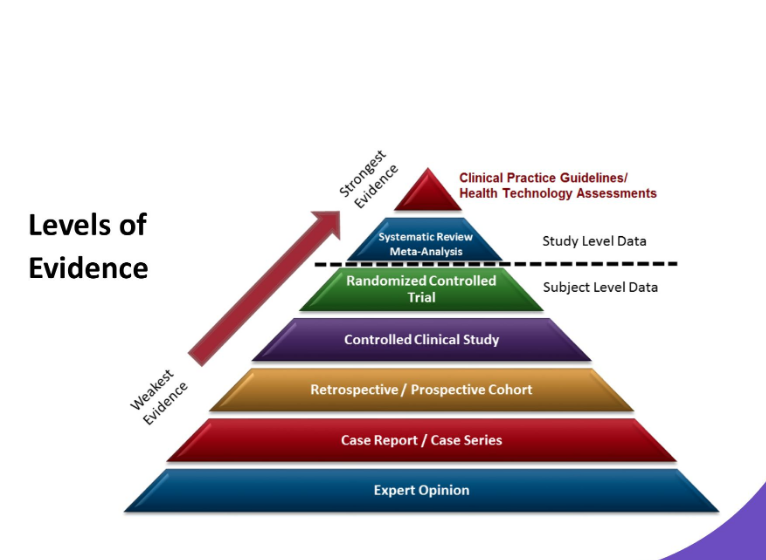
Levels of evidence:
do not mean that weaker levels are not good sources of information, just not as strong
strongest: clinical practice guidelines/health technology assessments, then systematic review meta-analysis
Are all RCTs better than a cohort study?
a well-designed cohort study might provide better evidence than a poorly executed randomized controlled trial
may be poorly designed
a lower-level article may be better evidence than a higher level one
Practice Guidelines
check authorship and affiliations
reputable guidelines usually associated with non-profit organizations
some guidelines sponsored by drug companies (probably biased toward drug that company produces)
funding source
date of publication
takes a long time to complete, very costly (many experts gather together), may not reconvene very often
ex. stemi guidelines: from 2013
sometimes do focused updates
some update annually (diabetes)
methodology of development
how was literature searched, how was literature chosen, how did they grade level of evidence
level of evidence for recommendations
Systematic Review vs Meta-Analysis
Systematic review:
authors collect evidence from previously conducted studies and summarize it
NO statistics performed
Meta Analysis:
authors collect evidence from previously conducted studies and summarize
statistics performed
“study of studies”
Advantages and Disadvantages of Systematgic Reviews and Meta-Analyses
advantages:
comprehensive
increased precision of effect
larger sample size
enhance statistical power
disadvantages:
quality of studies included
low quality studies may yield inappropriate conclusions
publication bias
overstimulation of treatment effects
confounding factors
incomplete reporting
Primary Literature:
randomized controlled trial
The Life Cycle of Scientific Information
start at original research
write up and rewrite results
submit for publication
peer review, likely sent back to rewrite (or rejected entirely)
Peer Review:
”a process by which something proposed (as research or publication) is evaluated by a group of experts in the appropriate field”
Not everything in a journal is peer-reviewed
original research will be peer-reviewed
systematic reviews and meta analyses will be reviewed
editorials, opinions, etc will not be reviewed
Evaluating a journal’s reputability
recognized as a scholarly publication
transparent publication process
respected within discipline
Is it indexed in medline?