The endocrine system
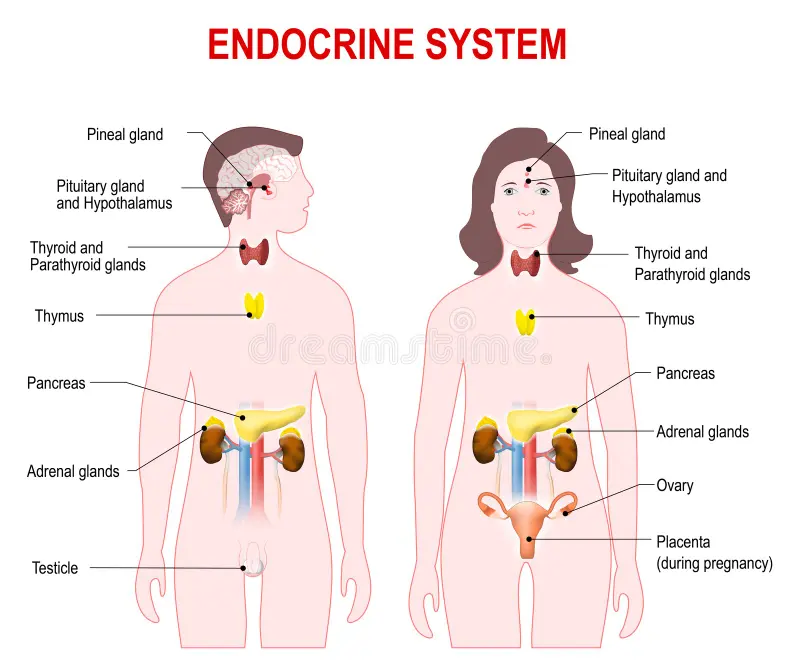
Endocrine organ | Anatomical location | Function/definition | Hormone(s) responsibility |
Hypothalamus | Anterior + superior to brainstem | Connects the endocrine system with the nervous system. The main job is to tell the pituitary gland to start or stop making hormones. | Anti-diuretic - causes kidneys to release water. |
Pituitary gland | Anterior to brainstem | Uses info from the brain to tell other glands in your body what to do | Cortisol - regulates body stress Growth hormone - influences height and builds bones and muscles. |
Pineal gland | Superior + posterior to brain stem | Helps the body get ready to sleep (creates melatonin) | Melatonin - sleep |
Thyroid gland | Laterally around the trachea | Controls your metabolism | Thyroxin - Plays role in digestive function, metabolism, brain development, bone health and muscle control. |
Adrenal glands | Superior on the kidney | Helps regulate metabolism, immune system, blood pressure, and response to stress and other essential functions | Adrenaline - Makes the heart beat faster and lungs breathe more efficiently |
Pancreas | Within the duodenum of small intestine and posterior to stomach and inferior to liver | make digestive enzymes that break down food and the hormones make sure you have enough sugar in your bloodstream and cells | Insulin - decreases blood sugar Glycogen - increases blood sugar |
Ovaries | Sit laterally to the uterus | Helps develop breasts, regulate menstrual cycle, support pregnancy | Estrogen - Develops a girl's sexual characteristics Progesterone - prepares the uterus lining for a fertilized egg implant to grow |
Testes | Laterally and posterior to the penis | Helps you grow facial hair, tells penis to grow larger, helps making sperm | Testosterone - regulates sex drive and bone/muscle math |
Hormones are secreted by endocrine glands to regulate and coordinate a range of bodily functions to create homeostasis.
Release of most hormones occurs in short bursts, although some are secreted over longer periods of time to stimulate permanent changes in the body.
Hormones only affect specific target cells by chemically binding to specific receptors.
There are two types of hormones:
- circulating hormones: they travel around the body in the blood. for example adrenaline and testosterone
- Local hormones: act on neighbouring cells without entering the bloodstream and are usually inactivated quickly. For example glucagon or serotonin
circulating hormones are regulated by complex feedback loops that are influenced by:
- Signals from the nervous system such as adrenaline
- Chemical changes in the blood, such as insulin
- Other hormones such as growth hormone
Positive feedback loops
Occurs when a product feeds back to increase its own production. And a positive feedback loop is not looking to reach homeostasis
Negative feedback loops
Occurs when a product feeds back to decrease its own production. Brings things back to normal when they start to become too extreme. Negative feedback keeps the concentration of a hormone within a narrow range so negative feedback looks to reach homeostasis.
The hypothalamus and pituitary gland are together responsible for homeostasis.
- The hypothalamus is part of the brain that controls the pituitary gland.
- The pituitary gland is an endocrine gland located below the hypothalamus in the brain.
- Neurohormones such as GHRH and somatostatin come from the hypothalamus and directly influence the pituitary gland.
- Nerve impulses from the hypothalamus also stimulate the pituitary gland.
The anterior pituitary is controlled by releasing and inhibiting hormones secreted by the hypothalamus. These hypothalamic hormones are carried to the anterior pituitary through a network of blood vessels called the hypothalamic-pituitary portal system.
in response to signals from the hypothalamus, the anterior pituitary gland synthesises and releases a variety of hormones into the bloodstream which then travels to target glands or tissues in the body, stimulating or inhibiting the release of other hormones.
The posterior pituitary gland stores and releases two hormones produced by the hypothalamus: oxycontin and vasopressin
GHRH - growth hormone-releasing hormone:
- Primary role to stimulate release the release of growth hormone from anterior pituitary gland.
- when hypothalamus detects the need for more GH in the body and releases GHRH into bloodstream
Somatostatin:
- Also produced by the hypothalamus
- Role is to stop the release of GH from the anterior pituitary gland
- When GH levels in the bloodstream are too high or when body needs to temporarily decrease GH secretion, the hypothalamus releases somatostatin.
GH - Growth hormone
- produced by anterior pituitary gland. and main function is to stimulate growth and cell regeneration in the body
- its secretion is controlled by the balance between GHRH and somatostatin.
- When GHRH levels are higher than somatostatin levels GH is released and enters the bloodstream.
- When somatostatin levels are higher than the GHRH levels GH secretion is stopped