Decision Networks & Value of Perfect Information
Decision Networks
MEU: choose the action which maximizes the expected utility given the evidence
can directly operationalize this with decidsion networks
BNs with nodes for utility and actions
lets us calculate the expected utility for each action
New node types:
chance nodes
just like BNs
actions
rectangles
no parents
act as observed evidence
utility node
diamond
depends on action and chance nodes
Action selection
instantiate all evidence
set action node(s) each possible way
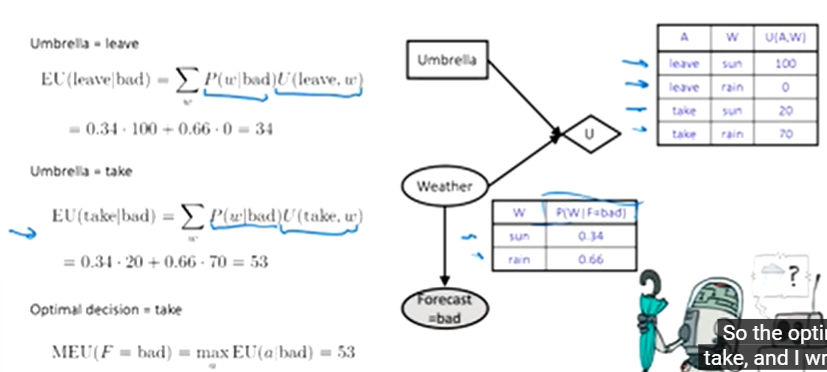
calculate posterior distribution for all parents of utility node, given the evidence
calculate expected utility for each action
choose maximizing action
Ex.
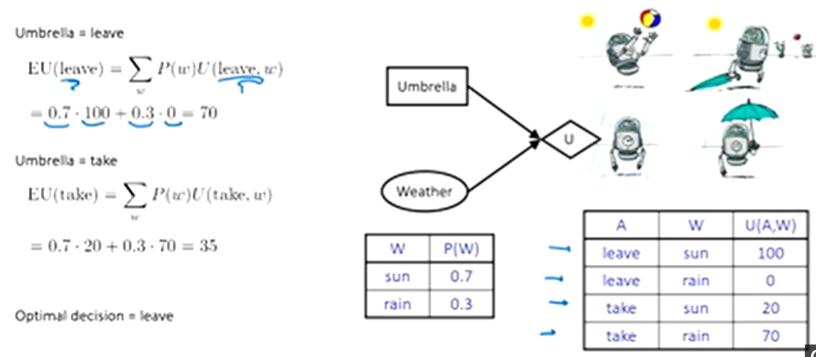
Example with BN:
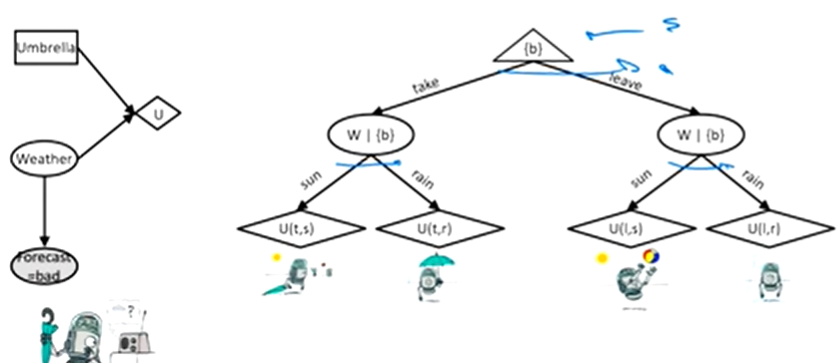
Decisions as Outcome Trees:
Value of Information
compute value of acquiring evidence
can be done directly from decision network
ex. buying drilling rights:
two blocks A and B, only one has oil, worth k
can only drill in one location
prior probabilities 0.5 each & mutually exclusive
drilling in either A or B has EU = k/2, MEU = k/2
what is the value of information of O?
value of knowing which has oil
value is expected gain in MEU from new info
if we know oilLocation, MEU is k
gain in MEU?
Assume we have evidence E = e, value now would be:
MEU(e) = max ∑ P(s | e) U(s, a)
now assume we see that E’ = e’
MEU(e, e’) = max ∑ P(s | e, e’) U(s, a)
But E’ is a random variable whose value is unknown, so we dont know what e’ will be
Expected value if E’ is revealed and then we act:
MEU(e, E’) = ∑ P(e’ | e) MEU(e, e’)
Value of information: how much MEU goes up by revealing E’ before acting
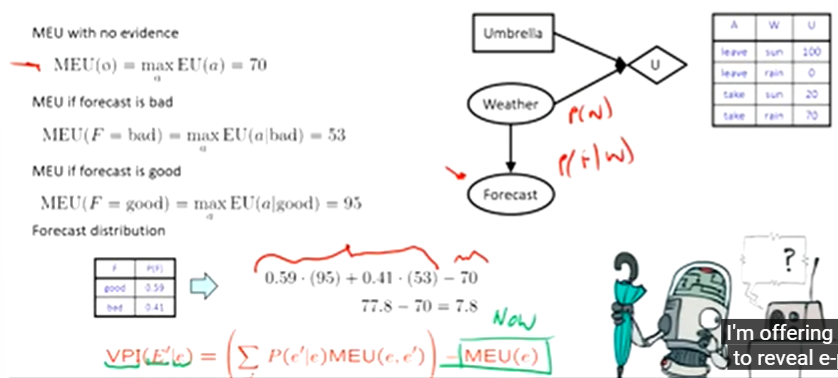
VPI(E’ | e) = MEU(e, E’) - MEU(e)
VPI Properties
Nonnegative
∀E’, e : VPI(E’ | e) ≥ 0
Nonadditive
VPI(Ej, Ek | e) ≠ VPI(Ej | e) + VPI(Ek | e)
VPI Oil Example:
VPI(oilLocation) = k/2
VPI(scoutingReport) = between 0 - k/2
VPI(scout) = 0
VPI(scout | scoutingReport) = ?
generally,
if Parents(U) ⊥ Z | CurrentEvidence
then VPI(Z | CurrentEvidence) = 0
VPI Example:
POMDPs
states S
actions A
transition function P(s’ | s, a) or T(s, a, s’)
rewards R(s, a, s’)
observations O
observation function P(o | s) or O(s, o)
POMDPs are MDPs over belief states b
Solving:
use truncated expectimax to compute approximate value of actions