BIO NOTES
Chapter 1: Studying Life
LIVING ORGANISMS HAVE A COMMON ORIGIN AND SHARE SIMILARITIES
BIOLOGY: The scientific study of organisms (living and fossils)
The goal of biological study is discovering/ understanding the unity and diversity of the processes that make up life on Earth.
Life formed about 4 billions years ago
The common features living organisms share proves that all life has common ancestry.
Evolution has generated enormous diversity of life
Levels of Biological Organization:
Atoms, small molecules, large molecules, cells, tissues, organs, organ systems, organism, population, community, ecosystem, biosphere.
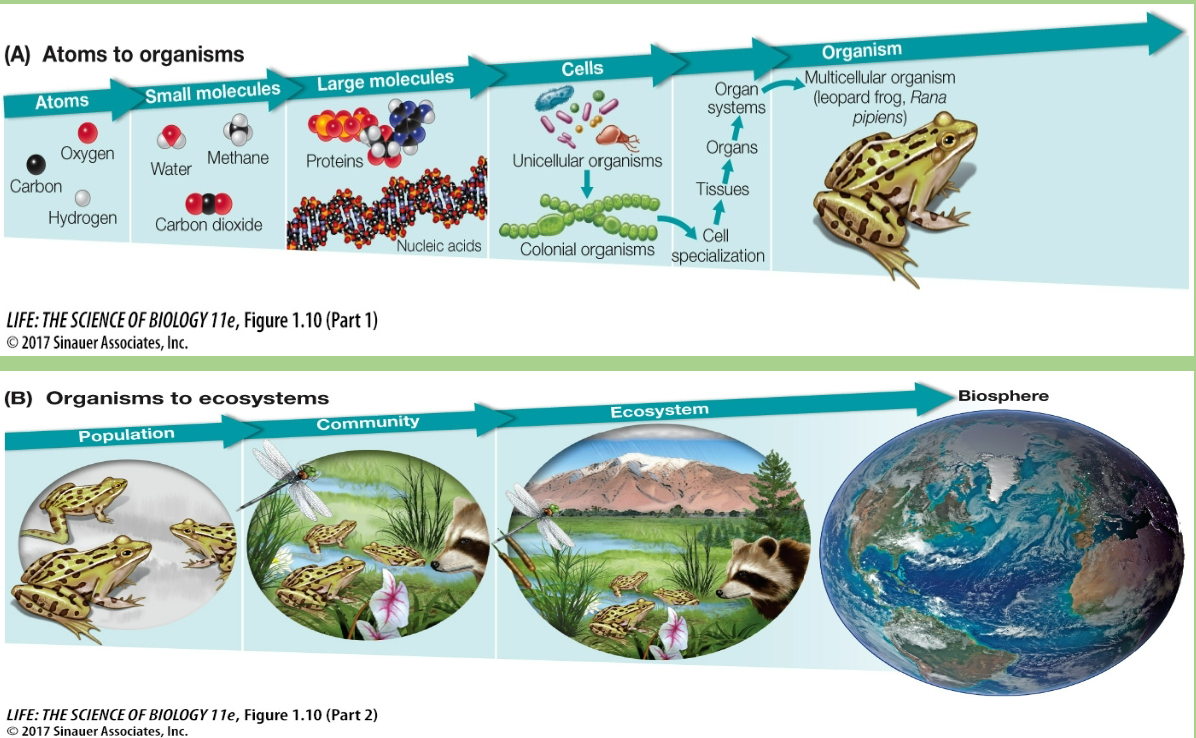
Life on Earth is diverse, yet all life forms share common features that separate them from the nonliving.
Made of a common set of chemical compounds
Made up of CELLS (smallest living unit that can carry out life process)
Use molecules from the environment to synthesize new molecules
Extract energy from the environment and use it to do work (Using Sun)
Contain genetic information
Respond to stimuli (Stimulus: an environmental condition that causes an organism to react to and adjust)
Regulate their internal environments (Homeostasis: Same state)
Exist in populations that evolve over time
GENETICS AND EVOLUTION ARE FUNDAMENTAL PRINCIPLES OF BIOLOGY
Gregor Mendel showed that inherited traits exist in discrete units which were later termed genes.
The discovery of DNA and it's functions transformed biological science.
Charles Darwin compiled factual evidence for evolution and proposed that all organisms are descended from a common ancestor and are therefore related.
Best known for the evolutionary mechanisms of Natural Selection
Evolution is the major unifying principle of biology
Genus: Group of species that share a recent common ancestor
Species: Base unit of taxonomic classification. A group of populations of evolutionarily closely related organisms capable of interbreeding.
Each species has a distinct scientific name, a binomial (genus and species)
Written in one of two ways
Homo sapiens OR Homo sapiens
Escherichia coli OR Escherichia coli OR E. coli
BIOLOGISTS INVESTIGATE LIFE THROUGH EXPERIMENTS THAT TEST HYPOTHESES
INFO
UNDERSTANDING BIOLOGY IS IMPORTANT FOR HEALTH, WELL-BEING AND PUBLIC POLICY DECISIONS
Understanding biological principles is essential for us to lead healthy productive lives and to be good stewards of our planet
agriculture and medical practices require the application of biological knowledge in order to serve human beings
human activities are resulting in unprecedented rates of change in Earth’s systems
Public policy
our newfound scient
ific abilities raise ethical and policy issues
biologists are called on to advice government agencies on many issues
Chapter 2: Small Molecules and the Chemistry of Life
Matter: Anything that has mass and occupies space; all matter is composed of atoms
Atom: smallest unit of chemical element; physical and chemical properties of atoms depend on the number of particles the atoms contain
Proton: subatomic particle, positive electrical charge, located in nucleus
Neutron: subatomic particle, no charge, located in nucleus
Electron: subatomic particle, negative charge, located in orbits around the nucleus
the further an electron is from the nucleus the more energy it has
Electrons determine how atoms will combine with other atoms to form stable associations (molecules)
Valence shell: an atom’s outermost energy shell (fixed distance)
Valence electrons: Involved in chemical reactivity
Element: a substance that cannot be converted to a simpler substance
Living organisms’ tissues are made up of six elements
Carbon (C), Oxygen (O), Hydrogen (H), Nitrogen (N), Phosphorus (P), Sulfur (S)
Compound:
Molecule:
No other element is as versatile as carbon; carbon is present everywhere in nature.
Carbon has four valence electrons so the ability to form four bonds as well as the ability to bond itself which creates very strong bonds
ATOMS BOND TO FORM MOLECULES
The energy level of an electron is higher in a shell farther from the nucleus
The valence shell electrons determine how the atom combines with other atoms
atoms with unpaired electrons in their valence shells are unstable and will undergo reactions to fill the shell
Reactive atoms attain stability:
by sharing electrons with other atoms
by losing or gaining one or more electrons
either activity can form a chemical bond (an attractive force that links two atoms together)
Covalent bonds are the strongest
Electronegativity: the attraction of a given atom for the electrons of a covalent bond; the more electronegative an atom is, the more strongly it pulls shared electrons toward itself; this can cause an unequal sharing of electrons
depends on:
its positive charge
the distance between the nucleus and the valence shell electrons
Oxygen has the highest electronegativity
higher proton count
electrons are closer to nucleus
smaller bond
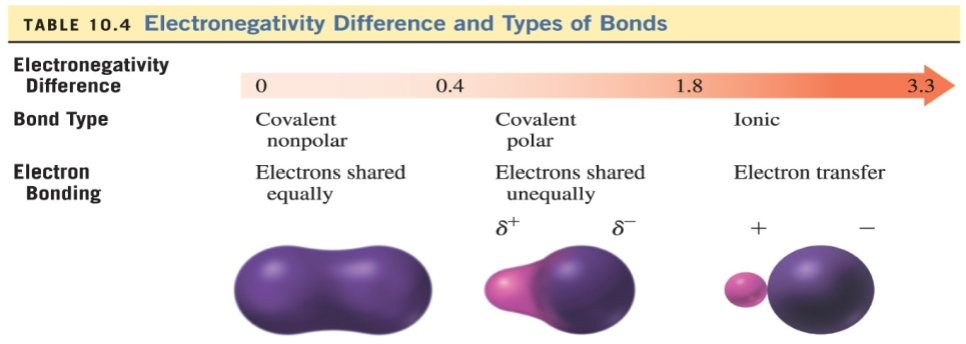
Covalent Bond: forms when two atoms attain stable electron numbers in their shells by sharing (equally or unequally) a pair of electrons
VERY STRONG and stable. Much energy is needed to break them
Polar covalent bond (unequal sharing of electrons)
One atom has greater electronegativity, so electrons are drawn more to that atom
The bond has a slightly negative charge on one end (pole) and a slightly positive charge on the other (pole)
Water is a polar molecule
Nonpolar covalent bond (equal sharing of electrons)
atoms have similar or equal electronegativities
Ion: Electrically charged particle that forms when an atom gains or loses one or more electrons
Cation: Positively charged ion
Anion: Negatively charged ion
Ionic Bond: a chemical bond resulting from the electrical attraction between oppositely charged ions
Hydrogen Bond: a weak chemical bond that is formed when the slightly positive hydrogen atom of a polar covalent bond in one molecule is attracted to the slightly negative atom of a polar covalent bond in another molecule or in another reigion of the same molecule; form between water molecules; DNA and proteins.
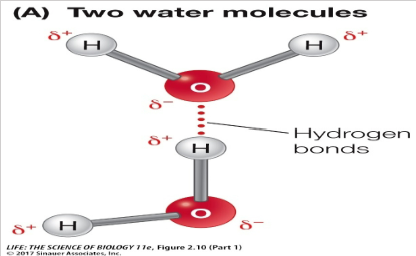
Polar molecules that form hydrogen bonds with water are considered to be hydrophilic (water-loving); hydrophilic substances dissolve in water
Nonpolar molecules such as hydrocarbons (molecules containing only hydrogen and carbon atoms) are hydrophobic (water-fearing); hydrophobic don’t dissolve
CHEMICAL REACTIONS TRANSFORM SUBSTANCES
The bonding of atoms to form molecules is not necessarily permanent. Molecular interactions— how they break up and how they find new partners— occur constantly
Chemical Reactions: occur when atoms collide with enough energy to combine or change their bonding partners; the making and breaking of chemical bonds leads to changes in the composition of matter
Reactant:
Product:
Energy: capacity to do work or the capacity for change, energy usually changes form during chemical reactions
THE PROPERTIS OF WATER ARE CRITICAL TO THE CHEMISTRY OF LIFE
Water has special properties:
polar molecule, forms hydrogen bonds and has a tetrahedral shape
These special properties allow for these characteristics of water:
Water molecules are farther away from one another in ice than in liquid water. There are cavities between molecules.
Soluble compounds mix completely with water.
Solution is a substance (solute) that dissolved in a liquid (solvent)
Acid: substance that releases H+ in aqueous solution
Base: substance that accepts H+ from an aqueous solution
pH scale: quantitative means for stating the [ ] of H+ in solutions
Buffer: substance that minimizes changes in the [ ] of H+ and OH- in a solution maintains a relatively constant pH.