Fallacy
Fallacies of Relevance
The Appeal to the Populace (ad Populum)
An informal fallacy commited when the support offered for some conclusion is
an inappropriate appeal to the multitude.
Appealing to what “most people think” rather than to logical evidence
The Appeal to Emotion
An informal fallacy committed when the support offered for some conclusion is emotions-fear, envy, pity, or the like-of the listeners.
Using feelings like fear, pity, or flattery instead of logic to persuade.
The Red Herring
An informal fallacy commited when some distraction is used to mislead and confuse.
Distracting from the real issue with an irrelevant topic
diversion
The Straw Man
An informal fallacy commited when the position of one’s opponent is misrepresented and that distorted position is made the object of attack
Misrepresenting someone’s argument to make it easier to attack
distortion
type of red herring fallacy
Argument Against the Person (ad Hominem)
An informal fallacy commited when, rather than attacking the substance of some position, one attacks the person of its advocate, either abusively or as a consequence of his or her special circumstances
Attacking the person instead of addressing their argument
type: abusive, poisoning the well (naninira), tu quoque
Appeal to Force (ad Baculum)
An informal fallacy commited when force, or the threat of force, is relied on to win consent.
Using threats or intimidating instead of reasoning
Missing the Point (Ignoranto Elenchi)
An informal fallacy commited when one refutes, not the thesis one’s interlocutor is advancing, but some different thesis that one mistakenly imputes to him or her
Drawing a conclusion that doesn’t follow the argument.
Fallacies of Presumption
Accident
An informal fallacy in which a generalization is applied to individual cases that it does not govern
Applying a general rule to a specific case where it doesn’t properly fit
Complex Question (Plurium Interrogatium)
An informal fallacy in which a question is asked in such a way as to presuppose the truth of some proposition buried in the question
Asking a question that assumed something unproven or traps the answer
"Have you stopped cheating on your exams?” (Assumes the person has cheated.)
Begging the Question (Petitio Principii)
An informal fallacy in which the conclusion of an argument is stated or assumed in one of the premises
The argument assumes the truth of what it is supposed to prove
“I’m trustworthy because I always tell the truth”
4. false dichotomy
5. false analogy
Fallacies od Defective Induction
The Argument from Ignorance (ad Ignorantiam)
An informal fallacy in which a conclusion is supported by an illegitimate appeal to ignorance, as when it is supposed that something is likely to be true because we cannot prove that it is false
Claiming something is true just because it hasn’t been proven false
The Appeal to Inappropriate Authority (ad Verecundiam)
An informal fallacy in which the appeal to authority is illegitimate, either because the authority is appealed to has no special claim to expertise on the topic at issue, or, more generally, because no authority is assured to be reliable
Relying on an authority figure who isn’t qualified to speak on the subject
False Cause (non Causa pro Causa)
An informal fallacy in which the mistake arises from accepting as the cause of an event what is not really its cause
Assuming that because one event follows another, the first cause second
A → B
Slippery Slope: A > B > C > D then A > D
Hasty Generalization
An informal fallacy in which a principle that is true of a particular case is applied, carelessly or deliberately, to the great run of cases.
Drawing a broad conclusion based on too few or unrepresentative examples
Fallacies of Ambiguity
Equivocation
An informal fallacy in which two or more meanings of the same word or phrase have been confused
Using a word with more than one meaning in an argument, causing confusion.
“All trees have bark. Every dog barks. Therefore, every dog is a tree”
Amphiboly
An informal fallacy arising from the loose, awkward, or mistaken way in which words are combined, leading to alternative possible meanings of a statement
An informal fallacy caused by ambiguous grammar or sentence structure, leading to more than one interpretation
“The police shot the thief with the gun.” (Was the thied holding the gun or were the police using it)
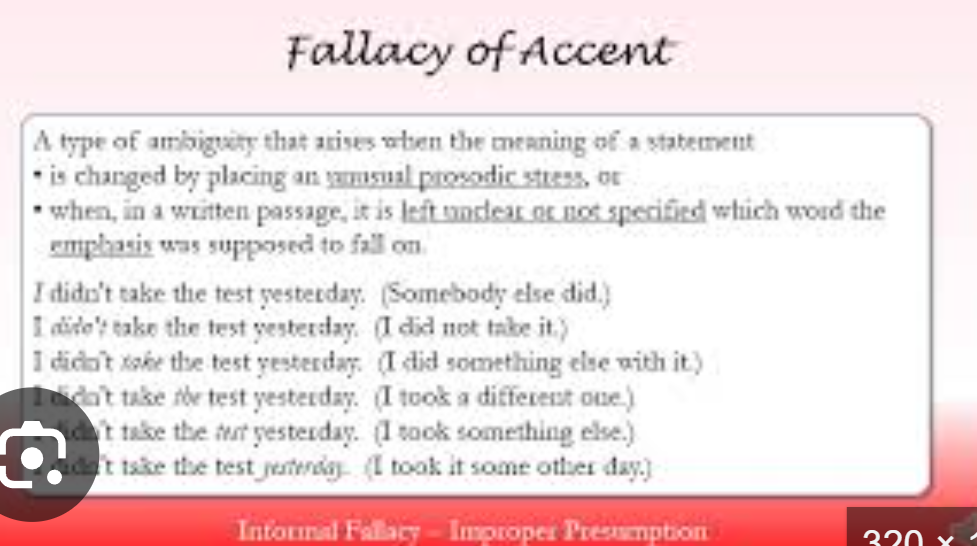
Accent
An informal fallacy committed when a term or phrase has a meaning in the conclusion of an argument different from its meaning in one of the premises, the difference arising chiefly from a change in emphasis given to the words used
Changing the meaning of a statement by emphasizing different words or taking words out of context
Composition
An informal fallacy in which an inference is mistakenly drawn from the attributes of the parts of a whole to the attributes of the whole itself
Assuming that what is true of the parts must also be true of the whole
Division
An informal fallacy in which a mistaken inference is drawn from the attributes of a whole to the attributes of the parts of the whole
Assuming that what is true of the whole must also be true of the parts